


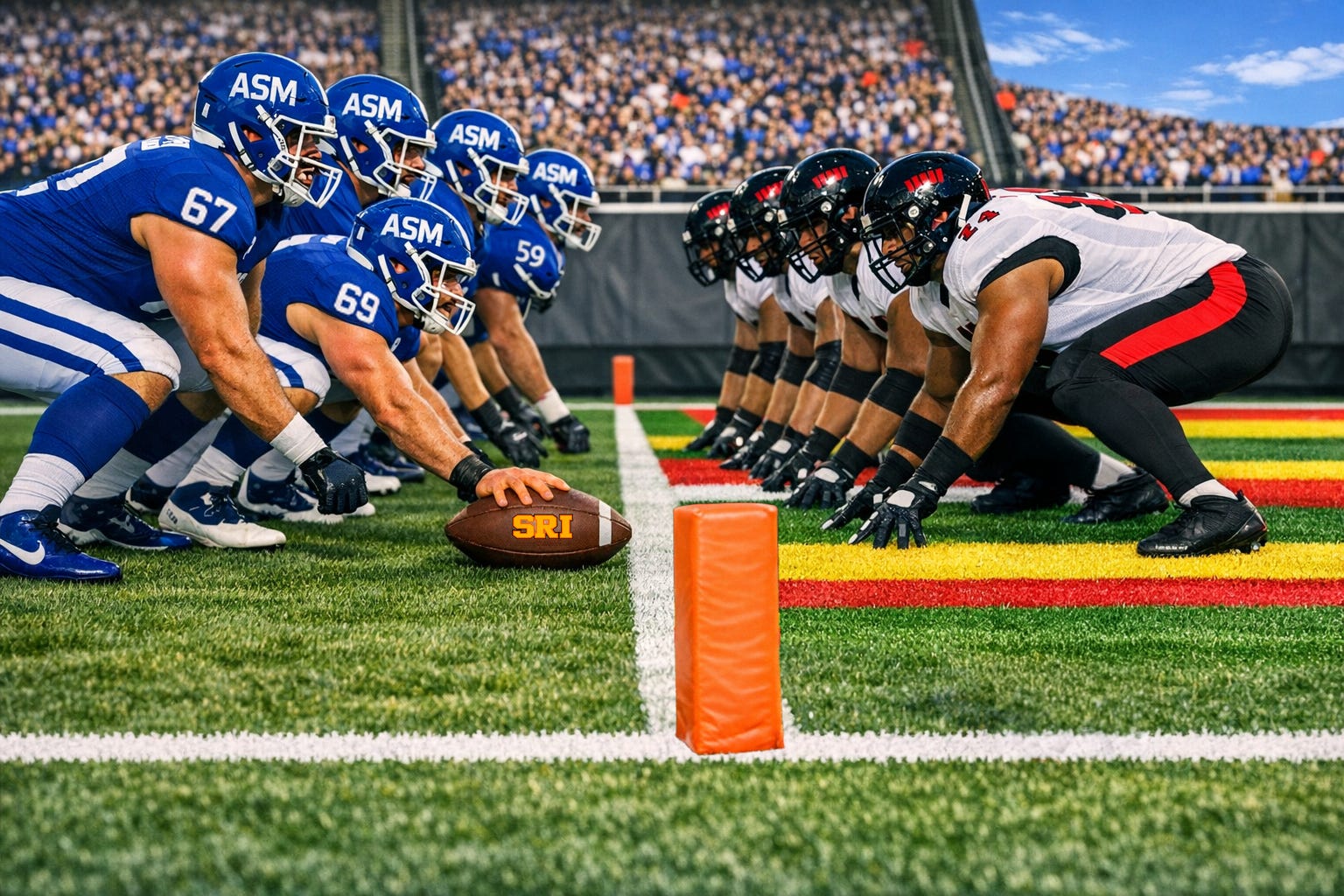
The Meeting That Could Change Everything
“Where is Toronto?”
Really? Of all the questions he could ask, this was the one?
I exhaled. Just like that, the knot in my stomach loosened. Maybe—just maybe—my dream was still alive. Maybe I wouldn’t have to explain to my parents how their $140,000 had vanished. They trusted me when I told them about our little startup and committed some of their retirement savings to it.
And now it seemed the men across the table, the Division of Market Oversight at the CFTC, held the keys to our future.
We were pitching a product that, on its face, was a long shot: Sports futures. We believed in it and we believed it served the public interest.
Do sports and money mix? We set out to prove that gambling was not the only option. And the fact that we were sitting in this room at the CFTC made us feel like we weren’t crazy.
Across the table were seasoned regulators. On our side: Myself, Chris Rabalais (our CEO at the time), our consultants and our exchange partner. You may remember Chris from Origins I, he was the one who conceived AllSportsMarket® (“ASM”) many years ago when he had a hunch: Why does a stock market for sports not exist? He partnered with Ace Underhill, a brilliant coder whose real passion is Hollywood. I was a young Turkish immigrant, a few years into a tax consulting job, with an economics Ph.D. and an obsession with market design who, as I told you in Origins I, has stumbled his way into a Costa Rica sports finance startup. There we were, with an unthinkable proposal: Trade sports futures on regulated U.S. markets.
We walked through the details of the product and handed over our self-certification draft. The table in front of them contained Sports Risk Index (“SRI”) values for Major League Baseball teams as of December 31, 2007. Unsurprisingly, sitting at the top was the New York Yankees at 1,158.60. The Mets followed at 965.13, then the Red Sox at 919.28. Most teams were in the 300–600 range, with a couple below 300.1
Then came a pause—a few seconds that felt much longer. Muscles tightened. The Division of Market Oversight didn’t make final decisions on product listings, but they made recommendations to the five commissioners who did. And those recommendations were usually followed.
In that moment, it felt like whatever words came next would predict our fate.
Were we about to survive—or be shut down?
“Where is Toronto?”
...Wait, what?
As with most entrepreneurs, I was optimistic to the point of delusion. When they asked, “Where is Toronto?”, what I heard was: “We represent the Commission, and we approve this product.”
In reality, it was nothing of the sort. Chances are it wasn’t even a positive signal.
The regulator was simply pointing out that our table was incomplete. The Toronto Blue Jays—the only Canadian team in Major League Baseball—were missing.
There was a simple explanation: We hadn’t yet secured Canadian TV data, so our preliminary index only included U.S.-based teams.
Looking back, it was absurd to expect any kind of decision in that room—or even a meaningful hint. This wasn’t our first contact with the CFTC; we’d had some preliminary conversations that led us there. But this was new territory for them. They needed time to evaluate, digest, and follow procedure—exactly what you’d expect from a government agency doing its job.
Still, walking out of that meeting, I felt elevated.
The High After the Meeting
We met up with Bernie and Alex for lunch to debrief. Bernie Nicholls, the legendary NHL player, was our public face and connected us with professional sports leagues. Alex, a Costa Rican native, was the company’s legal counsel. They’d been waiting anxiously nearby.
I’m pretty sure that if you had surveyed every lunch table in D.C. that day, you wouldn’t have found a group quite like ours: A misfit American who lived in Costa Rica, a Turkish kid barely out of school, a former NHL star for the L.A. Kings, and a Costa Rican lawyer. Startups have a way of bringing together the unlikely.
Were we close? Man, I certainly hoped so.
I was gainfully employed at the time. I knew there were lines I couldn’t cross, and I did respect them. This wasn’t a second job—I knew that was off-limits. I had previously been asked whether I’d consider joining the advisory board (not even the Board of Directors yet), and to stay safe, I declined. I wasn’t receiving compensation of any kind. I barely said a word in the meeting. Still, I felt somewhat… uneasy.
Then again, I figured I might be quitting soon anyway.
I looked down at my sandwich. It was too much. My stomach muscles had started contracting again—the way they always do when I’m stressed. I knew what that meant: Time to unload.
When I came back to the table, I picked up the sandwich and started munching, chatting with the guys.
It was October 28, 2008—a clear, crisp afternoon in D.C. It felt like we owned the town. We were already talking about a baseball launch during Spring Training 2009—less than six months away.
We were close. Real close.
Once we launched, I figured real capital would follow. A C-suite role seemed inevitable. I’d leave tax consulting behind and enter the world of finance full-time.
We were already scouting locations near D.C. for a new office. My wife and I would probably relocate to the East Coast.
Everything seemed to be falling into place.
Nothing could have been further from the truth.
AllSportsMarket Came First
Here’s what was true: The SRI wasn’t supposed to be the lead product. That honor belonged to ASM, the market where traders can trade stock-like instruments of their favorite teams. We would later call them SportShares®.
Traders, myself included, ate it up. There was some decent traction, including some early TV coverage, and the market scaled to thousands of users.
We were approaching genuine VC territory, but there were a couple of issues: One was perception: Chris was running the market from Costa Rica, where he lived at the time, and Costa Rica was considered the mecca of sports betting. But the bigger issue wasn’t even perception; it was the product itself. The reality was people put in money, bought a virtual share of a sports team, and they got paid when their team won. For a skeptical crowd who would take the position that sports and money do not mix, it would be easy to label it as gambling.
What is gambling? Now you know why I started to think about this question early. It was a genuine academic interest colliding with a financial one. After doing a market microstructure dissertation at UCLA, comparing peer-to-peer exchanges with traditional bookmakers, I was now seeing true financial innovation in action. And I absolutely needed to understand what I was getting myself into.
Two Competing Philosophies of Innovation
In the last couple decades, America has seen many entrepreneurs that adopted the approach “Shoot first, ask questions later.” Kalshi and its peers are the latest examples. Go out and sell the product first, and deal with the legal questions later. It becomes this cycle: Sell, make tons of money, use some of that money to hire the best lawyers you can, and by the time the wheels of litigation are done turning, you are probably too-big-too-fail anyway. Your legal arguments get an assist from sheer size, as well as lobbying dollars.
Kalshi is the latest example, but not the first one. Back in 2016, I was in the audience when there was a daily fantasy sports panel at DePaul University. DraftKings and Fanduel had barged onto the scene, and there were many legal issues to consider. Dan Wallach was one of the panelists. Marc Edelman, a legal scholar, was also part of the panel and was visibly frustrated. He did not think it was appropriate for DraftKings to scale quickly amidst serious legality concerns, and he felt that it was even more irresponsible to consider going public as it would bring in a group of public investors who would inherit the legal risks. Dan Werly, now with the Tennessee Titans, had a different take: “If DraftKings hadn’t done this, we wouldn’t be sitting here today discussing this matter.”
There. The two competing mindsets. One is the story of the bold entrepreneur who takes risks to make something happen at all costs. The other is responsible innovation: If you find yourself in an uncertain regulatory environment, sort out the regulatory kinks first.
The latter approach can be very costly. For starters, revenue does not come in unless you have a commercial product. If you go the route of “Compliance first, commercialization later” instead of “Shoot first, ask questions later,” you bleed cash every day. You might say: “Well, this is what VCs are for.” To some extent that is true. But VCs don’t always want to pay you to figure out regulatory compliance. They want to see the product-market fit. They want you to sell. And then the same issue exists with your partners–multiple leagues told us: “Figure out the regulatory piece and come back.”
So there are many headwinds for the entrepreneur attempting to do the right thing. This creates a terrible dichotomy: The most reckless model, which oftentimes isn’t even true financial innovation (really just old vices masquerading as such), is what reaches the market. The real innovation gets stuck in red tape. And as we’ll see in future Origins essays, it sometimes even gains the ire of the regulator anyway.
Chris Hires Alston & Bird and NERA
For better or worse, Chris squarely fell in the second camp. Yes, he did start the market in Costa Rica to see if it had legs. But as the market scaled, he became uneasy. He didn’t want to just barge ahead like DraftKings, and later Kalshi, would do. This is not speculation. This is actually what happened. I know this because I had a courtside seat.
Chris found a D.C. law firm to explore the regulatory possibilities for ASM. They started looking at it, and basically said: This is complicated. You need Paul Architzel for this.
Paul had previously spent more than 20 years at the Commodity Futures Trading Commission and played a pivotal role in the Commodity Futures Modernization Act. Paul then recommended that NERA come in as the economics consultant, specifically Sharon Brown-Hruska, who had just left her acting Chair position at the CFTC. Revolving door? Sure, but working with government employees-turned consultants is helpful for startups that want to navigate through regulatory uncertainty. They know what works. And they were a great duo. Smart, honest, friendly.
Late 2006/early 2007 ASM was the lead product. Then Paul and team gave Chris a legal opinion in February 2007:
Elements of its business model could be interpreted by U.S. authorities as constituting the business of betting or wagering through the Internet, making ASM vulnerable to the risk of enforcement action pursuant to the [UIGEA].
Ouch. This was a bit risky, eh?
I disagree with the gambling characterization. To this day, I’m not aware of a law that would support the conclusion that ASM is a gambling product. That said, I certainly understood where Paul was coming from. He was coming from a good place. He was just pointing out that there will be an uphill battle.
Chris read it the same way. A different person would ignore the opinion and just barge ahead. A different person would have fired Architzel, done some more lawyer-shopping and found one that would produce a more favorable opinion. Most entrepreneurs would be more reckless, something society is confusing with being bold. Chris wanted to be prudent. He didn’t want an uphill battle. But he also didn’t want to give up on his vision of creating financial innovation for the sports industry. So he asked Sharon and Paul: What other financial products can we develop for the sports industry?
Building the SportsRiskIndex©
Sharon came up with a new idea: If we created an index that broadly correlated with franchise revenues, theoretically futures contract tracking that index could be used for risk management purposes. She pointed us to research done by a gentleman named Lou Guth. Guth started with a simple question: What determines the value of a sports franchise? He acknowledged that there were some idiosyncratic factors such as a new stadium or a star athlete with a loyal following, but he also identified some fundamental market conditions “which have a large and predictable impact on franchise value.”
The idea was to resurrect that piece of research and turn it into an index, and then create a futures product that uses that index as an underlying, not unlike S&P 500 futures. The exercise was not so much to create an alternative valuation methodology as Forbes already had sports valuations that were widely followed, but to create a valuation proxy using publicly available inputs so a futures product could be created around them. Sports is a huge industry, and just like any other, it needs risk management tools. The broadcasting deals were improving and the valuations were increasing. Nothing goes up forever though, and other than some bespoke solutions, there wasn’t much that existed in the market that would help sports leagues hedge their risk.
With Guth’s research guiding the process, Sharon and her team started running some regression analyses. In parallel, a preliminary meeting was held with the CFTC to gauge initial reactions. The feedback was promising; they viewed sports like any other industry and were not opposed to a sports futures product as long as there was meaningful price discovery and risk management. Section 5(g) was gone already, but the economic purpose test was still the North Star.
When all was said and done, the SRI’s make-up included:
Attendance;
TV ratings;
Local population;
Local per capita income; and
Existence of a second local team in the same sport.
When Performance Doesn’t Equal Value
What was missing was as important as what was included: Sports performance. Single-game outcomes, deep playoff runs, championships… None of that was factored into our index construction.
Why not? Don’t successful teams create value for themselves? Guth was skeptical:
We also ruled out a number of other possible determinants of franchise value: for example, we found value to be unaffected by a team’s competitive standing in the league.
There were some real-world examples that supported this view. The Cubs were the cleanest case: A perennial underachiever on the field and they hadn’t won a World Series in a century (“The Curse of the Billy Goat” anyone?). Yet they’ve always been a fan favorite and one of the most valuable franchises in baseball. If you’ve ever been to Wrigley Field, it’s not hard to understand why.
NERA’s research confirmed that original conclusion. It showed that there was a long-run, indirect effect of sports performance on team valuations. But statistically speaking, it wasn’t very meaningful. So, in the final specification, sports performance didn’t make the cut.
Even though this was all before the enactment of Dodd-Frank, it was a sigh of relief. It was helpful to discover that the economic analysis didn’t quite support on-field performance as a meaningful determinant of franchise valuation. If it were, it would have created some tension and a host of gambling-related questions.
If sports performance was a meaningful contributor, then index integrity would demand its inclusion, but its very inclusion would have made things somewhat political and could have led to the denial of the entire index futures idea; an unwelcome outcome for not only us, but for the entire sports industry. But because performance was a factor only to some extent, and more so in the long-term, our reason for exclusion was economic, not political.
We effectively gained an assist from the regression analysis. The results naturally converged to one where we could avoid the gambling issues, without sacrificing the integrity of the economic model.
The factors that did make it were all coming from publicly available resources or through agreements with third party vendors. The TV ratings for example, would be provided by Nielsen. Nielsen’s coverage of the Canadian market was still evolving. Hence the question: “Where is Toronto?”
Taking the SRI to Washington
When we walked into the CFTC’s building in October 2008, with a proposed self-certification in hand, there were many thoughtful questions. More broadly, the whole experience, while somewhat stressful, was also very educational and cordial. The Division was engaged, the debates were intellectually stimulating, and the process was principled. Working with the CFTC in 2008 was a great experience overall.
As mentioned, our SRI construction did not include sports performance. Even with that exclusion, the Division was concerned that the product could be used for gambling purposes. A regulator being worried about gambling when the product had literally nothing to do with sports outcomes may seem archaic to you, disconnected from reality, or too strict. But this was our actual experience with the government less than two decades ago. The Division was genuinely worried about contracts that even remotely smelled like they could be gambling vehicles.
The Division wanted to know more about that possibility. They gave us some homework: Could one use the SRI to bet on the outcome in a postseason game based on how attendance figures entered the model?
Sharon and her team did a quick analysis and ran it by Paul. We looked at one team, the Arizona Diamondbacks. The answer was no. The contract moved only a tiny bit in response to a hypothetical win which would then impact attendance and thus the index. The gambling-minded person would not find it attractive at all. NERA wrote something up and we waited. Tic toc, tic toc.
After a few quiet weeks, Paul followed up. On December 11, we heard back from the Division saying the only thing left was an informal catch-up with the commissioners. All signs continued to point to a successful launch. Our designated contract market (“DCM”) partner, the United State Futures Exchange (“USFE”), would formally submit the self-certification drafted, and we would go live.
The Call That Changed Everything
A few days later, Chris and USFE General Counsel Matt Lisle got on the phone to discuss the final steps.
Instead, they spent the call talking about something else entirely.
“We’re not going to make it.”
The 2008 recession took many businesses to the cleaners, and unfortunately, USFE was one of its victims. USFE was a subsidiary of MF Global. They were already not doing very well financially and really needed our product. Ultimately, MF Global would decide to pull the plug on our DCM partner.
Remember, a designated contract market is the license you need. Without a DCM you have nothing. USFE needed us just as much as we needed them. It was the classic symbiotic relationship, and it was unfortunately coming to an end. That said, most failures are also potential opportunities hiding in plain sight, and USFE was no exception.
A Wild, Brief Window of Opportunity
The USFE was considering potential suitors. Chris immediately recognized the potential, telling us:
Guys.. I smell an opportunity to buy an exchange here or at least be part of the syndicate that funds USFE as the exclusive carrier of our products.. basically we have our own market operation AND the killer product of the century.
That was amazing foresight by Chris. It would have been quite the move. We wouldn’t need to worry about finding a DCM, because we would be one. This was a firesale. That DCM license could probably have been acquired for a few million dollars back then, maybe even less.
And if we somehow couldn’t get the SRI futures over the finish line ourselves or achieve commercial success? It would have still been a great asset to own. Arguably, in today’s environment the DCM license would be worth more than $100 million.
Money doesn’t solve all your problems, but cash is king when these types of opportunities present themselves. USFE had a license that nobody other than us was really interested in. But it all happened way too quickly. I was just a couple of years into an entry consulting position with a baby on the way. I didn’t have anything extra. My parents’ $140,000 filled some gaps, but they didn’t have the means to come up with enough capital to acquire a failing DCM. The only other possibility was Nick, our Dutch angel. But the recession was impacting his payment processing business, too. He was about to be tapped out.
The End of the Runway
When ASM was considered to be risky, Chris did the prudent thing and pivoted, which resulted in another great piece of financial innovation. A risk management tool for the sports industry, when none existed. He found the best advisors he could, convinced a DCM to do business with him, and successfully led the regulatory process, together with Paul and Sharon. It was first and goal.
Yet, right at the one yard line, financial innovation was… intercepted. It was nobody’s fault in particular. It just happened.
When MF Global pulled the plug on USFE, our chances of getting the SRI futures through became that much slimmer. If memory serves me right, there were approximately 15 other exchanges at the time, but available capital was drying up for everyone. I could not, in good conscience, ask my parents for more money after the USFE failure; that would have been throwing good money after bad.
Was going back to ASM an option? No, it wasn’t. A few months prior to our October 2008 SRI meeting with the CFTC, Chris had also decided to de-risk that business. Remember, the starting question was whether we would be able to get ASM regulated in the U.S., and Paul not being too bullish on that possibility was part of the reasoning behind why Chris pivoted to the SRI.
In early 2008, Paul became even more conservative when he recommended that ASM stop accepting deposits from U.S. customers (due to regulatory uncertainty). The U.S. segment made up the majority of the company’s business. Agreeing to that change was effectively financial harakiri. Chris, once again, took the prudent route, knowing all too well, that it was going to kill the business.
Between 2003 and 2009, Chris led the efforts resulting in two pieces of financial innovation (an investment product and a risk management product) for the sports industry, which to this day remains unmatched.2 Him refusing to be reckless was the reason we ended up with two. It was, even in hindsight, a good pivot.
Yet, both were effectively dead on arrival. Without capital, the company certainly couldn’t afford buying or becoming a DCM. At that point it had owed NERA and Alston & Bird a significant amount of money (Sorry Sharon and Paul). In July 2009, Alston & Bird stopped representing the company.
What Happens When Everything Stops
A recession wiped out the runway, there were no more meetings with regulators, and the dream we’d spent years building–turning sports into an asset class–suddenly had no obvious legal home.
So, what do you do when a startup loses its exchange partner, its capital, its lawyers, and finally its luck?
You’d think the ordeal would end there, but it didn’t. Just as the SRI lost all its steam on the one yard line, a new threat emerged—one that didn’t come from Washington, or Wall Street, or any regulator at all. It came from a single disgruntled trader in Los Angeles, a courthouse neither of us had ever stepped foot in, and a lawsuit that would drag Chris into one of the darkest chapters of the entire ASM saga.
Coming Up Next On Origins
The lawsuit, the fallout, and the moment everything truly broke.


The underlying index has been specifically developed to track the relative value of various sports franchises. Thus, the Yankees were considered to be more valuable than the Mets, which, in turn, were considered to be slightly more valuable than the Red Sox. The SRI was not a valuation exercise per se, but the index measured the revenue generation capabilities of a franchise, so team indices could be considered as valuation proxies. It wasn’t exact, but roughly, an index value of 1,000 translated to a billion dollar valuation.
Later, the company would be granted SRI patents in China and Canada. The former is abandoned, the latter is still in effect.