


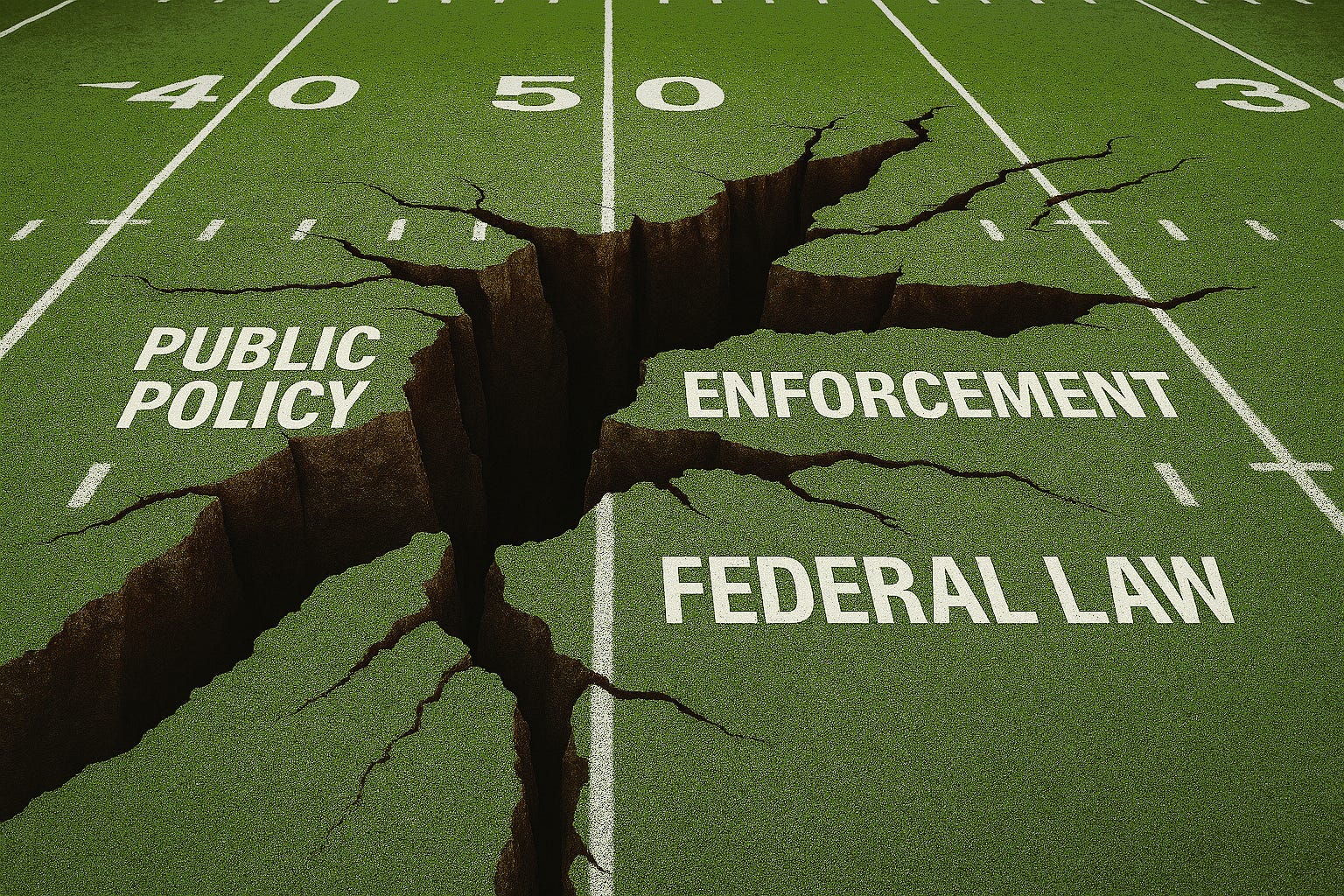
Congrats to the Seahawks on a well-deserved Super Bowl win.
The game has always been big.
The money bet on it? That pile is ever-increasing.
The American Gaming Association estimates:
Americans will wager a record $1.76 billion legally on Super Bowl LX.
They frame it as proof of:
…continued growth and strength of the legal, state- and tribal-regulated sports betting market.
But let’s be honest here: That number doesn’t even include prediction markets.
Meanwhile, The Atlantic reported (paywall) an early volume snapshot and an estimate from Dustin Gouker:
…Kalshi has already seen more than $167 million in bets on the game, and that number could conceivably crack $1 billion…
Across all bets, Gouker’s estimate of $1 billion in volume on Kalshi turned out to be a fairly good one. On the game's outcome alone, Kalshi still cleared half a billion. Volume and handle are an important distinction, but still…

The question that matters here isn’t how much was bet via prediction markets, it’s this:
Is it legal?
Well, it depends on whom you ask.
Chris Christie Enters the Chat
Christie helped create this entire regulatory landscape. He contends that the prediction markets are not legal:

Let us be precise here: Christie, former Governor of New Jersey, believes prediction markets, and only the prediction markets, are flouting the law. Not the state-regulated sportsbooks, of course. They are the “good guys”: Paying taxes to the state, protecting game integrity, keeping minors out, etc.
Christie posted for all to see:

Christie isn’t just commenting from the sidelines, either. He’s advising the AGA on sports event contracts. That tracks. After all, the only reason states have sports gambling at all is Murphy v. NCAA (PDF opinion). The only reason Christie’s name is not etched in that docket forever is because he left the governor’s office before SCOTUS issued its opinion. But it was Christie’s fight from the very beginning.
It wasn’t even clear that Christie was going to win; the sports leagues were a formidable opponent. At the time, Attorney David Boies thought New Jersey was facing an uphill battle. Christie pushed anyway. He lost in the Third Circuit and for a moment, it seemed that the window of opportunity had closed when SCOTUS denied cert. Then, after some legislative maneuvering, he tried again. SCOTUS took the case and the rest is history.
The AGA backed him by filing an amicus brief (PDF) in the SCOTUS case. Now that prediction markets are eating the states’ lunch, Christie is returning the favor.
So, similar to the AGA backing Christie, who’s backing the proliferation of prediction markets?
Yep, you guessed it. The new CFTC Chair, Michael Selig:

And here’s where things get uncomfortable.
Is it appropriate for the head of a federal agency to publicly weigh in on an active legal controversy, even if it’s from a “personal” account?
Especially when it doesn’t match what he told Congress a mere two months ago. While working as outside counsel (Paradigm) in 2024, Selig co-authored a letter signaling his thoughts that it would be “arbitrary and capricious” to characterize sports event contracts as “gaming.” Did he truly intend to defer to the courts? The more plausible explanation is that he kept his views quiet until securing his position at the CFTC.
If this doesn’t bother you, then we have a very different vision for how public institutions should represent our nation.
Let’s return to the core question.
If Christie is right–if there is no federal preemption and sports gambling is purely a state matter (his position in Murphy v. NCAA)–then half a billion dollars was illegally traded on just one prediction market platform yesterday.
If Selig is right–not about legality–but about federal law preempting state law–then what does that say about the $157+ billion Americans have wagered across all sports, a figure that continues to climb every year?
Big Game Betting - It’s All Illegal
Yesterday, Americans wagered billions on the Super Bowl.
Openly.
Casually.
Cheerfully.
Various platforms advertised during the broadcast itself, $10 million a spot we might add, and are endorsed by leagues that once swore gambling would destroy the integrity of sports.1
And if you’re wondering why you didn’t see Kalshi or Polymarket ads, it’s because the NFL is still forming its stance. For now, prediction markets are still in the same category as tobacco, pornography and firearms. That could change soon.
Nobody wants to flow against the grain (except us really). Here’s the part that nobody wants to say out loud:
All of it is illegal.
Not “unregulated.”
Not “under-regulated.”
Not “a gray area.”
Illegal.
The fact that we pretend otherwise says something uncomfortable about how far American law has drifted from its own foundations.
To see how we arrive at our illegality conclusion, we first need to understand what Murphy didn’t do. Why that SCOTUS decision is unfinished business. That’s our next post.
Then, next week, we will bring it all together and tell you why we have a $150+ billion illegality problem.
Final Thoughts
So, if the house always wins, who is the house?
Theoretically it will be the institution that benefits most from a nationalized sports gambling scheme. It may extend beyond the platforms that offer the bets and it will be at the expense of the American public.
Which brings us to the bigger question: Who’s really going to have the public’s best interest at heart?
The AGA had Christie’s back. Now he’s returning the favor.
The CFTC has the prediction markets’ back and surely they will be returning the favor.
So, who will have America’s back?


Here are the links: DraftKings, FanDuel. Fanatics released this longer version before the Super Bowl.