


I. The Moment the Federal Story Escalated
Part I ended with a warning: The state‑level fights in New York and New Jersey were not the end of the story–they were the beginning of a federal escalation. What we are witnessing now is the most aggressive assertion of federal authority in the history of prediction markets, and it is happening through a statutory mechanism that had been dormant for nearly half a century.
The Commodity Futures Trading Commission (“CFTC”) has revived its emergency powers under Section 8a(9) of the Commodity Exchange Act (“CEA”), a provision so rarely used that many observers believed it had effectively fallen out of the regulatory toolkit. It hadn’t. It was simply waiting for a moment when the Commission believed the integrity of the national derivatives market was at stake.
That moment arrived in July and August of 2026, and it arrived because of prediction markets.
The CFTC’s sudden activation of emergency powers–twice in 30 days–marks an escalation point in the federal posture. These were not responses to manipulation, delivery squeezes or commodity shocks, but something the American public has never seen–state interference. And they signal that the federal government now views the jurisdictional stakes around prediction markets as existential.
II. The Dormant Nuclear Option
Section 8a(9) is one of the most potent authorities Congress ever gave the CFTC. It allows the Commission, upon finding of an emergency, to direct a registered exchange to take whatever action the agency considers necessary to maintain or restore orderly trading. Historically, this meant stepping in when markets were on the brink of distortion–when manipulation was imminent, when physical delivery systems were collapsing or when geopolitical shocks made price discovery impossible.
John Lothian, whose newsletter has chronicled derivatives markets for more than 25 years, recently noted in his corrected newsletter:
The CFTC has exercised that authority six times since its creation: four times between 1976 and 1980 and twice during the past 30 days. The accurate and still remarkable point is that the commission allowed its emergency power to remain dormant for 46 years…
…The CFTC did not invoke Section 8a(9) during the Hunt brothers’ silver-market corner, the September 11 attacks, or the 2008 financial crisis. It relied instead on exchange action, coordination, administrative relief and other supervisory powers.
Until prediction markets forced it out.
III. What “Emergencies” Used to Mean
To understand the magnitude of the CFTC’s recent actions, it’s worth revisiting what the agency historically considered an emergency:
In 1976, the CFTC intervened in the expiring Maine potato futures contract after surveillance economists identified a concentration of long positions and a shortage of railroad cars needed for delivery. The Commission imposed 100% margin requirements and restricted trading to liquidation only.
In November 1977, the CFTC, acting in conjunction with the New York Coffee and Sugar Exchange, declared an emergency in the expiring December Coffee futures contract amid concerns that positions accumulated by coffee-producing countries threatened a manipulation. The Commission ordered the phased liquidation of all positions according to a prescribed schedule.
In 1979, severe weather and speculative concentration in the March wheat contract led the CFTC to suspend trading and ultimately prohibit further trading. The Chicago Board of Trade sued, but the appellate court vacated the injunction, holding that Congress gave the CFTC sole discretion to determine an emergency.
In 1980, President Carter’s Soviet grain embargo abruptly canceled millions of tons of agricultural exports. The CFTC suspended trading for two days across multiple exchanges to prevent a disorderly collapse in prices.
These were genuine market emergencies–physical shortages, geopolitical shocks, manipulation threats. They were not legal disputes. They were not jurisdictional fights. They were not triggered by state gambling laws. The 1979 wheat episode did eventually produce litigation, but only after the CFTC had already exercised its emergency authority. The legal dispute was a consequence of the emergency action–not its trigger.
The modern revival is something entirely different.
IV. The Modern Revival–Two Emergencies in 30 Days
Michigan: Protecting Executed Contracts
In late June, a Michigan state judge barred Kalshi (PDF) from offering sports contracts to Michigan residents and subsequently directed it to void, cancel and refund certain already-executed trades. Kalshi responded by submitting to the CFTC a notification of its adoption of an emergency rule (PDF) that would force‑liquidate those positions so it could comply with the state court.
On July 14, 2026, the CFTC blocked it:

The Commission stayed Kalshi’s emergency rule and invoked Section 8a(9), ordering Kalshi to fulfill the trades normally. It argued: Essentially, if a state court can unwind executed trades for residents of that state, the uniformity of the national derivatives market collapses.
“The Commission will not allow states or state courts to bully registered entities into violating the Commodity Exchange Act,” Selig said.
This was the first emergency invocation in 46 years–and it was triggered not by market instability, but by a state judicial remedy.
New York: Protecting the Federal Regulatory Architecture
New York Attorney General Letitia James sued Kalshi under state gambling law, seeking a temporary restraining order preventing Kalshi from offering contracts “within or from New York”:
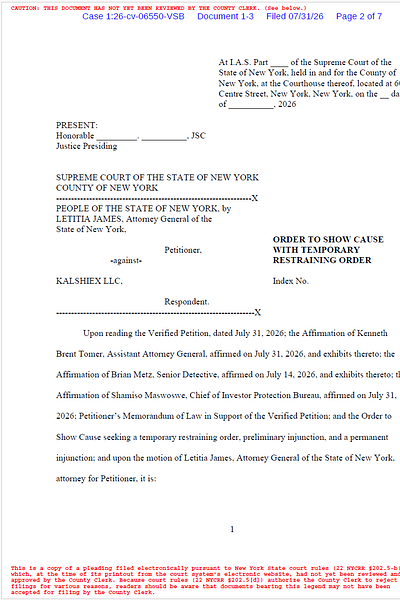
Because Kalshi is headquartered in New York, the CFTC interpreted this as a threat to shut down Kalshi’s event‑contract business nationwide. New York also sought $36 billion in monetary relief.
Kalshi notified the CFTC that this constituted an imminent market emergency and the Commission agreed; on August 11, the CFTC issued its second emergency order (PDF) and it was even more consequential.
The CFTC found that New York’s action created a “major market disruption” preventing the market from accurately reflecting supply and demand. The order described a chain reaction: Forced liquidation could leave traders unintentionally exposed, trading could migrate suddenly to other exchanges, and prices could begin incorporating a regulatory shutdown risk based on geography rather than the underlying event.
But the order went further. It invoked exclusive federal jurisdiction and warned that if New York could use gambling laws against Kalshi, it could use them against any derivatives product regulated by the CFTC–especially given the concentration of financial institutions in New York.
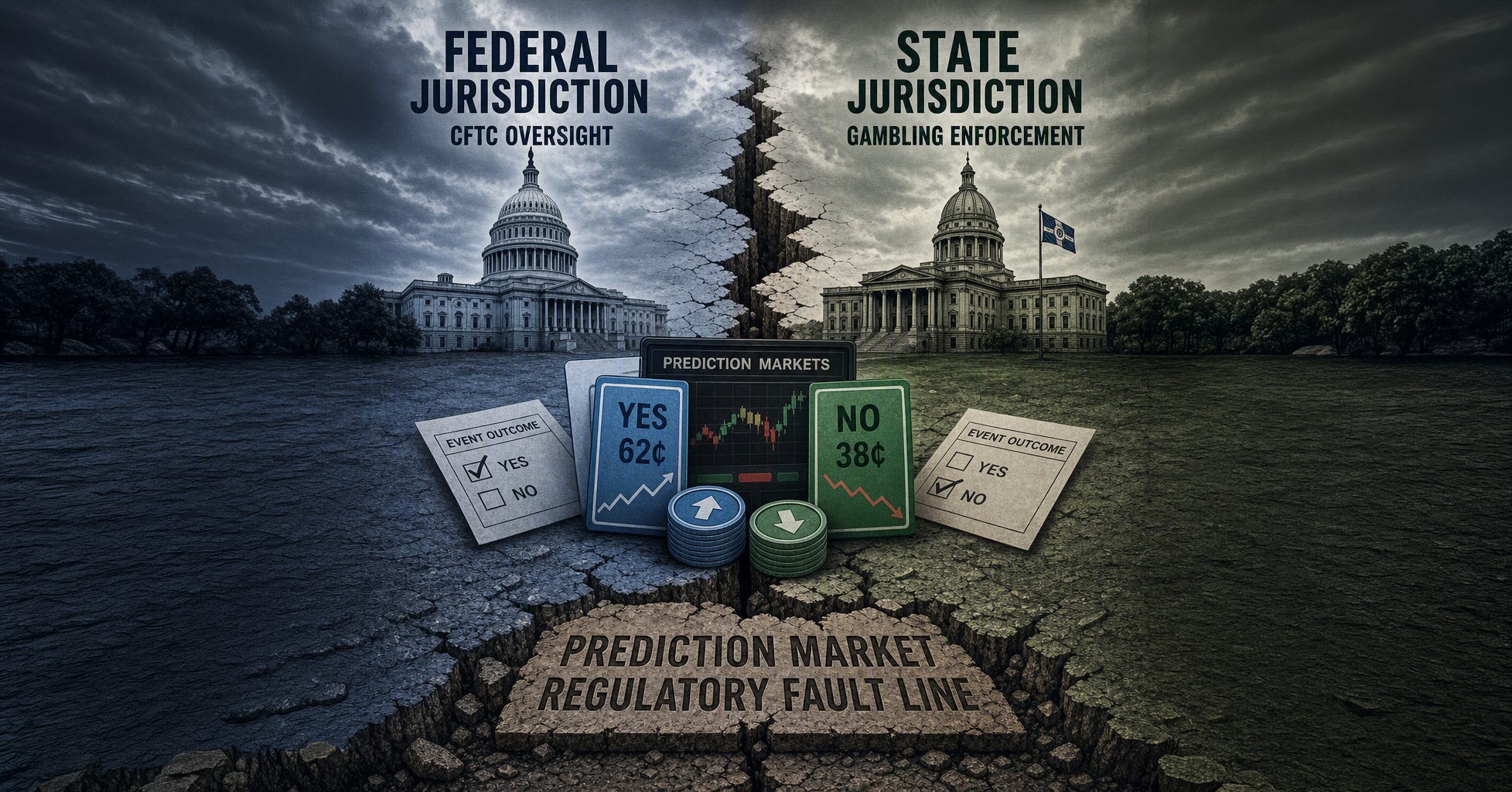
This was not merely a regulatory response. It was a federalism statement.
V. The Rulemaking Offensive–The Pre‑SCOTUS Cleanup Operation
The emergency orders did not occur in isolation. They seem to be part of a broader federal strategy to tighten guardrails around prediction markets–a strategy that appears designed to prepare the industry for eventual Supreme Court scrutiny.
In reference to this Indian Gaming Association (“IGA”) webinar, Steve Ruddock, publisher of Straight to the Point, noted the seeming coordination between the CFTC and Kalshi. IGA Chairman David Bean put it more sharply: “Chairman Selig of the CFTC is coaching this industry to prep them for the Supreme Court.”
The CFTC has issued a series of advisories that look less like routine regulation and more like a cleanup operation.
NPR reported that the CFTC launched a review of “mention markets,” which allow betting on the number of times a word or phrase is spoken during an event. These markets are easily manipulable–a single individual can influence the outcome. Kalshi removed all sports‑related mention markets during the probe.
The CFTC also issued an advisory warning exchanges against randomized rewards, “risk‑free” incentives, unlimited payouts, and promotions guaranteeing profits. These programs, the Commission said, could distort markets or impede regulatory review.
There was also some added congressional pressure along the way:
Democratic Senators Adam Schiff and Alex Padilla, joined by several colleagues, demanded that the CFTC rein in wildfire betting. They warned that wildfire markets create perverse incentives, including potential arson, and asked whether such markets are “in the public interest.” Polymarket had accepted more than $1.2 million in wildfire bets tied to the Palisades and Eaton fires.
“Offering bets on destructive wildfires threatens to minimize communities’ suffering all so the rich and powerful can profit,” Schiff wrote.
Schiff also introduced the DEATH BETS Act, which would ban contracts on assassination, terrorism, war, and similar events. The CFTC already prohibits these categories under Rule 40.11, but that prohibition rests on regulatory expansion rather than statutory text–a tension highlighted in the Ninth Circuit’s August decision in Kalshi v. Nevada (PDF)–now petitioned (PDF) for an en banc hearing. The bill does not expand the CFTC’s authority so much as codify categories the agency previously attempted to ban through rulemaking. Its real function is political: reframing the issue as a public‑safety crisis and building a legislative record that certain markets are inherently dangerous.
The CFTC’s June rulemaking proposal, which revises Rule 40.11 and introduces a three‑step inquiry into whether event contracts involve unlawful activity, terrorism, assassination, war, or gaming, is part of the same offensive. Amanda Fischer of Better Markets called it “a feeble attempt to shore up an area where they are overwhelmingly losing in court.”
The federal government is tightening the perimeter.
VI. The Constitutional Clash–The Fight Over Federal Preemption
At the center of this conflict is a simple question: Can states apply gambling laws to federally regulated event‑contract markets?
The CFTC’s recent actions suggest the agency believes the answer is no. By invoking emergency powers to block state interference, the Commission is treating state enforcement itself as a market emergency. It is asserting that prediction markets fall squarely within the national derivatives framework Congress created.
Critics disagree.
Benjamin Schiffrin of Better Markets accused the CFTC of “cheerleading” for prediction markets and directing Kalshi to violate court orders. Matt Levine also said it was “amazing that a federal regulator has concluded that any effort to shut down sports gambling would be an emergency for financial markets.” Attorney Daniel Wallach has consistently posted on X (Twitter) that the CFTC’s emergency orders are unprecedented and appear tactically timed, a pattern that raises the possibility they were intended to influence the Second Circuit’s review.
Wildfire markets illustrate the stakes. They raise public‑safety concerns–arson, insider trading, manipulation–that states argue justify gambling enforcement. They also show why the CFTC believes exclusive jurisdiction is necessary to prevent dangerous markets from migrating offshore.
The constitutional clash is now unavoidable.
VII. The Broader Regulatory Context
The federal government is not uniformly aligned. Politico (paywall) and The Hill reported that prediction‑market companies were removed from the White House tech meeting agenda, suggesting caution at the executive level.
Meanwhile, the CFTC convened its Innovation Advisory Committee, bringing together leaders from Polymarket, Kalshi, Coinbase, Robinhood, Nasdaq, and CME:

The meeting featured heated debate over manipulation risks, self‑certification, and the future of event‑contract regulation.
CME CEO Terry Duffy criticized self‑certified event contracts, warning of manipulation risks in speech‑based and geopolitical markets. Chairman Selig pushed back publicly, illustrating the broader jurisdictional battle between traditional exchanges and prediction‑market platforms.
The regulatory landscape is shifting rapidly.
VIII. Why This Matters for Prediction Markets
Prediction markets are no longer a niche experiment. They are now a regulatory flashpoint.
The CFTC argues that Congress intended a single national derivatives market. State‑by‑state shutdowns threaten liquidity, price discovery, and market stability. Forced liquidation, arbitrage disruption, exchange migration, and regulatory‑risk premiums all distort the market’s ability to reflect supply and demand.
Wildfire markets show how event contracts can create incentives to influence real‑world outcomes. They demonstrate why the CFTC is under pressure to define “public interest” and “manipulation risk” more clearly. They preview categories likely to be prohibited under future rulemaking.
The emergency orders signal that the federal government is willing to use extraordinary powers to protect the national market structure–and to assert exclusive jurisdiction over prediction markets.
IX. Conclusion–The Federal Counterstrike Has Begun
The CFTC has revived a dormant nuclear authority twice in 30 days. Both invocations were aimed at state interference, not market manipulation. The federal government is now treating prediction‑market regulation as a matter of national market stability and constitutional structure.