


In my previous article, I argued that SCOTUS will decide only a small fraction of sports betting’s trillion-dollar problem, leaving us with more questions than answers.
Why? To understand that, we have to combine law with economics, two of my favorite subjects. More specifically, we have to:
Examine what the statute actually says; and
Understand the powerful incentives in play.
Where else would one start and what better explanation than the incentives themselves would explain which questions are ultimately presented to the Supreme Court?
Let’s dive in.
Setting The Clock to The 1970s
Why are we going back to the 1970s? Shouldn’t we just look at the Dodd-Frank provisions? Isn’t that where the definition of “swap” comes from anyway?
Yes, that’s where it is, and yes, we’ll get there. But to understand what Congress ultimately did in 2010, we first need to understand the regulatory framework it inherited. That takes us back to 1974, when Congress fundamentally reshaped federal oversight of commodity futures markets and established the CFTC. The changes made that year laid important groundwork for the regulatory framework that Dodd-Frank would later expand in response to the financial crisis.
Some of you might be wondering, if I’m so concerned with the most natural starting point, why would I not start at the beginning, in 1922 with the Grain Futures Act?
Consider this for a moment: A Substack is ultimately no different from a book, any other form of writing, or even a movie for that matter. It’s a storytelling mechanism. Just as books don’t always follow a strict chronological order, neither does a Substack. Movies often open with some scene that initially appears random, but it’s intended to give the audience a glimpse of the action and the stakes; then the gaps are filled in along the way.
The fact that we’re dealing with a rather technical subject doesn’t alter these fundamental principles. In my opinion, 1974 provides the initial glimpse we need. From there we’ll fast forward or rewind where necessary.
The CFTC Arrives
Here is what we had when the CFTC was in the womb:
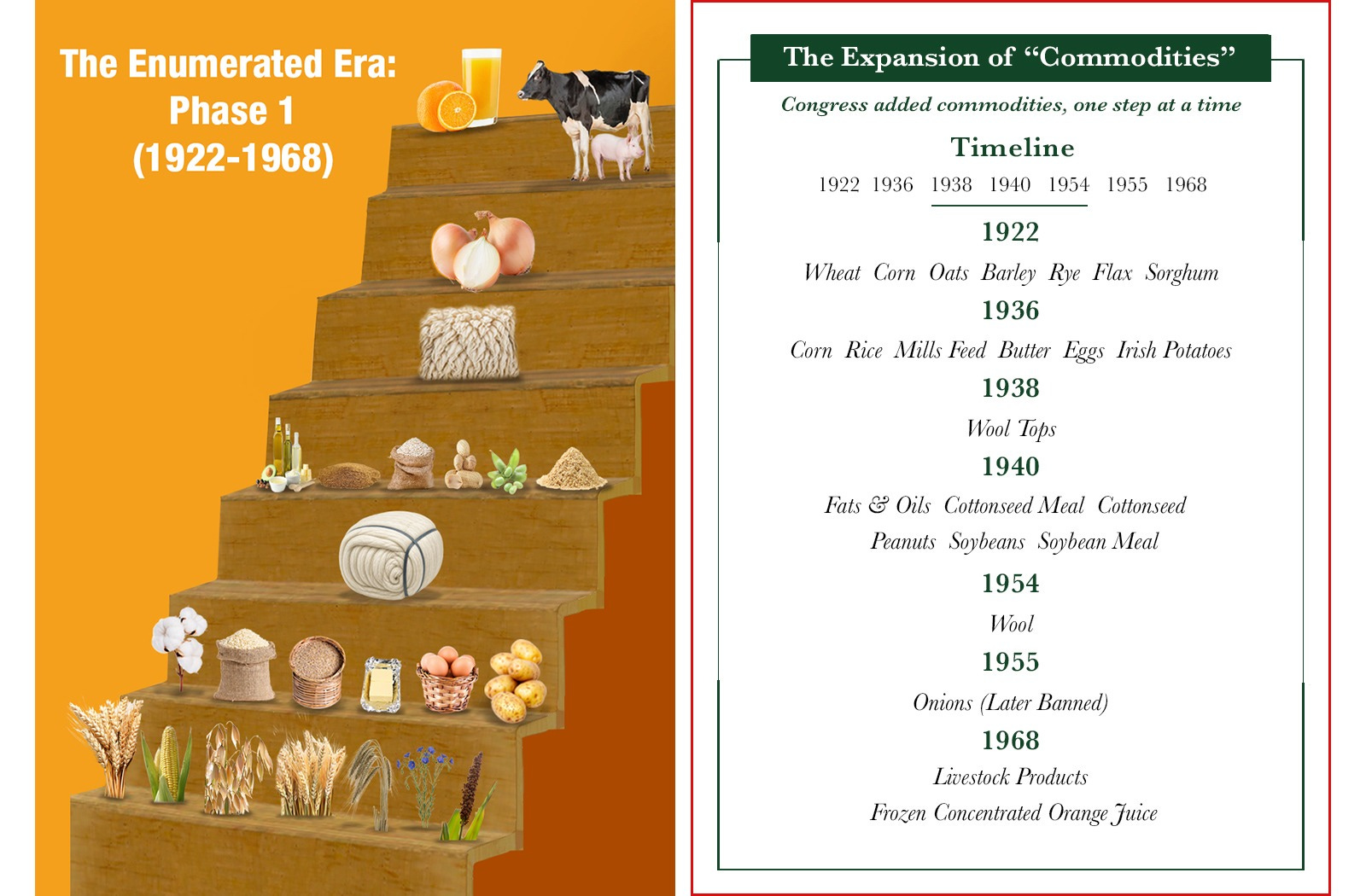
We started with seven grains under the Grain Futures Act of 1922, and Congress kept adding commodities, one at a time. But two significant obstacles stood in the way of national commerce:
First, although federal oversight existed, the boundaries of federal authority weren’t exactly established. As the CFTC explained in its Ninth Circuit amicus brief (PDF), referring to the Grain Futures Act:
But the Supreme Court found that this preemptive design was not sufficiently explicit in the statute, which resulted in states continuing to regulate or even prohibit futures trading.
And the 1936 Commodity Exchange Act didn’t exactly resolve the issue either:
And when Congress expanded federal oversight of futures markets in 1936 with the Commodity Exchange Act, Pub. L. No. 74-675, 49 Stat. 1491 (1936), the boundary between federal and state authority remained unsettled…
A second factor was also in play. The economy was evolving, and futures markets were moving beyond agricultural origins into the financial world. The CFTC highlights that transition:
Futures markets originated in the United States at transportation hubs for agricultural products like grain, butter, and eggs. Over time, exchanges began to offer contracts for other physical commodities like metals, oil, and gas, and later introduced cash-settled futures linked to less tangible measures like interest rates and price indices.1
Congress’s response was the Commodity Futures Trading Commission Act of 1974. The title gives it away: This was when the CFTC emerged from the halls of Congress and entered the financial markets.
It was a sea change and the CFTC’s brief captures its significance:
The 74 Act amendments to the CEA worked a sea change in the regulation of U.S. derivatives markets in three critical ways. First, Congress established the CFTC, vesting in it the authority to administer the CEA. Second, Congress expanded the scope of the CEA to cover “all commodities.” Third, Congress expressly gave the CFTC “exclusive jurisdiction” over U.S. commodity futures and options markets.
So what did the law actually say? This:
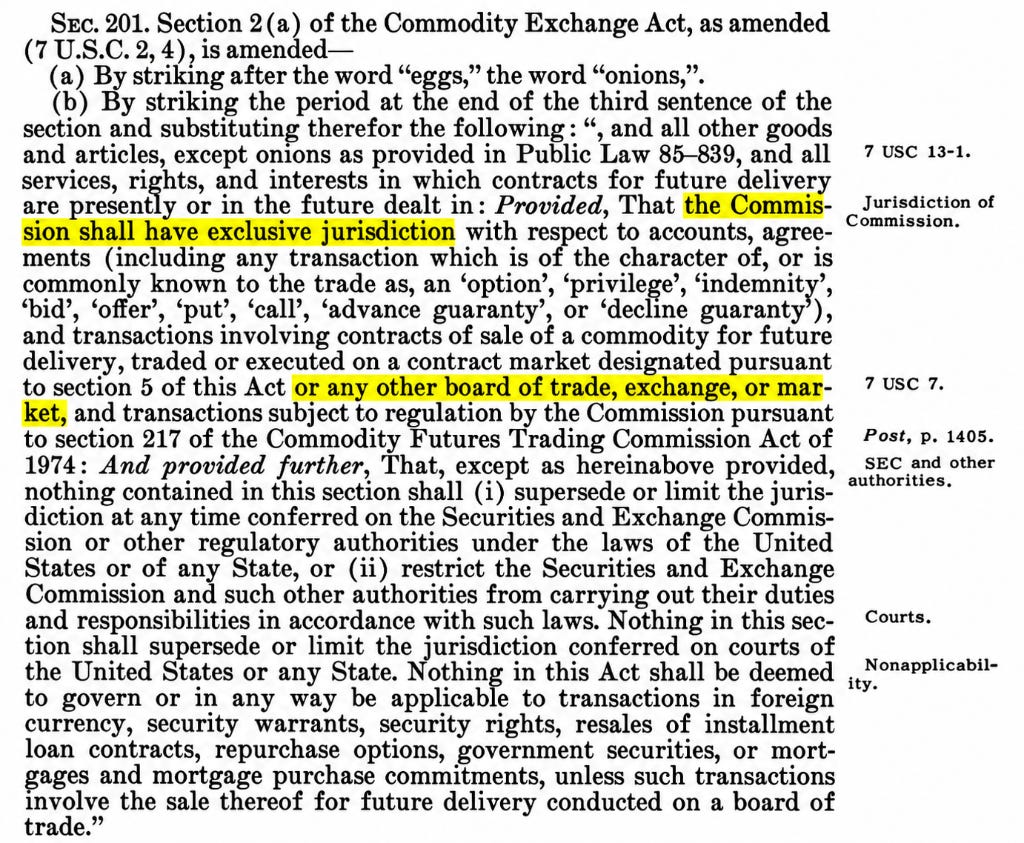
The word “or” in the second highlighted passage matters greatly, so let me zoom in on that language:
transactions involving contracts of sale of a commodity for future delivery, traded or executed on a contract market designated pursuant to section 5 of this Act or any other board of trade, exchange, or market…
That’s incredibly broad, isn’t it? It’s hard to imagine language much broader than “any other board of trade, exchange, or market.”
That’s what Lex and Bianca thought, too, in our 🎙️ LexBeyond Ep. 31 - Polymarket’s Constitutional Play podcast. Read that language in isolation, and you’d reasonably conclude that Congress wasn’t just concerned with activity on designated contract markets. It was also asserting authority over activity in any other market.
And that concern in particular dates all the way back to the 1920s.
