



The sports betting/prediction market debate is everywhere. Here are just a few recent examples:
Tarek Mansour, Kalshi CEO, writes an op-ed piece in the Wall Street Journal, giving it the title: When Is a Sports Bet Not a Sports Bet?1
According to a Bank of America survey (reported by Nick Devor/Barron’s), 20% of respondents consider sports betting to be “nontraditional” investing, and Gen Z is twice as likely to see it that way.
And then there’s the burgeoning conference scene: PREDICT 2026 (I was one of the speakers on the federal v. state panel), and NEXTPredict (I was there, too). Las Vegas’ Prediction Market Conference starts today, and there are more conferences and panels on the way, I assure you.
Read the headlines and you might think certainty is waiting on the other side of a Supreme Court decision.
I understand the expectations. The simple model of government etched into our minds from childhood is one built on the separation of powers and checks and balances. Congress makes laws, the executive branch carries them out, and when there are gaps or disagreements, the courts sort them out.
And make no mistake. For immigrants like myself, this system, which has worked for more than two centuries, is a big reason people leave their homes and come here to make America their new home.
I was reminded of these basics recently when I went through the process of becoming a U.S. citizen, something I’m proud to have done. Here are two of the flashcards I studied for my citizenship test:
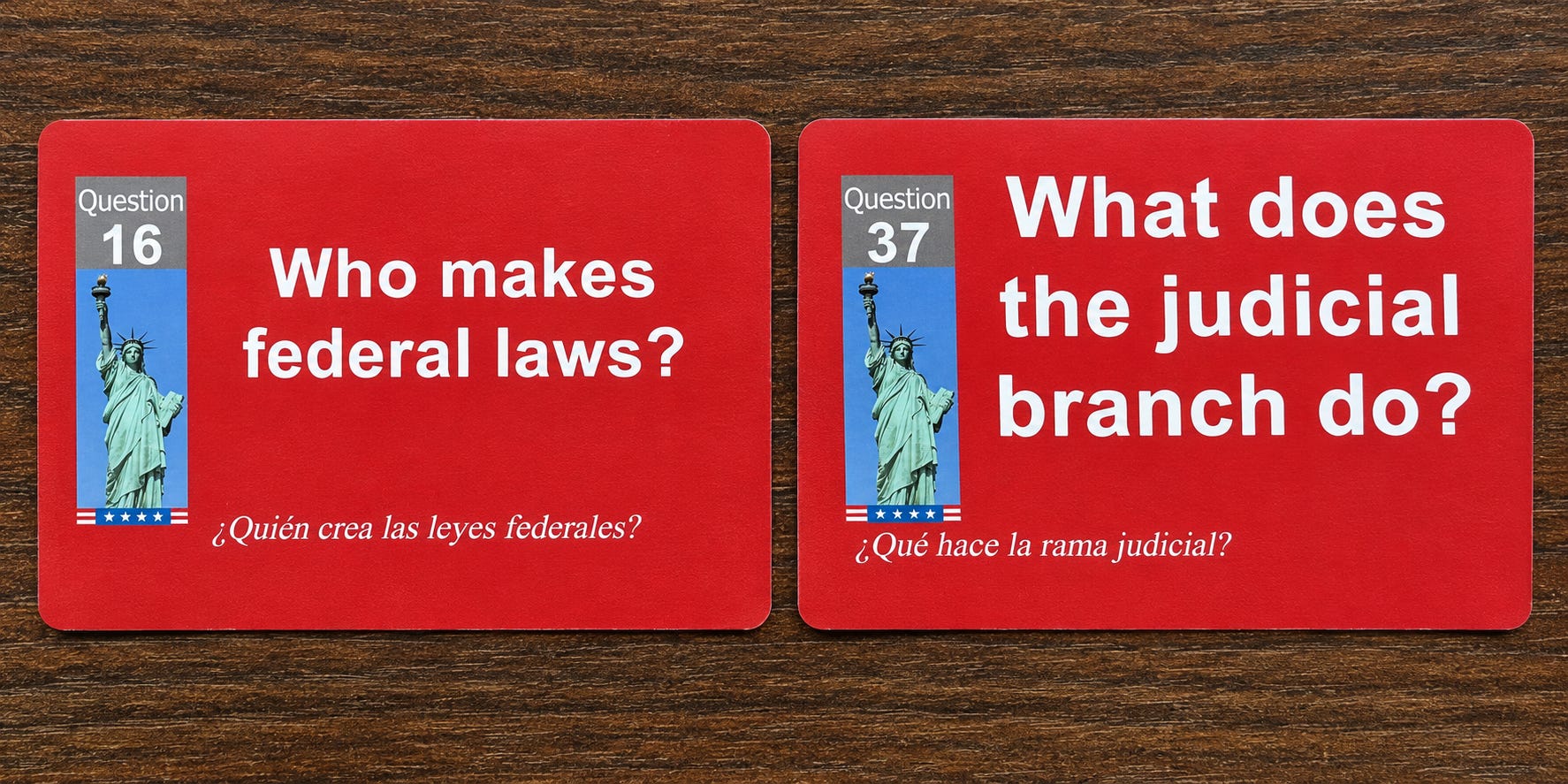
And the answers:
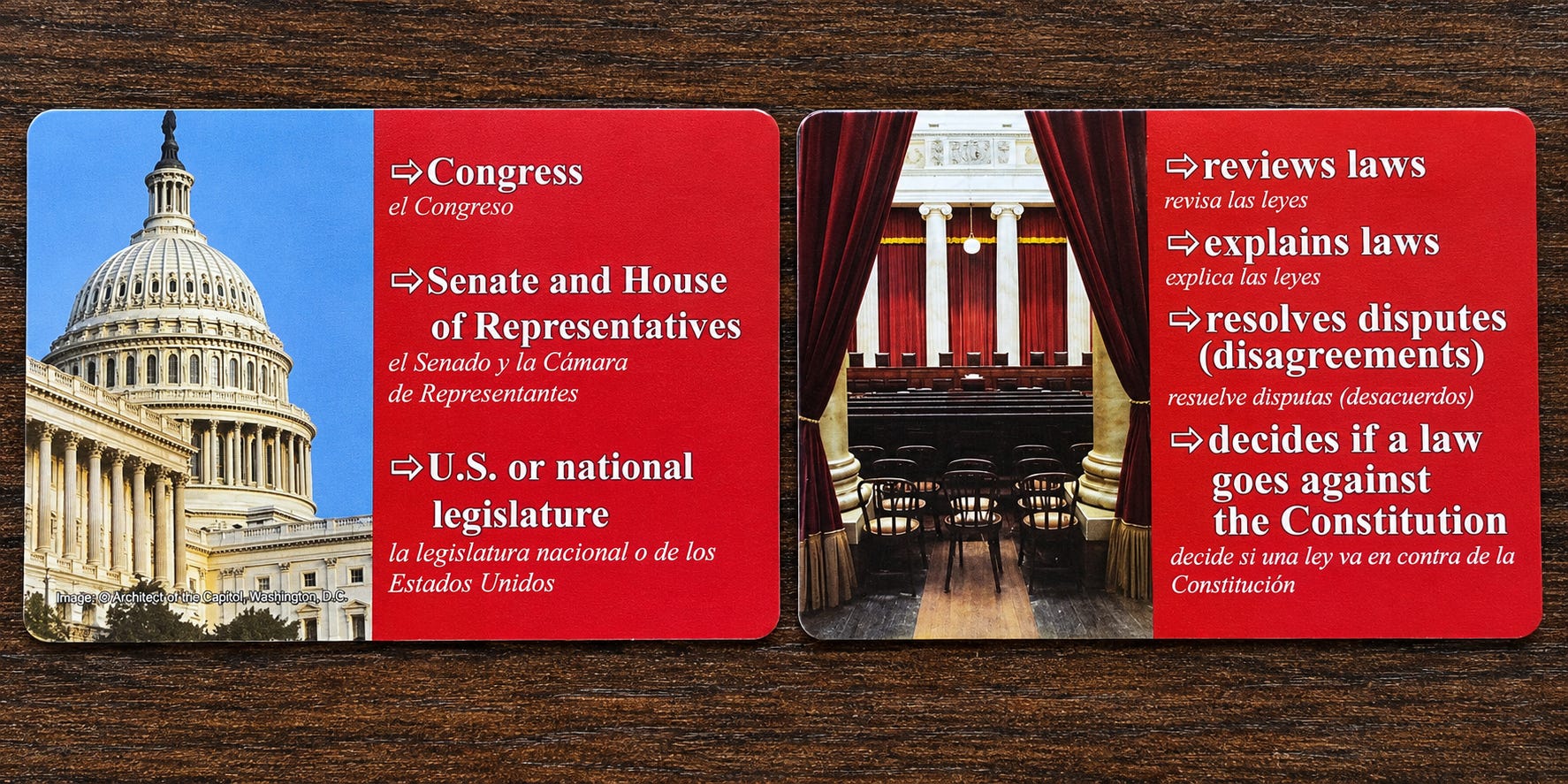
What the Founding Fathers envisioned is clear enough. Is it too much to expect the system to work when a trillion dollars is in play?
Let’s start with where things stand when it comes to the intersection of sports and money:
I think we can agree that the laws are not exactly clear.
There’s also plenty of disagreement over what the executive branch is doing versus what it should be doing.
And the judiciary has stepped in to sort it all out. With 170+ prediction-market-related cases and counting, including decisions going both ways on the federal vs. state divide, I think we can also agree that the courts are having a difficult time sorting it out themselves.
But isn’t this precisely why we built the country around the separation of powers and checks and balances? When nothing else works, what happens? The highest court in the land enters the chat.
Isn’t it rational to expect some certainty then?
I understand the expectations. I just wouldn’t bet on it.
How Big Is The Market?
How much on-shore sports betting has happened since Murphy?
The state numbers are publicly reported. The latest number we have is $695 billion since 2018.2 And a little over half of that comes from just six states (mind you, some states joined the gold rush later than others).
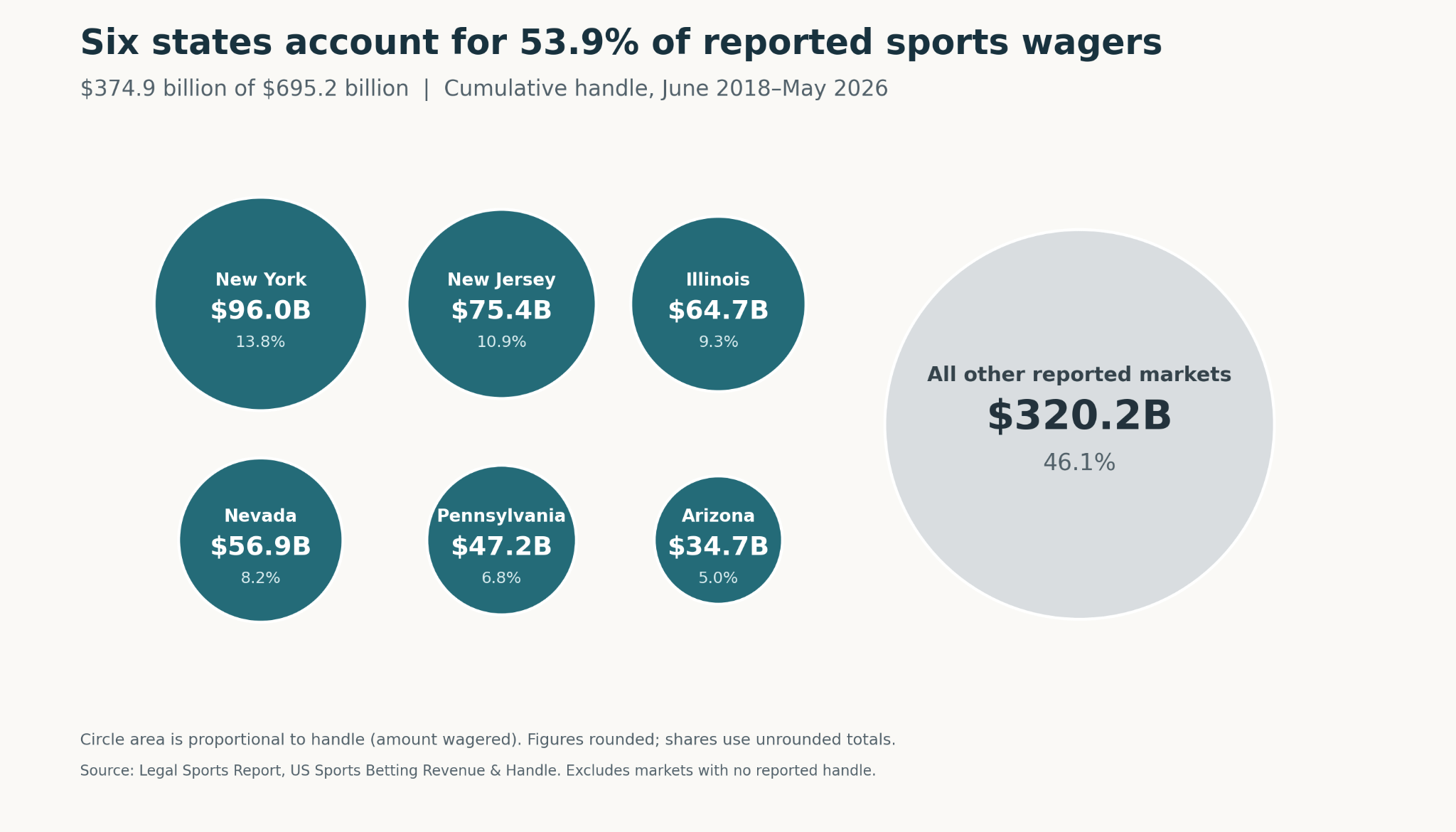
That only goes through May 2026, so to see where things might stand by the end of the year, we’ll need to take a few things into account:
Football is here, and September through December are traditionally much busier than June and July. That said, the American Gaming Association projects largely flat NFL wagering: $29.5 billion this season, compared with $29.4 billion last season.
The World Cup made things more interesting this summer. In Pennsylvania, for example, June wagering rose nearly 18% from a year earlier.
Missouri adds another wrinkle. It launched sports betting on December 1, 2025, meaning last year’s June through December total includes only one month of Missouri wagering. This year’s will include all seven.
So let’s start with last year’s June through December volume: $96.4 billion. I believe the observations listed above, in totality, would warrant a modest bump to $105 billion. Add the two and what do we get?
$695 billion through May + $105 billion for June through December = $800 billion since Murphy.3
A big number, no doubt.
But state-regulated sportsbooks aren’t the only way to risk money on sports outcomes anymore. We now have prediction markets whose volume primarily comes from sports. So, how much activity is going on there?
We’ll get to that but first, the first contract…
The First Sports Event Contract
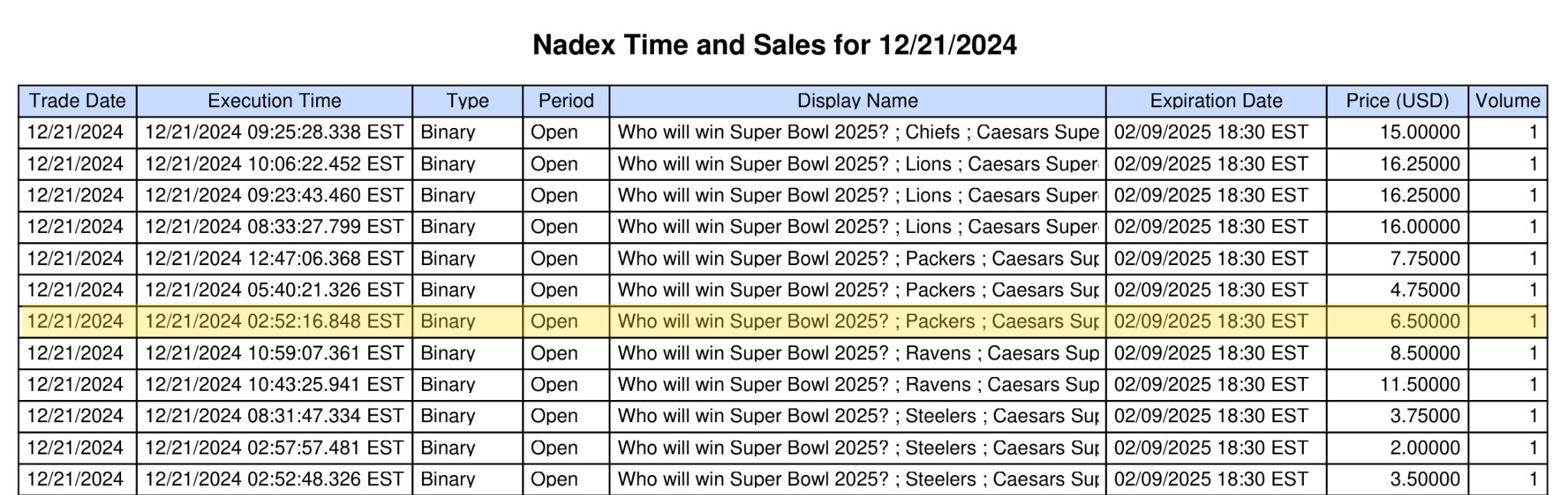
It was December 21, 2024, at 2:52 A.M. Eastern time. Someone, perhaps a Cheesehead who couldn’t sleep, bought a Packers futures contract on Nadex to win their fifth Super Bowl. The price? $6.50. About the cost of a Frappuccino.
Green Bay has a way of showing up at the beginning. The Packers went public, sort of, in 1923 and won the first Super Bowl on January 15, 1967. And when Crypto.com’s sports contracts began trading in 2024, the earliest execution I could find was a single contract on the Packers winning their fifth.
Crypto.com has its own claim to being the first. In December 2024, through Nadex, it became the first DCM that self-certified a sports event contract (PDF) to the masses; Kalshi’s contracts would come about a month later. Remember, unless the CFTC acts, the contract goes live quickly. The self-certification document said as much, stating: “The Exchange intends to list the Event Contract for trading no later than December 23, 2024.”
Indeed, the first trade happened a few days before Christmas. How do we know this? The exchange data is public, that’s how. The full document is here (pp. 187-188) and below is the snapshot showing the first trade:
That was a gutsy move by Nadex. It was not the first-ever DCM that self-certified sports event contracts, however. That distinction belongs to ErisX, a story we told in Episode 24 of the LexBeyond Podcast - 🎙️When Sports Trading Attempted On-Exchange. One distinction worth noting: ErisX’s filing (PDF) limited itself to eligible participants, shutting out retail.
This wasn’t Nadex’s first encounter with event contracts, either. It had self-certified election markets and, formerly known as HedgeStreet, had already listed and traded other contracts. But the more revealing history is in the memorandum accompanying HedgeStreet’s designation as a DCM. There, the CFTC effectively said, “No sports, please.” HedgeStreet was a small outfit back then, trying to compete with CME:

But self-certifying and immediately listing? As far as I can tell, that did not happen with ErisX contracts; when it announced the filing, it said it was “looking to launch contracts,” and that their “sporting event based contracts (pending regulatory approval) will be listed on Eris Exchange.”4 Ultimately, they withdrew their self-certification when they saw the writing on the wall.
That did not happen with Nadex’s election contracts either. Nadex submitted its election contracts on December 19, 2011, but scheduled the new contract rules to take effect on January 4, 2012. The CFTC initiated its 90-day review and requested suspension of listing and trading on January 3—one day before that scheduled effective date. It then prohibited the contracts on April 2, 2012.
And, to be clear, if we use the words “sports contract” broadly, the Green Bay Packers contract wasn’t the first to be traded either. Visit Eric Ramsey’s TickerTracker (amazing site, I highly recommend), and you will see that there were a few traded contracts involving NFL coaching jobs and one on NBA expansion before December 21, 2024.5
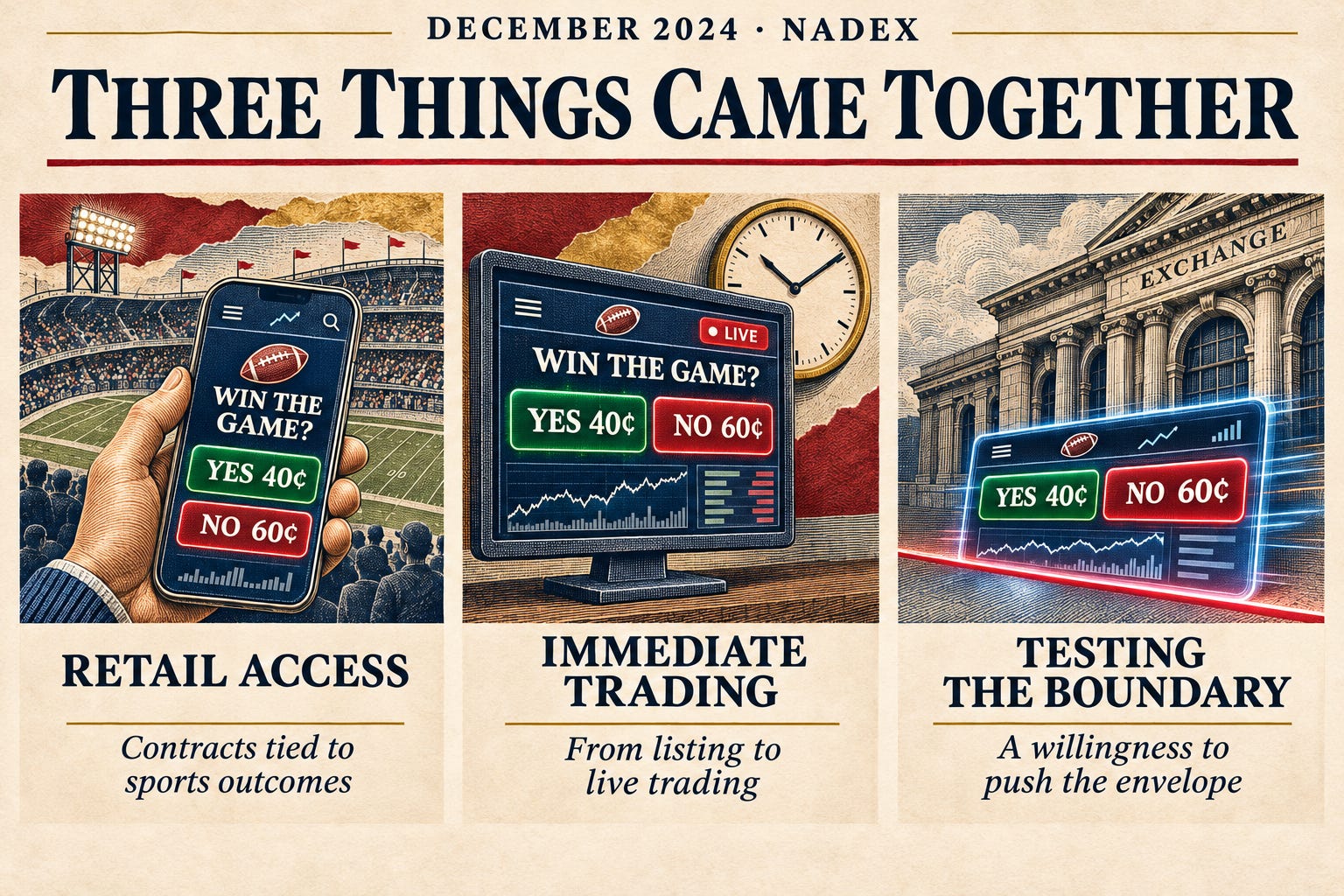
Sports event contracts for retail, resolving on sports outcomes? Hadn’t been done before. Immediate trading of sports event contacts? Doesn’t look like that happened before, either. And neither did Nadex commencing trading contracts it thought may push the envelope. That’s new too.
So, in December 2024, these three things came together in the hands of Nadex. That bravado carried over when the CFTC initiated a review on January 14, 2025 (Letter PDF). In a different world, a DCM would have respected the stay and would not have even listed the contract in the first place. But Nadex basically said, “Not this time,” and continued listing.
Kalshi self-certified its sports event contracts on January 22, 2025 (PDF) and began trading them on January 23, 2025. As mentioned, they have traded sports-related contracts, about $690,000 volume spread over different NFL coaching contracts and one NBA expansion contract; nine markets in total up through January 22, 2025.
Then, on January 23, sports event contracts appeared. NFC championship, Super Bowl winner, NBA finals, March Madness, Stanley Cup winner, events of that nature. Eight markets in total.
The volume? $690,000 and change.
I’m not kidding. Kalshi listed sports event contracts resolving on sports performance, and on Day 1, they saw exactly the same volume they saw from a lifetime (albeit limited) of non-performance sports contracts.
The rest, as they say, is history.
The Data
We have our origin story and we have an excellent dataset in Eric Ramsey’s TickerTracker. So how big is this market? Let’s go down the rabbit hole, shall we?
Some simplifying assumptions, which I believe are justified. There are non-performance sports contracts trading, but they are not that material, so I will track the entire sports volume and treat it as a reasonable proxy for sports event contracts resolving on game outcomes. Also, 99.5% of the parlay legs are sports per Eric Ramsey, so I am going to treat all parlays as sports event contracts.
With those simplifying assumptions, here’s how that breaks down by exchange, through October 31, 2026. Some exchanges came online later than others and some minor players, such as Gemini Titan, aren’t even tracked yet, so cumulative volume share isn’t necessarily a good proxy for market share.
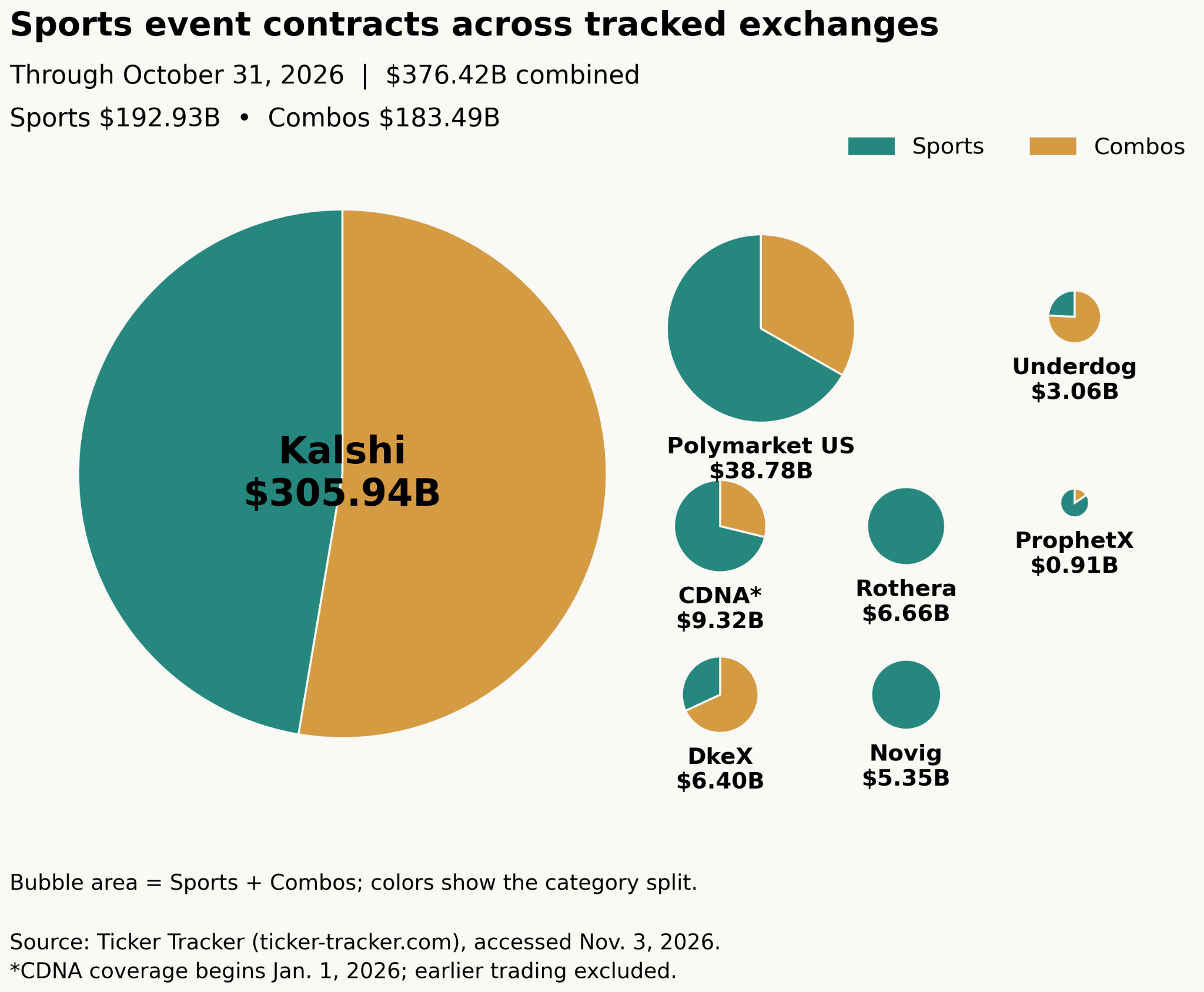
A couple of observations:
Kalshi dominates. I don’t think anybody who is on any of these cap tables can complain much, including Novig’s Sydney Sweeney, but, Kalshi surely appears to be running away from the field.
Combos dominate. The lifetime mix is close to 50-50 but that’s only because combos are new. If left undisturbed, the trend is clear. Financial innovation in the 21st century increasingly looks like the good-old parlays on DCMs. And if Letitia James, New York’s Attorney General is correct, those may not even be peer-to-peer.
All commentary aside, let’s come back to the numbers. With only two months to go in 2026, let’s go ahead and annualize the figures. I don’t think anything fancy is needed here, we are now deep into the NFL season and it’s the main driver. So, just extrapolating from October 2026 volume of approximately $110 billion, on a straight-line basis (adjusting for one less day in November), gives us another $218 billion in volume.
Let’s add the two:
$376 billion through October + $218 billion for November and December = $594 billion since inception.
Now that we have the prediction market numbers, let’s correlate it with the sportsbook handle on the other side. Before we get to the result, however, we need to work on one problem with the comparison. Volume isn’t the same as handle, so we can’t just simply add the two numbers together. Why? Sportsbook volume is relatively straightforward. You place a bet, the sportsbook takes the other side, and generally speaking, you can’t trade out of your position. Add up all those wagers and you have the total handle.
Sports prediction markets work differently. Say Trader A pays 40 cents for a Yes contract, and Trader B takes the No side at 60 cents. That’s $1 in notional volume. Fine. But even setting market making aside, that contract can be traded again, and again. Suppose Trader A sells that same Yes contract to Trader C for 50 cents. Reported notional volume now reads $2, even though there is still only one outstanding Yes/No pair. The original buyer, Trader A, has exited with a 10-cent profit, regardless of how the event turns out. Trader C now holds Yes, purchased for 50 cents, while Trader B still holds the original No, purchased for 60 cents. If the contract resolves to Yes, Trader C receives $1 and makes 50 cents, while Trader B loses 60 cents. If it resolves to No, Trader B receives $1 and makes 40 cents, while Trader C loses 50 cents.
So what’s the sportsbook handle equivalent of this? Maybe the better question is: What were we trying to measure with handle in the first place? Ex-ante risk, meaning the public’s appetite to place a bet? Or the risk still open at settlement? With traditional sports betting, those two measures largely collapsed into one. Now with prediction markets in the picture, they don’t necessarily line up.
Eilers & Krejcik Gaming had a table at NEXTPredict, and it was great chatting with them. They have a sleek research product that includes a mechanism for converting prediction market volume into a sportsbook handle equivalent. Unfortunately that is behind a paywall. So, for purposes of this discussion, I’ll take one for the team and sacrifice a little precision in favor of setting the stage. I’ll go out on a limb, make an estimate, albeit not a scientific one, and apply a two thirds haircut to the $594 billion in volume from earlier. That gives us $198 billion. What’s a couple billion between friends? Let’s round that up, now where do we stand?
$200 billion.
Let’s add these two numbers together:
$800 billion (state-regulated sports betting) + $200 billion (sports event contracts) = $1 trillion.
A trillion dollars of sports outcome risk.
Now comes the question: How much of that trillion dollars is actually in play when the highest court in the land finally weighs in?
The Supreme Court
First, the threshold issue is whether or not the Supreme Court will even take the case; remember SCOTUS accepts less than 2% of submitted petitions.6 This one certainly checks all the boxes: A trillion-dollar economy, a circuit split, and a subject that’s in the national headlines practically every day.
Timing is a separate matter.
On October 30, Kalshi secured an extension in the SCOTUS case, moving its deadline to respond to New Jersey’s petition to December 7. A decision on whether to hear the case before year-end now looks unlikely. Under Court Rule 15.5, the petition ordinarily cannot be distributed to the justices until at least 14 days after Kalshi files its response, unless New Jersey expressly waives that waiting period.
Then, according to attorney Daniel Wallach, cases distributed during that late December block are funneled directly into the January 8, 2027 conference—the first major session following the winter holidays. So, it looks like the earliest we may have an answer from SCOTUS is the Monday following the Court’s January 8 private conference, January 11, 2027.
So, what’s at stake here?
My answer: Only a small fraction of that trillion dollars. More specifically, 20%. And I see just two possible outcomes. Either the fragmented market stays intact, or prediction markets lose their 20%. If prediction markets lose, states will have seen what’s possible. Some may look at the opportunity and say, “Wait a second. We’re leaving money on the table here. Let’s do this.” That could accelerate legalization. And chances are, over time, we gradually crawl back toward that $1 trillion figure.
But if the 20% stays intact? Then we could see the roof getting blown off.
Kalshi’s Series A investment deck (PDF), which has been making the rounds (X post by Alfred Lin (Sequoia)), might end up being too conservative.
What Will the Supreme Court Likely Not Decide?
Should the CFTC allow or prohibit these products? Certainly a noteworthy question. But that’s not the one being put before the Court, so we shouldn’t expect an answer. At PREDICT 2026, I was sitting next to the CFTC’s General Counsel on stage, who said something along the lines of: Maybe the CFTC should prohibit these contracts, but they are still swaps. And I agree.
Does the Wire Act apply? Remember Jay Cohen (🎙️ Lexbeyond Podcast Ep. 22), the original sports futures guy who went to prison over it? The Wire Act still comes up from time to time, including in the New York litigation. But that’s not the issue before the Court here, either.
And what about the other 80%, the state-regulated side? I’ve wondered whether state-regulated sports bets might have been swaps all along. But that’s not going to be on the table either. Why? Because that’s not the question the Court is being asked to answer.
These are all important questions, so why are they not on the table? To understand why, we have to dig into the architecture of the statute itself, along with the significant incentives that are in play.
Next up on Full Court Press is “Congress Didn’t Write Half a Sentence.”


Two noteworthy responses: John Lothian and Charles Fain Lehman.
These totals exclude Florida, Washington, Wisconsin, North Dakota, and New Mexico, where sports betting is operated by tribes and monthly handle figures are not publicly available.
As a cross-check, that would put the full-year 2026 total at about $172 billion, compared with $166 billion in 2025. That’s roughly 3.5% annual growth—a reasonable assumption.
“Regulatory approval” was an interesting choice of words, given that ErisX chose self-certification under §40.2 rather than voluntary approval under §40.3.
Go to Explorer from top navigation, make sure you pick Kalshi as your exchange, go to sports, and do a custom search from an early date, say, October 1, 2023 through December 21, 2024.