


The State of Play
Parlays dominate.
Threats against athletes are rising.
Sportsbooks are using AI to identify the customers most vulnerable to gambling harm.
Growth at all costs appears to be the industry’s dominant strategy.
Sydney Sweeny gets the headlines, but almost nobody addresses the underlying issue.
How, exactly, did we get here?
You can blame rampant capitalism. You can chalk it up to greed. You can point to financial nihilism. And yes, all of those played a part.
But I keep coming back to one deceptively simple thought: Fantasy sports is not a game.
Sounds crazy? Stay with me. Let me tell you a story.
Draft Night
“Good pick.”
The reaction came from the other side of the room. Brandon, a colleague, apparently liked my choice. One beautiful August day in 2006, we had gathered over pizza and beer in a Chicago conference room for our fantasy football draft. By the sixth round, we needed a tight end. I announced that our team was taking Chris Cooley of the then-Washington Redskins. Honestly, I did not know much about Cooley, but he seemed like a good choice.
Our team was shaping up well. Really well. We had drafted, in order, LaDainian Tomlinson, Terrell Owens, Tom Brady, Roy Williams, Chester Taylor, and now Cooley. One GOAT and two Hall of Famers. I was a brand-new tax associate at PwC, the global public accounting firm, and had somehow ended up co-managing a fantasy football team with two partners.
How we failed to win that year is beyond me. Tomlinson played out of his mind: 2,323 yards from scrimmage and an NFL-record 31 touchdowns. No player had ever scored that many in a single NFL season. No player has done it since. As if that were not enough, he also threw two touchdown passes. Owens led the NFL with 13 receiving touchdowns. Williams tied for third in the league–and led the NFC–with 1,310 receiving yards. Taylor, our fifth pick, finished ninth in the NFL with 1,216 rushing yards–just one yard shy of eighth place. Even Cooley, the player I knew almost nothing about, finished fifth among tight ends in fantasy scoring.
You bet it was a good pick, Brandon!
To recap, we had a running back who set the NFL’s single-season touchdown record, the league leader in receiving touchdowns, the NFC leader in receiving yards, a top-ten rusher as our fifth pick, the fifth-highest-scoring fantasy tight end–and Tom Brady at quarterback.
It was my first foray into fantasy football, and it was the best team I would ever assemble in a draft. Honestly, it may have been the best team ever assembled in a PwC conference room. It was ours to lose. And lose we did.
The championship trophy went to two colleagues–ladies, you know who you are–who claimed to have selected their players primarily based on looks.
Luck, you might say. Luck plays a role, of course. But run that season one hundred times, and I still believe our team wins at least eighty of them. History, however, runs only once. In the version we lived in, the improbable happened.
None of this made me question whether fantasy football involved skill. It plainly did. I believed that then, and I have never wavered.
Nearly a decade later, however, I would find myself confronting a different question entirely: whether fantasy sports was really a game.
Fantasy Goes to Court
As I munched on pizza, sipped my beer, and accepted congratulations for selecting Chris Cooley in the sixth round, I had no idea that fantasy sports was already making its way through the courts.
A complaint had been filed in federal court in New Jersey on June 20, 2006, roughly two months before our draft. Back then, I paid little attention to the legal world beyond the occasional major headline. I certainly was not tracking an obscure lawsuit brought by a Colorado attorney named Charles “Chuck” Humphrey.
Humphrey knew a thing or two about gambling. He also knew the law. A former securities lawyer and avid poker player, he had financed a major poker tournament, backed a team of players, and built Gambling Law US, an extensive online resource devoted to federal and state gambling laws.
When he looked at fantasy sports, he saw gambling. He also saw an opportunity. Humphrey was refreshingly candid about his motivation:
I’m doing this because I think I’ve stumbled onto something where maybe I can make a lot of money. It’s that simple. I’m in it for the money.
There was an obvious problem with bringing a lawsuit: Humphrey had never participated in any of the leagues. He could not identify anyone who had.
But he had found an unusual legal vehicle. He invoked gambling-loss-recovery statutes descended from the 1710 Statute of Anne. These old qui tam laws allowed private citizens, under certain circumstances, to pursue money allegedly lost by someone else through illegal gambling.
Humphrey assembled a roster of corporate defendants almost as formidable as my fantasy team: Viacom, CBS, CBS Television Network, SportsLine, Hearst, Disney, ESPN, Vulcan, Vulcan Sports Media, and The Sporting News. He later dismissed all but ESPN, Sportsline, and Vulcan Sports Media.
His complaint invoked the laws of eight jurisdictions and alleged that participants were wagering their entry fees for the opportunity to win prizes. According to Humphrey, the results depended predominantly on chance because of player injuries and the ordinary unpredictability of sporting events.
The lawsuit failed.
As the court explained in its opinion, Humphrey had not identified a single participant, wager, loss, or date on which a loss had occurred. The court also viewed the payments as entry fees for a contest, not wagers. Participants received a season’s worth of services in return, the prizes were fixed in advance, and the operators did not compete against the participants or have a stake in who won.
While the case was pending, Congress enacted the Unlawful Internet Gambling Enforcement Act of 2006 (“UIGEA”), tucked into a much larger port-security bill. UIGEA was an enforcement statute aimed at online payment channels, not a declaration that fantasy sports was legal. It expressly left existing federal and state gambling laws unchanged.
Congress had simply said: We are not coming after qualifying fantasy-sports transactions under this statute.
The court read more into it, treating that limited exclusion as confirmation that fantasy sports was not gambling “as a matter of law.” The result was a false aura of legitimacy: Congress had supposedly blessed fantasy sports, and a federal court had supposedly declared it legal.
A statute with loose ends and a court opinion willing to tie them together were all opportunistic entrepreneurs needed. Daily fantasy sports sped straight through the opening that was created.
Fantasy Numbers Balloon
With that apparent legal blessing, fantasy sports continued to grow. The estimated number of players in the United States and Canada climbed from 500,000 in 1988 to 35.9 million by 2011.
Now it was time to see what else could be built.
Nigel Eccles came at the question from a revealing direction. Before FanDuel, he and his partners had created Hubdub, a prediction market where users wagered virtual money on elections, news and other real-world events. Hubdub was not making money, but Eccles noticed that one category consistently attracted attention: sports.
He also noticed something else. Nothing in UIGEA’s fantasy-sports language required a contest to last an entire season. Draft a team in August, manage it for months and then lose to Janice in accounting? Too much work. Too much patience. Too little money–and not nearly enough immediate gratification.
That was yesterday’s fantasy sports.
FanDuel, launched in 2009, compressed the experience into a single day. Three years later, former Vistaprint colleagues Jason Robins, Matt Kalish and Paul Liberman reached the same conclusion and founded DraftKings. Daily fantasy was the future.
On a whim, I opened a FanDuel account in late 2014. I was still drinking the Kool-Aid myself. It was all fun and games, right? It certainly was fun. A game? It was not.
But before I figured that out, Ethan Haskell had to happen.
The Scandal
On October 5, 2015, the world woke up to this:
Scandal Erupts in Unregulated World of Fantasy Sports
At the center of the story was Ethan Haskell, a content manager at DraftKings who had inadvertently released internal data showing how frequently players had been selected in the company’s contests. That same week, Haskell won $350,000 playing on FanDuel.
The implication was explosive: A DFS employee appeared to have used inside information to win on a rival platform.
A subsequent investigation cleared Haskell. The evidence showed that he did not receive the DraftKings data until after his FanDuel lineup had been locked. But by then, the damage was done. Haskell had become the face of a scandal, and the public had begun asking whether an unregulated industry handling enormous sums of money could be trusted to police itself.
DFS survived. My relationship with it did not. I stopped giving my money to an ecosystem that no longer seemed to be on the up and up. I became an observer instead. The insider-information issue concerned me, but it also led me to a more fundamental question:
Was this gambling?
The Times article appeared on October 5. The following day, New York Attorney General Eric Schneiderman’s office sent letters (PDF) to DraftKings and FanDuel demanding information about their operations. By the time Haskell was cleared, the machinery of government was already churning.
DraftKings Lawyers Up
New York moved quickly. On November 10, Eric Schneiderman declared daily fantasy sports illegal gambling and ordered DraftKings and FanDuel to stop accepting wagers from New Yorkers.
Five days later, John Oliver introduced the controversy to a much larger audience:

Oliver contrasted the office fantasy leagues of old with the industry they had become. Congress, he explained, had created a small opening for traditional fantasy sports. DraftKings and FanDuel came bursting through it “like a pack of wolves.”
After comparing DFS with online poker, Oliver delivered his conclusion: “By any rational definition, daily fantasy is gambling.” Was it? DraftKings and FanDuel were not about to roll over because an attorney general–even one as powerful as New York’s–had picked a fight with them.
DraftKings hired David Boies, one of the country’s most prominent litigators (PDF), and Boies embarked on a media tour of sorts. To anyone who would listen, he would calmly make two points: Daily fantasy was a game of skill, and the industry had operated openly in New York for years without interference from the attorney general:

[Want more podcasts and videos like this? We now have a curated, expanding collection stored for you on our LexCurrent PM Reporter - free with registration for our Founding 250 members.]
The second point struck me as opportunistic. Regulatory silence says very little about legality, particularly when a business has grown faster than the government’s ability to understand it. Enforcement was unlikely to arrive until DFS became large enough–and conspicuous enough–to command attention.
The first point was more interesting. Oliver’s conclusion resonated but Boies was making a legal argument. Then, as now, I understood that gambling is actually a legal term. Not a behavior or a vibe. It was time to do some reading. What did New York law actually say?
I looked more closely and found something the public debate had largely missed. Under New York Penal Law § 225.00, gambling could arise in two ways: by risking something of value on a contest of chance, or on a future contingent event not under the person’s control or influence.
Boies’s skill argument addressed the first route. It did not necessarily answer the second.
That changed the question. Daily fantasy could involve substantial skill and still constitute gambling under New York law. Forming a roster did not have to be a contest of chance if the money ultimately turned on the future performances of athletes the customer could neither control nor influence.
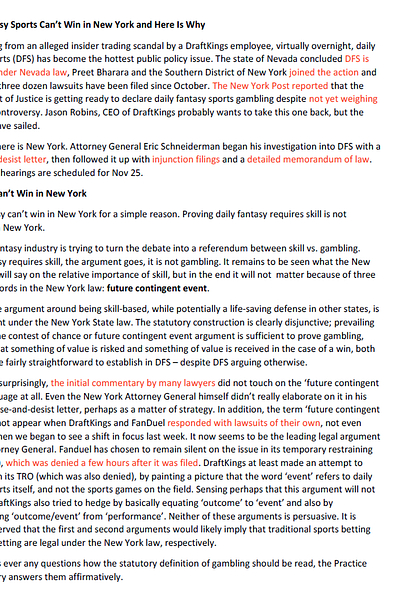
To me, that was the ball game. I wrote up the argument:
Now it needed a home and I had one in mind.
Rejected by Legal Sports Report
The controversy gave Chris Grove and Dustin Gouker no shortage of material. Their outlet, Legal Sports Report (“LSR”), was among those covering daily fantasy most closely, producing a steady stream of work on the unfolding dispute.
LSR seemed like the natural home for my argument.
I was not yet in a position to put my own name on it, so we followed the same blueprint we had used with the 2013 Supreme Court petition: I wrote the substance, and Chris Rabalais agreed to put his name on it.
On November 23, 2015–three days before Thanksgiving–he sent the piece to LSR. Grove wrote back the same day:
Good piece, well written, and I tend to agree with the analysis.
With that said, we’re going to pass because it’s tough for us to run external opinions on legal matters from non-lawyers.
I was appalled. I believed the piece made an important argument, and Grove appeared to agree. His explanation also struck me as difficult to reconcile with LSR’s own record: The site had published legal analysis by Jeff Hwang, who was not a lawyer either.
Whatever editorial line LSR was drawing, it did not appear to be as simple as lawyers on one side and nonlawyers on the other. The piece needed an audience. LSR could have given it one. Without LSR, it went almost nowhere.
The State Wins Round One
Two days after LSR rejected my piece, the lawyers gathered before Judge Manuel J. Mendez. The November 25 hearing focused heavily on the meaning of a “future contingent event” beyond the customer’s control or influence–the same language at the center of my analysis.
Kathleen McGee, arguing for the attorney general, spent most of her opening on that part of the statute. Unlike the fact-intensive debate over skill and chance, she argued, this presented a relatively clean question of law.
A customer could study statistics, build an algorithm, and select a roster brilliantly. None of that gave the customer control over how many yards an athlete ran, whether he fumbled at the goal line or whether he slipped on wet turf.
Judge Mendez appeared to be moving in the same direction. His first substantive intervention during the nearly two-hour hearing came as FanDuel emphasized the skill involved in selecting a roster. The judge’s response, in substance: The customer may possess the skill to select the players, but after that, the customer is “relying on someone else’s skill.”
He contrasted DFS with a hole-in-one contest, where the person paying the entry fee also takes the shot. The golfer controls his own performance. The fantasy customer does not. That was the cleanest path through the case. It also happened to be the argument I had written two days earlier.
On December 11, 2015, Judge Mendez granted the attorney general’s request for a preliminary injunction, barring DraftKings and FanDuel from accepting entries from New Yorkers.
For a few hours, the ruling sent a shockwave through the industry. An appellate judge stayed the injunction later that same day, allowing the companies to continue operating while they appealed. But the state had won the first round. There was, however, a problem with the victory.
New York law supplied two routes to gambling: a contest of chance or a future contingent event beyond the person’s control or influence. Judge Mendez had recognized the distinction at the hearing. Yet somewhere between the hearing and the written decision, the clean line blurred.
The decision cited both routes and concluded that the attorney general was more likely to prevail under the definitions of “gambling” and “contest of chance.” It never meaningfully developed the future-contingent-event analysis that had dominated the hearing. That provided DraftKings with another opening.
It was difficult for the company to argue that customers controlled or influenced the performances of the professional athletes they selected. It was much easier to demonstrate that assembling a successful fantasy roster required skill.
By allowing the dispute to remain framed as a contest between skill and chance, Judge Mendez had permitted the industry to play on its preferred field. As the case moved forward, David Boies continued making that argument publicly:

If Boies looked confident, there was a reason. He had compelling evidence on his side.
An analysis by Ed Miller and Daniel Singer (PDF), found that just 1.3 percent of DFS participants captured 91 percent of participant profits during the first half of the 2015 baseball season. Singer led McKinsey’s Global Sports and Gaming Practice.
The same small group winning repeatedly was powerful evidence that DFS involved substantial skill. That evidence did not prove DFS was not gambling. It proved that DFS involved skill. Those were not the same proposition. But once the case was framed as skill versus chance, the distinction became easy to miss. The public remained unconvinced. DFS looked like gambling. It sounded like gambling. People felt that it was gambling in their bones.
So who was right?
Both sides were. Boies was right that daily fantasy involved skill. The public was right that it was gambling. The mistake was assuming that those two conclusions could not coexist. The public’s intuition did not need to be discarded. It needed to be connected to the correct legal argument.
The Discovery
My November piece had identified the future-contingent-event argument, but it had not fully resolved the underlying contradiction.
The DFS industry’s position was simple: DFS was a game of skill; therefore, it was not gambling. But the New York Penal Law also covered money staked on future contingent events outside the customer’s control or influence. DFS participants created their lineups, but they did not control how the athletes performed.
The problem became clearer when I mapped out the possibilities.
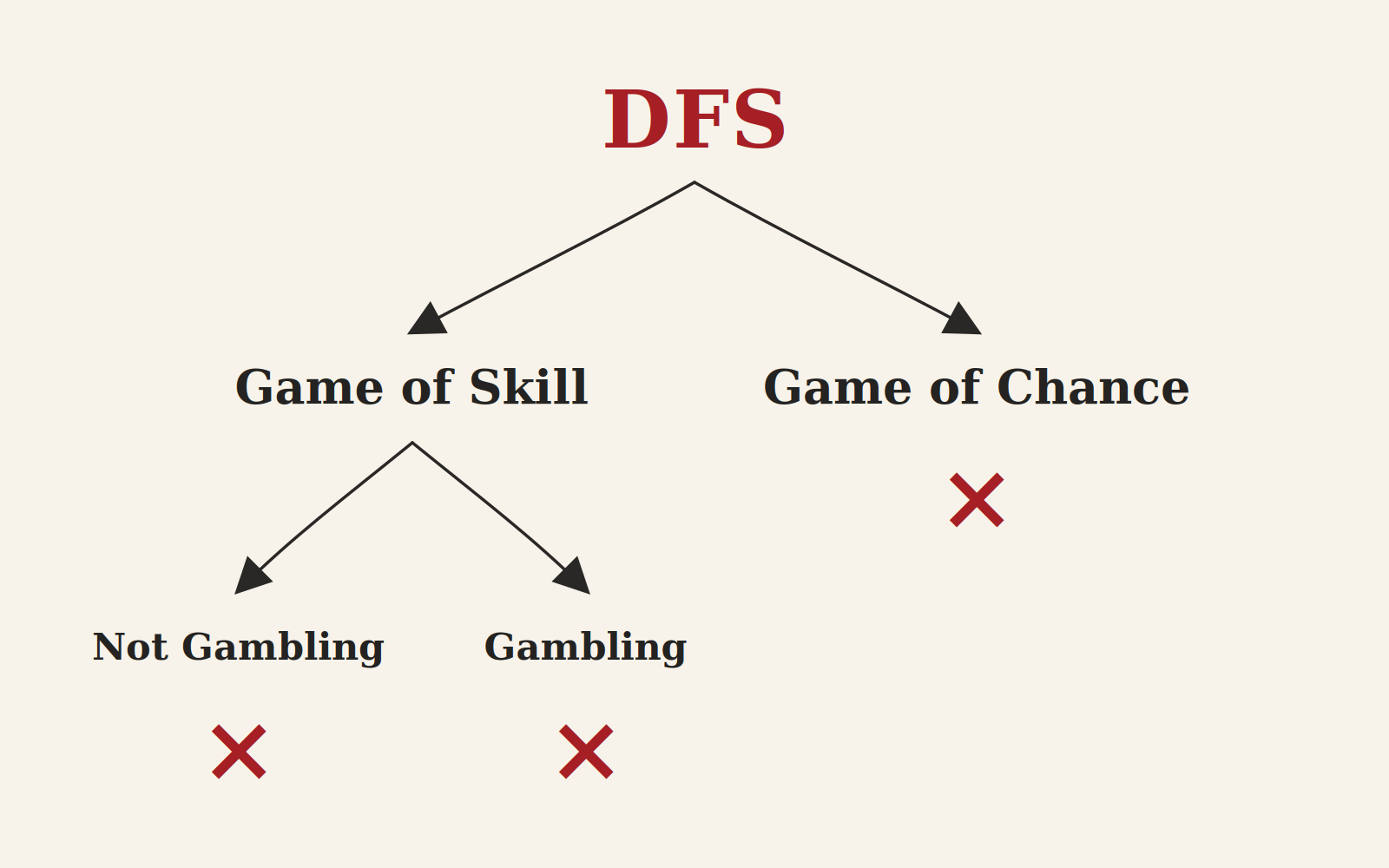
DFS could not comfortably be called a game of chance. The statistical evidence of skill was too strong. But calling it a game of skill–and therefore not gambling–created another problem. The same logic could provide an escape hatch for sports betting whenever the bettor acted skillfully.
If your response is “c’mon,” you have company. LSR didn’t hide how it felt about the issue:
A constitutional amendment to authorize sports wagering … [is] ... a lengthy process to be sure and one fraught with political pitfalls … The state could try to call sports betting “a game of skill,” so it can skirt the constitutional amendment requirement. That’s the tactic used to enact a daily fantasy sports law in 2016. (emphases added).
Seems far-fetched?
This very argument was presented to New York State lawmakers on January 24, 2018, by the New York Gaming Association. Later, Ted Leonsis would make a similar case, calling sports betting “a game of skill.”
I’m not sure the weakness of the argument was what kept it from gaining traction. When SCOTUS repealed PASPA, the state had another route to the same destination.
So here was the puzzle. Calling DFS a game of chance ran into the evidence. Calling it a game of skill that was therefore not gambling led to conclusions its own advocates seemed unwilling to accept.
The remaining possibility? DFS was simply skill-based gambling.
Dustin Gouker was a prominent advocate of that view. He made the case in a Washington Post piece and also discussed it with Dan Roberts on what appears to be a lost copy of the Sportsbook podcast. Fortunately I preserved the relevant portion of the transcript. He would make the argument again years later on a LSR podcast.
Jay Caspian Kang advanced a similar view in the New York Times. Even a DFS operator, Mondogoal, described its product that way.1
Intuitively, the compromise made sense. Legally, it was simply impossible, the law was foreclosing it. The usual comparison was poker. If poker was skill-based gambling, why couldn’t DFS be? But that comparison assumed the very point it needed to establish. Poker involves substantial skill, yet whether it qualifies legally as gambling depends on the governing law and how that law treats “chance.” Evidence of skill alone does not settle the question.
One federal court did find sufficient skill to conclude that poker fell outside the gambling prohibition it was applying. The Second Circuit reversed the following year on statutory grounds. That was hardly a clean foundation for a universal category called “skill-based gambling games.”
Nor did it answer the question that kept bothering me: If the category included DFS, why did so many of its advocates resist extending the same reasoning to sports betting? It was a very serious limiting principle problem.
Every available path seemed to end with a big red X.
I would soon encounter a Sherlock Holmes quotation on the wall of the local Mathnasium my children attended. It captured the process I had gone through perfectly:
When you have eliminated all which is impossible, then whatever remains, however improbable, must be the truth.
I had eliminated all of which was impossible. One untested assumption was the only thing that remained, which therefore became truth:
DFS is not a game.
With that, the sailor’s knot was untied.
Fantasy involves skill.
The studies were correct. I had known that since the day I drafted LT, TO and Brady. So what? That did not prevent it from being gambling.
The statute was not competing with itself.
The apparent contradiction came from treating DFS as a game in the first place. The skill evidence pushed the analysis away from the contest-of-chance provision, while the athletes’ future performance pulled it toward the future-contingent-event provision. Judge Mendez’s decision had left that tension unresolved.
If DFS was not a game, however, there was no reason to force it through the game-of-skill-versus-game-of-chance debate. The future-contingent-event analysis could stand on its own. That opened a larger question:
What about the rest of finance?
New York law lacked the express financial instrument exceptions found in some other states, including Illinois). Read broadly, its future-contingent-event language appeared capable of reaching options, futures and much of modern finance.
To me, that was a signal to look beyond state gambling law. Once DFS was understood as a market, the federal financial framework came into view. As federal commodities law expanded, part of New York’s provision began to look like a statutory fossil: language written for an earlier regulatory world, still on the books after federal law had occupied much of the territory it once described.
Dead leaves, waiting to be picked up.
The intuition that skill AND gambling could coexist was sound.
Of course they could. They had coexisted for decades. What I rejected was the attempt to resolve the legal problem of calling DFS a “skill-based gambling game.” Within the framework I was applying, that label preserved the very confusion we needed to escape. It also exposed the weakness in another argument: that the relevant event was the fantasy contest itself, rather than the athletes’ performances.
I never understood why that argument gained traction. Others, including Steve Ruddock, saw through it too. Once I stopped treating DFS as a game, the contingent events were easy to identify: the performances taking place on the field.
I do not remember the answer arriving in a flash. I worked through the possibilities until nothing else remained. It was a wonderfully rewarding intellectual process, and I would not trade it for anything.
But here’s the thing. You can ask questions nobody else is asking and, with some luck, reach conclusions nobody else is. In theory, that insight is gold. In practice, there may be a reason why nobody else is asking.
Was I really the only person capable of working through a straightforward decision tree? Absolutely not. This was not rocket science. The more likely explanation was that people did not think the question was even worth asking. Or, more cynically, too few had the incentive to ask it.
Now, I thought, that might change. New York wanted to win its case. Surely the state might welcome an argument that helped it do so. Solving the puzzle was the first step. To explain it, I needed an analogy. And, of course, a strong visual.
The Mars Test
Technical arguments can take you only so far. You can cite the literature on play and games. You can walk through the logic. But you still face a stubborn reality: Roughly 60 million people think they are playing a game. The companies offering them likely think they are offering a game. Even the courts begin by debating what kind of game it is.
An assumption left unchecked for decades becomes difficult to see, let alone challenge. A mistaken truth. I needed a way to make people look at it again.
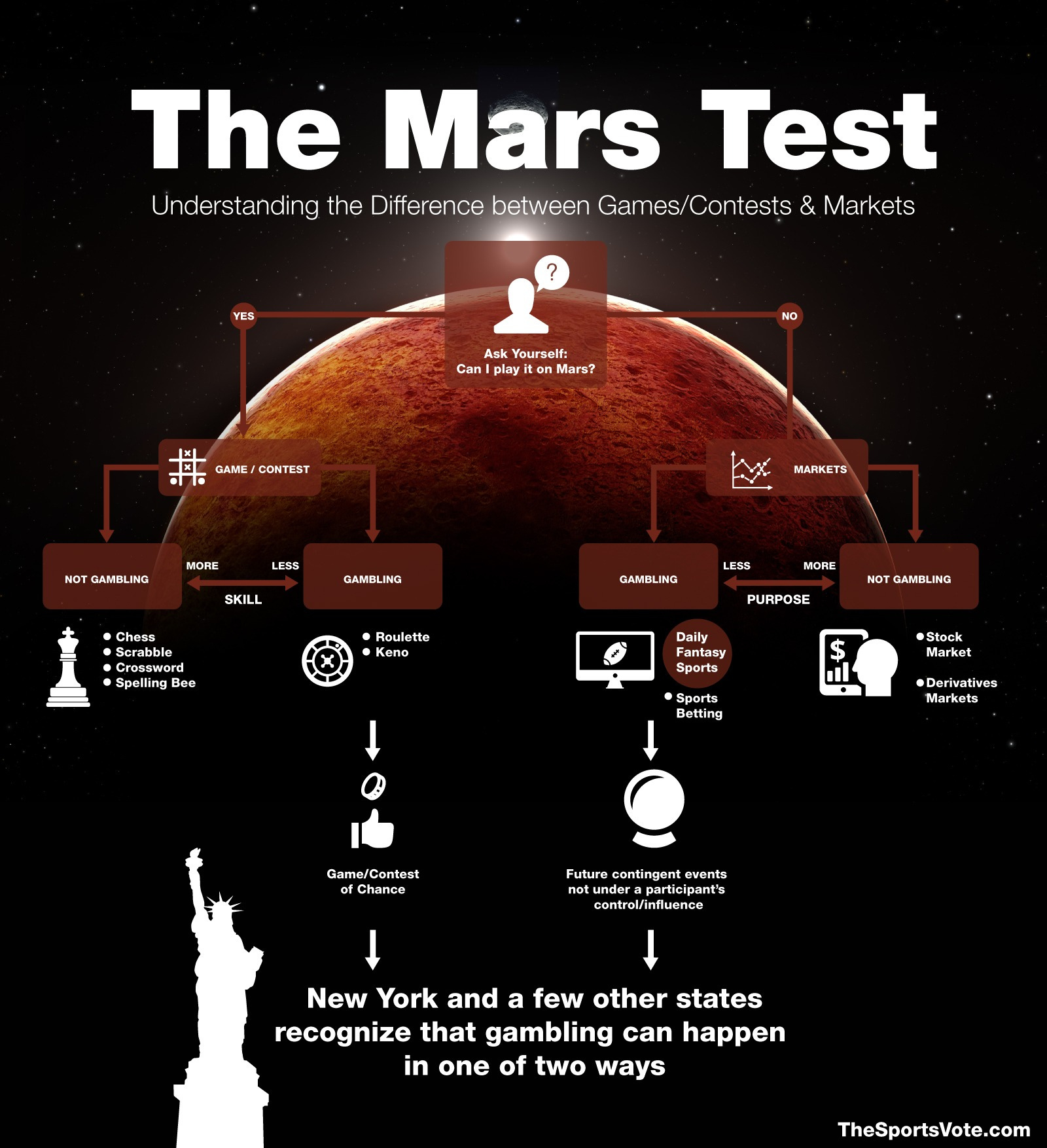
I found one in Elon Musk and his longstanding mission to colonize Mars. Put me on a spacecraft to Mars. Once we land we can play chess, poker, backgammon, basketball, Scrabble–you name it. We need the pieces, the cards, and/or the equipment. We need players and the game rules. What we do not need is a stream of results from unrelated events back on Earth. We are then able to determine who won by what happens within the game.
Now try playing fantasy football the same way. You can draft a roster on Mars. But without the results of football games played elsewhere, you cannot settle the contest. This very issue prevents this activity from being a game.
That was the distinction I wanted people to see. A game produces its outcome through play within its own rules. Fantasy sports takes the outcomes of several external events and uses them to determine who gets paid; that is not how you play a game.
You will not find the Mars Test in Black’s Law Dictionary. But the underlying distinction was familiar territory in the literature on play and games. (See Huizenga’s Homo Ludens or Caillois’s Man, Play and Games.)
I would go on to develop other tests, and each pointed me toward the same conclusion: DFS was not a game. It was a market built around transactions tied to future athletic performance–transactions I believed belonged within the federal futures and event-contract framework.
I did not have today’s generative AI tools to turn that idea into a visual. We found a graphics designer who would eventually produce this infographic:
Now I had a legal theory and a visual explanation.
I had never written an amicus brief, but I had written a Supreme Court petition, so I understood the general contours of the exercise. What I needed was a lawyer willing to get behind my argument.
An opportunity to make those connections came just a couple of months later.
The Symposium
By then, I was settled on my theory. When I saw DePaul was organizing a symposium near my home, and even closer to my office, I decided to attend.
One exchange between Dan Werly and Marc Edelman stuck with me. Edelman was doing extensive work on daily fantasy sports including a law review article based on his remarks at DePaul, amongst others. In all, three presentations became articles in the formal symposium issue.
He questioned the responsibility of DFS operators growing so quickly before the legal uncertainties had been resolved. Were they becoming too big to fail?
Werly dismissed the concern. Forcing the issue was a good thing, he argued. Otherwise, “we wouldn’t be here today.”
Careful conservatism, meet the move fast and break things philosophy. America has seen that contest many times, often with the latter approach winning out. It has also seen the disasters that can follow. Maybe, just maybe, my insight could help.
Is Wallach My Guy?
I had an unusual legal theory with the potential to change the “game.” What I did not have was a public voice in the debate. The practical next step was to find a lawyer who could help bring the argument forward. That could work for both of us.
Dan Wallach fit the bill. He had experience and was gaining visibility in the field. He also struck me as someone willing to follow the law wherever it led. We had begun exchanging emails before the symposium. He was certainly helpful, but did not want to serve as attorney of record for the amicus effort. When we met in person at DePaul, I hoped he might still review the brief and help me find a firm willing to represent us.
I wrote my amicus (PDF) draft and shared it with him. He kindly redlined it. I think he liked it. The subject line of his reply read: “Redlined draft -- not many changes at all (fantastic analysis).”
He worked hard to find a firm willing to take it on, but ultimately, nothing came together. The timing was short, and few attorneys were prepared to sign their names to an argument they had not written. Through other connections, I eventually got FisherBroyles to sign on. We had found our law firm but we had also missed our window–by a New York minute.
The Case That Never Was
Schneiderman had a strong case–and a preliminary-injunction victory–in his hands. But on March 21, 2016, he struck an agreement with DraftKings and FanDuel. The companies stopped accepting paid entries in New York. Schneiderman suspended his gambling claims while the appeal and legislative process played out. If Albany legalized DFS, those claims would disappear.
I do not think the significance of that decision by a single attorney general was fully appreciated then. I am not sure it is appreciated now. New York was a bellwether. Where New York went, the industry would follow. Yet the case was moving away from a judicial answer and toward a political one.
Our motion for permission to file the amicus brief appeared on the docket as denied. Why? I still do not know. Perhaps the court considered it moot after the agreement. Of the eight amicus briefs I have undertaken through several law firms–including my Supreme Court filing with FisherBroyles–this was the only one denied.
In an ideal world, the case would have continued, the brief would have been accepted, and a court would have confronted the underlying issue. Instead, the fight moved to Albany. DraftKings and FanDuel unleashed an intense lobbying campaign, even enlisting Jim Kelly and Vinny Testaverde for the final push.
The courtroom had not given DFS its answer, but the legislature was about to deliver it.
Goodell vs. Pretlow
I watched the entire Assembly debate, and one exchange stood out. Assemblyman Andy Goodell–cousin of NFL Commissioner Roger Goodell–took the “game of skill” argument through the same decision tree I had.
If skill meant DFS was not gambling, what about betting on horse racing? Serious handicappers study the horses, jockeys, track conditions, weather and mountains of data. Skill was plainly involved there, too.
Pretlow walked straight into the trap. If horse racing were invented today, he conceded, it “probably wouldn’t fall under this gambling.”
Goodell delivered the obvious response: New York’s Constitution expressly exempted horse racing precisely because its framers understood it to be gambling.
That was the moment.
The game-of-skill argument had reached its logically impossible conclusion–in public, on the Assembly floor–and it did not matter. The bill passed the Assembly 91-22 and then the Senate 45-17. Governor Cuomo signed it into law August 3, 2016. The contradiction remained. The votes were what counted. DFS was back in business.
The significance went beyond fantasy sports. DraftKings and FanDuel had demonstrated a political playbook: Build the business before the legal questions are settled, attract enough customers to make shutting it down politically difficult, and turn to the legislature when the courts threaten its survival. The debate over skill gave lawmakers a way to authorize the activity without calling it gambling. In my view, that was the larger victory. The industry could grow while the underlying legal question remained unanswered–a pattern that would repeat when nationwide sports betting arrived.
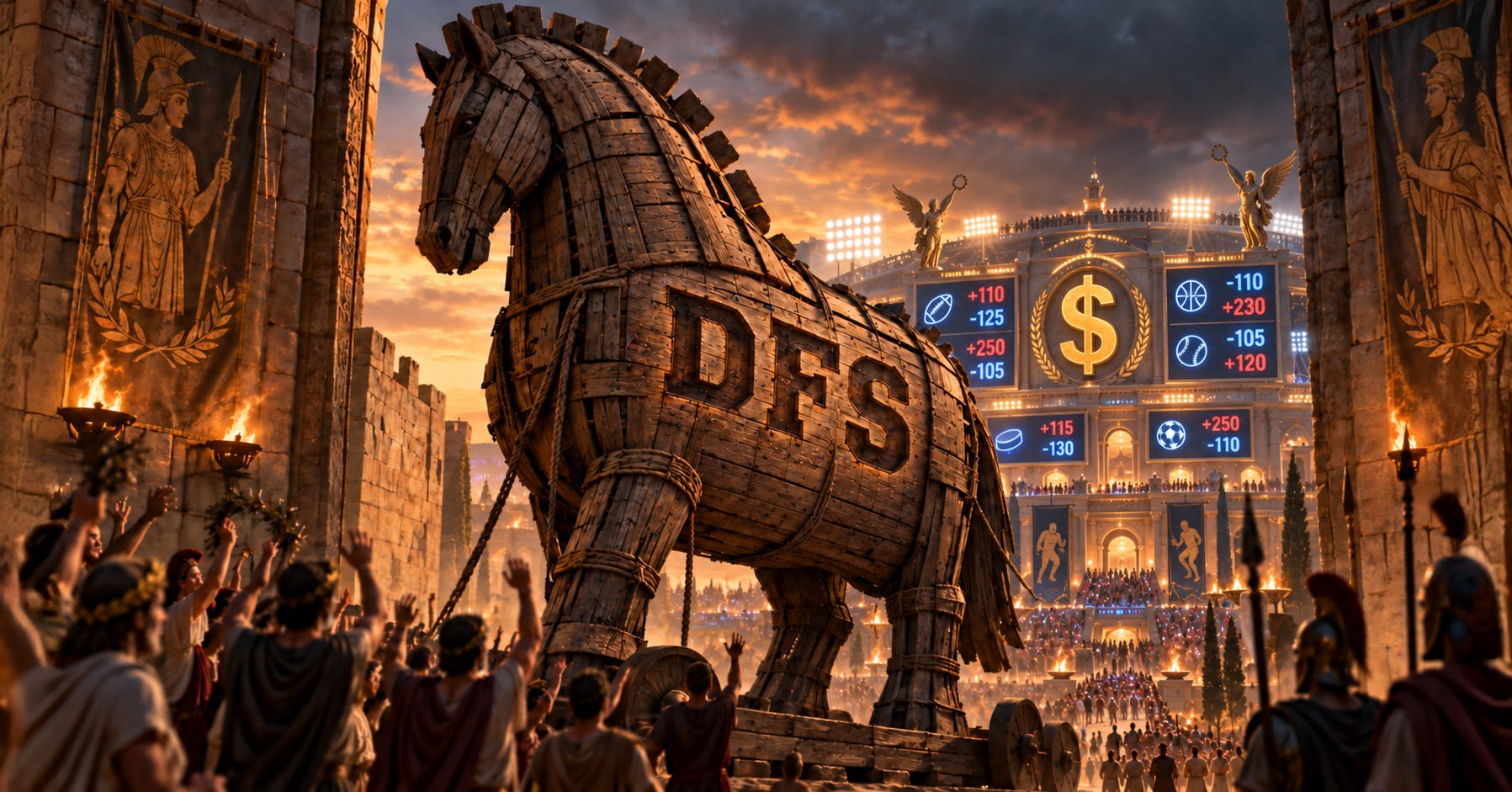
Daily fantasy sports was the Trojan horse. The larger prize was traditional, nationwide sports betting.
New Jersey Takes The Lead
While daily fantasy sports fought for legitimacy in New York, New Jersey was pursuing that larger prize. The state had lost its first challenge to PASPA, and the Supreme Court declined to hear the case in 2014. But Chris Christie was undeterred. New Jersey wanted sports betting and PASPA stood in the way.
On June 27, 2017, the Supreme Court granted certiorari.
I immediately saw the danger. The Court could strike down PASPA, everyone would interpret the decision to mean that sports betting belonged to the states, and a more fundamental question would go unanswered: Legally, what is a sports bet?
I had already asked the Supreme Court whether sports performance could constitute a commodity. After working through a similar question with DFS, the answer seemed even more clear. FisherBroyles signed on again, and on September 5, 2017, the New Sports Economy Institute filed an amicus brief in support of neither party. We put the issue directly before the Court:
Sports gambling contracts can potentially be characterized… as commodity [futures] contracts.
I may have been the only person making that argument in court (as an amicus), but the underlying insight was already out there.
In his 2016 New York Times examination of DFS, Jay Caspian Kang profiled Gabe Harber, a longtime DFS analyst and RotoGrinders host who had become increasingly critical of the industry. In a written statement to Kang, Harber put his finger on the problem:
In truth, D.F.S. is more like the stock market, with athletes instead of commodities.
Harber had the analogy exactly right. My argument followed it to its legal conclusion: DFS was not a game being played by its customers. It was a market built around transactions tied to future athletic performance.
The same reasoning extended to traditional sports bets.
Today, the popular narrative is that prediction markets and the CFTC recently invented this characterization to get around state gambling laws. They did not. The idea has been sitting in plain sight for years:

What changed was the argument’s commercial significance. Once billions of dollars began turning on the answer, an overlooked legal theory found a powerful constituency.
Nor is it true that the issue was never presented to the Supreme Court. The docket shows otherwise. Our brief expressly argued that sports-gambling contracts could fall within the federal commodities framework.
The Court did not address that argument when it struck down PASPA in 2018. That is very different from saying nobody raised it. Reasonable people can disagree about whether federal or state law should ultimately control. That is a legal debate worth having.
But we should, at minimum, begin with the correct history: The argument was made. It was made directly to the Supreme Court. And it was there long before prediction markets had billions of reasons to rediscover it.
The Supreme Court Speaks. But What Did It Say?
I will not belabor the Murphy decision here. It was enormously consequential–but, in my view, much of what followed rested on a misunderstanding of what the Court had decided. The Court invalidated one federal law. It did not erase three:

PASPA: Gone.
The Wire Act: Still on the books.
The Commodity Exchange Act: Still on the books.
The Court had opened one door. The states rushed through it as though the entire building was theirs. But the Wire Act continued to constrain interstate sports wagering, and the CEA still raised a separate question: Were sports bets contracts within the federal derivatives framework?
One agency could have forced that question into the open. The CFTC chose not to. That omission is what brought us to where we are today. But first, let us return to daily fantasy sports because that fight was not over.
Back to DFS
Legalization had not ended the DFS story.
On October 5, 2016–exactly one year after the Haskell story appeared in The New York Times–four New York residents sued the state. Their argument was straightforward: The New York Constitution prohibited gambling, and the Legislature could not authorize DFS without first amending it.
The reversal was remarkable. Just one year earlier, the state had taken the DFS operators to court. Now, after changing the law, the state was being taken to court by its own residents. And they were winning. The trial court declared the authorization unconstitutional in 2018, and the Appellate Division largely agreed in 2020.
Maybe my amicus was not so dead after all.
When White v. Cuomo reached New York’s highest court, I returned to the argument–this time with the Parlatore Law Group. Our brief was accepted (PDF). It also drew a separate response (PDF) from the state devoted entirely to its arguments.
The case moved in fits and starts. COVID slowed the appeal. Judge Michael Garcia recused himself, leaving the Court of Appeals with six judges and, apparently, a 3-3 split after the first argument. The case had to be argued again. By then, the industry had largely moved on. But I still hoped that the slow-turning wheels of justice might finally resolve the contradiction at the center of DFS.
Then, during oral argument, the residents’ lawyer faced a difficult question. For a moment, the opening I had been waiting for appeared.
“I’m Not Sure You Want to Go Down That Road”
October 5, 2021. What is with that date and DFS?
The residents’ counsel was stuck. The judges wanted to know why stock trading was not gambling under his theory, while DFS was. He had no clean answer.
To me, the way out was the same one I had identified years earlier: Stop treating DFS as a game.

DFS was a market. Viewed through that lens, skill was no longer the dividing line.
Building on that insight, our amicus brief focused on economic purpose: the distinction between markets that facilitate functions such as hedging and price discovery and those that exist principally as vehicles for speculation.
Without naming us, counsel referred to our brief and began focusing on economic purpose.
The court cut him off:
I’m not sure you want to go down that road. I mean, there are plenty of people who think that entertainment is a valid public purpose.
The state wanted no part of that framework either. In its response to our brief, it argued that “there is no support for the proposition” that an activity must serve a public interest beyond entertainment to avoid being gambling.
There was. You just had to look outside the four corners of state gambling laws. And to do that, you had to first acknowledge that you weren’t dealing with a game in the first place.
Of course entertainment can be a purpose. But the economic-purpose inquiry we raised under the Commodity Exchange Act asked something more specific: Did the contract perform a recognized market function?
Whether people enjoyed the product did not answer that question. The majority did not follow us down that road. It upheld DFS as a skill-based competition without confronting the market framework we had presented (opinion). But the dissent came remarkably close:
[T]he common understanding was that investments in stocks and commodities—regardless of the risk or skill involved—were simply not gambling because of a societal judgment about the nature and utility of those activities and their importance to a flourishing market economy.
Exactly. Purpose mattered. But again, to make DFS subject to that inquiry, DFS had to stop being a game.
The dissent recognized the distinction. To me, it stopped just short of what followed from it.
Where We Are Today
Parlays dominate.
Threats against athletes are rising.
Sportsbooks are using AI to identify the customers most vulnerable to gambling harm.
Growth at all costs appears to be the industry’s dominant strategy.
Sydney Sweeny gets the headlines, but almost nobody addresses the underlying issue.
How, exactly, did we get here? Now you know. It began with one assumption that virtually nobody bothered to examine: That fantasy sports was a “game.”
If nineteen years in public accounting taught me anything, it was this:
Assume nothing. Question everything.
I did, and every road led me to the same conclusion: Fantasy sports is not a game.
That may sound crazy. But treating it as a game kept producing contradictions, dead ends and distinctions that could not survive their own logic. To me, rejecting the conclusion is crazier than accepting it.
But when logic collides with the media, the courts, and the state, logic does not always win. Gatekeepers keep the gates. Daily fantasy sports was the Trojan horse, and it was welcomed inside.
What emerged was not fantasy. It was sports betting.


Daniel Barbarisi, Dueling with Kings: High Stakes, Killer Sharks, and the Get-Rich Promise of Daily Fantasy Sports, p. 78.