

Monday, May 14, 2018. I remember the day like it was yesterday.
I had just departed from Chicago en route to Los Angeles, midway through a four-month grind that had become my new normal. PwC had transferred me to the LA office earlier that year, but I had refused to uproot my kids in the middle of the school year. The compromise: Monday-Thursday in LA, Friday-Sunday back home. Repeat. For months.
If you’ve ever lived that life, you know the truth–it’s not glamorous. It’s exhaustion disguised as productivity. Mondays meant 6 a.m. flights out of O’Hare, which meant waking up at 3:30 a.m. Central. Land in LA, head straight to the office, work a full day, collapse in a hotel room. By Thursday, I’d finally feel human again… just in time to fly home and reset the cycle. You get the picture.
So on that fateful Monday, three months into the grind and nearing the finish line, I shifted in my seat, ready to grab a quick nap.
Then this popped up on my screen:

Sleep was no longer an option. My travel grind may have been ending, but the fight over sports gambling was just beginning.
The First Questions
Two thoughts hit me immediately.
First: What was the final tally?
Second: Did the Court consider the argument I had raised–that sports bets are commodity futures contracts and fall under CFTC jurisdiction?
When I finally read the opinion, the answers were clear:
6-3.
No.
Unsurprising but still disappointing.
Correcting the Record
There’s a persistent myth floating around that no one ever told the Supreme Court that sports gambling falls under federal jurisdiction.
That myth is demonstrably false.
These posts are the detailed play-by-play:
Backdooring Sports Gambling is Precisely What Congress Wanted to Prevent

A fundamental inaccuracy has been making the rounds, and it’s time we set the record straight.
Federal Preemption Has Been Barking For Years: Is Kalshi’s Latest Setback in Nevada Justified?

The full decision has dropped in Nevada (dissolution of Kalshi’s preliminary injunction) and it’s a doozy.
But here’s the TLDR version:
The Supreme Court was aware, or should have been aware, that the CEA covers sports bets. We know this because we told them.
Can We Be Friends?
An amicus brief is also known as a “friend-of-the-court” brief. The idea is to bring a novel perspective to a case that the court might find useful, especially if neither party is bringing it. So this was the amicus I drafted in consultation with FisherBroyles:
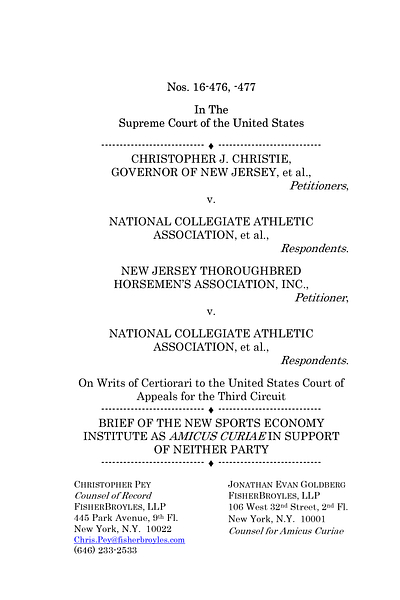
How does a tax consultant end up ghostwriting an amicus brief to SCOTUS on how the CEA impacts sports gambling? All good stories must be told and that’s exactly what we are doing in our upcoming book: Predictable. For now, let’s get back to the brief.
One of the questions I posed was:
Without a doubt, the CFTC has jurisdiction over political and box office contracts. Why should sports gambling be any different?
To our best knowledge, no one on the states’ rights side has ever answered that question. Not then. Not now.
The argument that “states have historically regulated sports betting” is misplaced. Just under ten years ago, Nevada was the lone exception. A few other states had largely irrelevant variations, but no betting on single-game outcomes. If states can claim jurisdiction over sports contracts, what stops them from claiming jurisdiction over election markets or weather derivatives? That’s precisely the kind of fragmentation that led Congress to create the CFTC to prevent.
SCOTUS didn’t engage with our amicus brief (PDF), but one former prosecutor and adjunct law professor did:
Finally got around to reading your amicus brief in Christie v. NCAA. Novel and clever. Well-done. I fear the Court may not grasp what you’re saying, but it won’t be because it’s not well-said.
We appreciated the compliment. And frankly–we believe the Justices would have understood had they truly chosen to engage. Sometimes even brilliant minds choose not to go there.
That choice had consequences. It jumpstarted what is now a $157-billion-a-year industry whose legality has been in doubt from day one. Today, the very federal vs. state conflict we raised almost a decade ago is being litigated in close to 40 cases.
The Key Question Everyone Got Wrong
Did SCOTUS pave the way for states to legalize sports gambling?
At the time, the universal answer was yes.
→ CNBC said it.

→ Legal experts concurred:

With the CBS legal analyst opining:
The ruling allows the states, if they want, to allow their citizens to engage in sports gambling. Any team, any time they want.
→ Maps were drawn:
CNBC continued its coverage the next day, adopting the same state-by-state legality view:

→ The AGA cheered:
Sara Slane, then senior VP for Public Affairs at AGA, was a staunch states’ rights advocate, insisting both sports gambling and casino gambling belong to the states:
States have been regulating that kind of activity, including state lotteries and slot machines, for decades, said Sara Slane, senior vice president for public affairs at the American Gaming Association, an industry group.
Sports betting, Ms. Slane said, “is going to require the same sort of rigor that’s been in place for the past fifty years.”
Yes, the same Sara Slane who now argues the exact opposite:
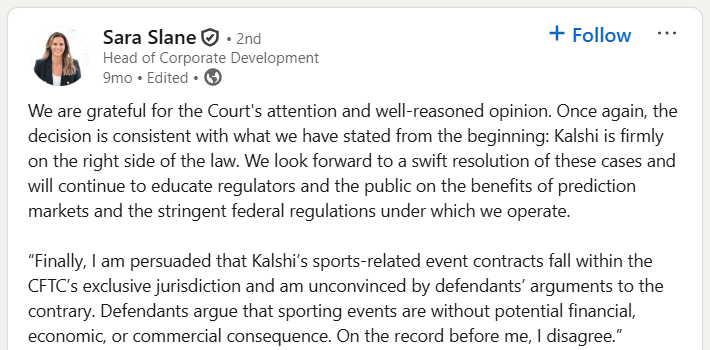
Is Kalshi on the right side of the law? No.
Kalshi’s Gambit: The Bet That Could Break Sports Gambling

Last week, we dismantled the notion that the “sports-is-a-commodity” theory (or, alternatively, the “sports-event-contracts-are-swaps” theory) was some post hoc invention by Kalshi–an argument that came out of left field. Instead, we argued that this idea has been lurking in the background all along.
But the CFTC jurisdiction?
Yes, that’s what we said back in 2017.
What Murphy Actually Did–And Didn’t–Do
Murphy did one thing:
It held that Congress cannot commandeer state legislatures.
That’s it.
Murphy did not:
Legalize sports betting
Bless state wagering regimes
Convert illegal contracts into legal ones
Address the Commodity Exchange Act
Dismantle federal gambling laws
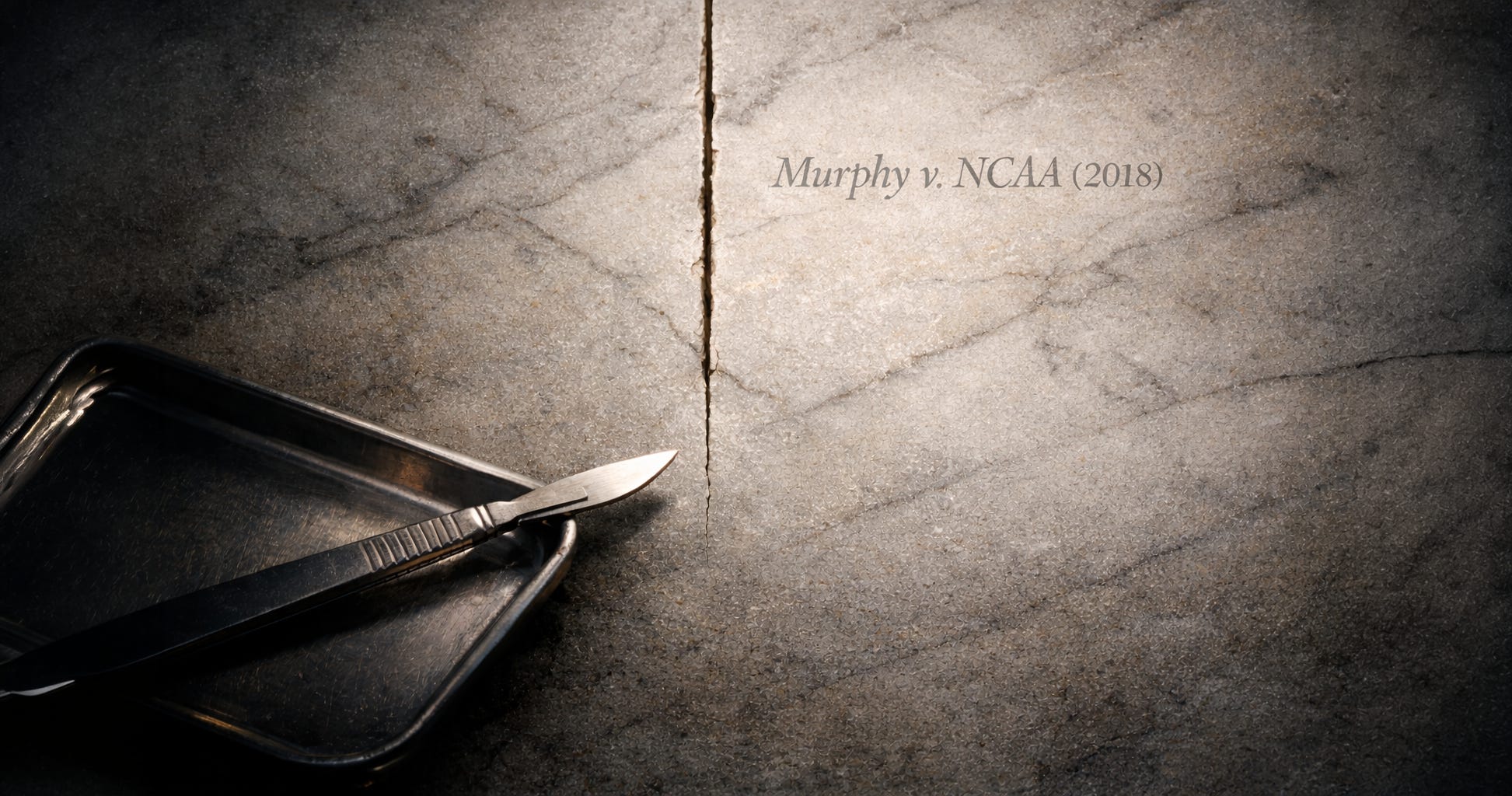
It was a scalpel, not a bulldozer. A narrow constitutional incision, not a regulatory overhaul.
States rushed in anyway—not to ask whether sports gambling was legal in the first place, but to monetize it.
Licensing replaced analysis.
Revenue projections replaced doctrine.
And the judiciary silence coupled with the regulatory vacuum created by the CFTC’s inaction enabled a very dangerous situation. Silence and inaction were mistaken for permission.
This is not how law works. Or at least, not how it’s supposed to work.
Why It Happened
If you’re wondering how something this big could be missed, the answer is incentives, as usual. The incentives are what led to an epic misinterpretation of Murphy:
SCOTUS didn’t need to address the CEA to resolve PASPA.
The CFTC didn’t want the political costs of stepping into sports gambling and chose to be silent.
States joined in on the gold rush and collected the tax revenue.
Leagues wanted the new revenue streams.
Consumers wanted to gamble.
When every incentive points in the same direction, critical thinking rarely stands in the way.
Laws aren’t ignored because people wake up one day and choose lawlessness.
Laws are ignored when powerful incentives collide with the checks and balances meant to reign them in–and nobody wants to be the beat cop that steps into that line of fire.
Where Do We Go From Here?
Two key questions remain:
Did SCOTUS pave the way for states to legalize sports gambling?
Short Answer: No.
We’ll unpack the technicalities in future posts, but the core point is simple: Murphy made a narrow constitutional cut. The broader jurisdictional and regulatory structure remained intact.
The bigger question–the one no one has answered is:
Who’s really going to have the public’s best interest at heart?
Who will have America’s back?
Murphy is unfinished business. The issue will return to the Supreme Court, and this time, a narrow ruling won’t be enough.
A scalpel won’t cut it.
A bulldozer will.