


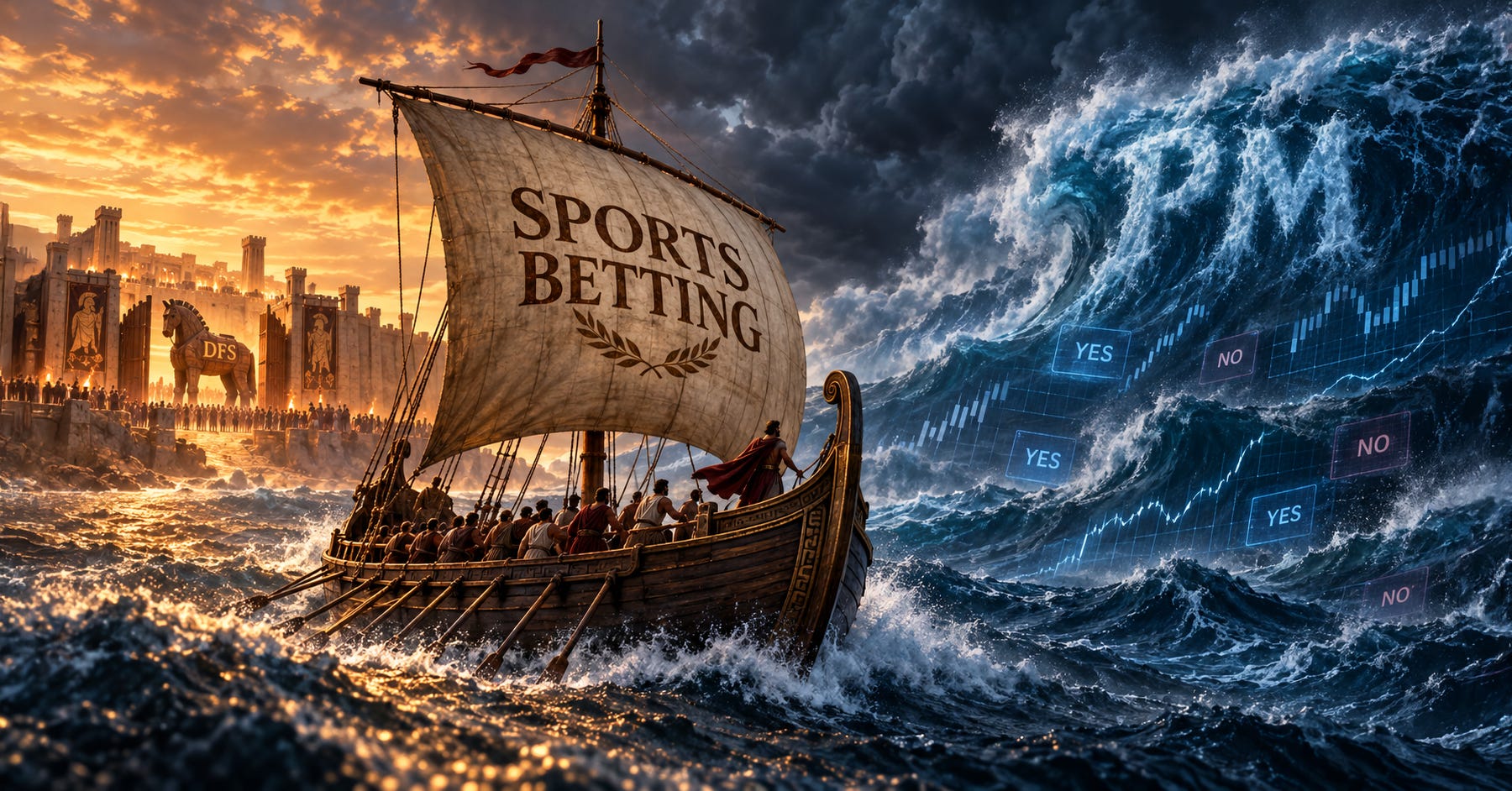
The Horse Got Them In
You may know the story of the Trojan Horse. It got the Greeks through the gates of Troy, but winning the war was not the same as making it safely home. Odysseus escaped the Cyclops, then couldn’t resist taunting him–and invited the wrath of Poseidon. Ingenuity saved him. Hubris nearly destroyed him.
I cannot help wondering whether state-regulated sports betting will follow a similar arc.
I argued last week that daily fantasy sports was the Trojan horse that helped get sports betting through the gates. Once inside, the industry flourished. But it may have become too confident in the permanence of its victory–and too dismissive of what was gathering outside.
Prediction markets may now challenge the legal assumptions that made that victory possible. No gods are required this time. Just economic incentives and good old-fashioned, ruthless capitalism.
Let us begin with a horror scenario whose full implications the sports-betting industry may not yet appreciate.
The Sportsbook Horror Story
The Supreme Court has three prediction-market petitions before it:
Flaherty v. KalshiEX, LLC, No. 26-299–petition filed September 2, 2026.
Robinhood Derivatives, LLC v. Dreitzer, No. 26-338–petition filed September 10, 2026.
North American Derivatives Exchange, Inc. d/b/a Crypto.com v. Nevada, No. 26-344–petition filed September 11, 2026.
Now imagine the following:
The Court agrees to hear one or more of these cases during its 2026-27 term. The outcome is anybody’s guess, but suppose it rules that state gambling laws cannot prohibit sports event contracts offered on federally regulated exchanges.
Soon afterward, an opportunistic prediction market brings a legal challenge to state-regulated sportsbooks, a state, or both.
Its argument is simple: If a contract paying money based on the outcome of a sporting event is a federally regulated derivative when traded on an exchange, what makes the instrument sold by a sportsbook materially different? DraftKings accepts money today in return for a contingent payment determined by a future sporting event. Call it a bet if you like. The Commodity Exchange Act may call it an off-exchange swap.
That is the sports-betting industry’s horror scenario and it certainly deserves more attention.
Is This a FIFO Story?
I never particularly liked my undergraduate accounting class, but it gave me one memorable phrase: first in, first out (“FIFO”). It is an inventory valuation method that treats the first items purchased as the first sold.
The analogy is not exact. Daily fantasy sports came first; sportsbooks are the business at risk in this scenario. But the idea of an earlier arrival being pushed out by a later one is hard to miss.
Daily fantasy sports helped create the possibility of nationwide legal sports betting (state-dependent). Sports betting then helped create the commercial demand, customer base, and political conditions in which sports prediction markets could flourish.
And prediction markets may now push sportsbooks back out.
The “Win Either Way” Illusion
DraftKings CEO Jason Robins believes his company is protected regardless of what the Supreme Court does. As he put it:
It’s funny, if you ask me: I’d rather see them stay, but if they got shut down by the Supreme Court tomorrow, our share prices would pop. We’re in a good position either way. We’re set up regardless of the outcome.
To that I say: Be careful what you wish for.
Robins expressed a similar view in an onstage conversation with Dan Roberts of Front Office Sports, around the 8:18 mark:

Here’s how he sees it:
But importantly, we also, and this has been a core part of our strategy, have to make sure we are well positioned either way. And we like to think we have put ourselves in that spot where prediction markets goes away, we’re still very well positioned just as we were before all this. And if it continues, we are well positioned to be a big beneficiary of the growth of that new industry.
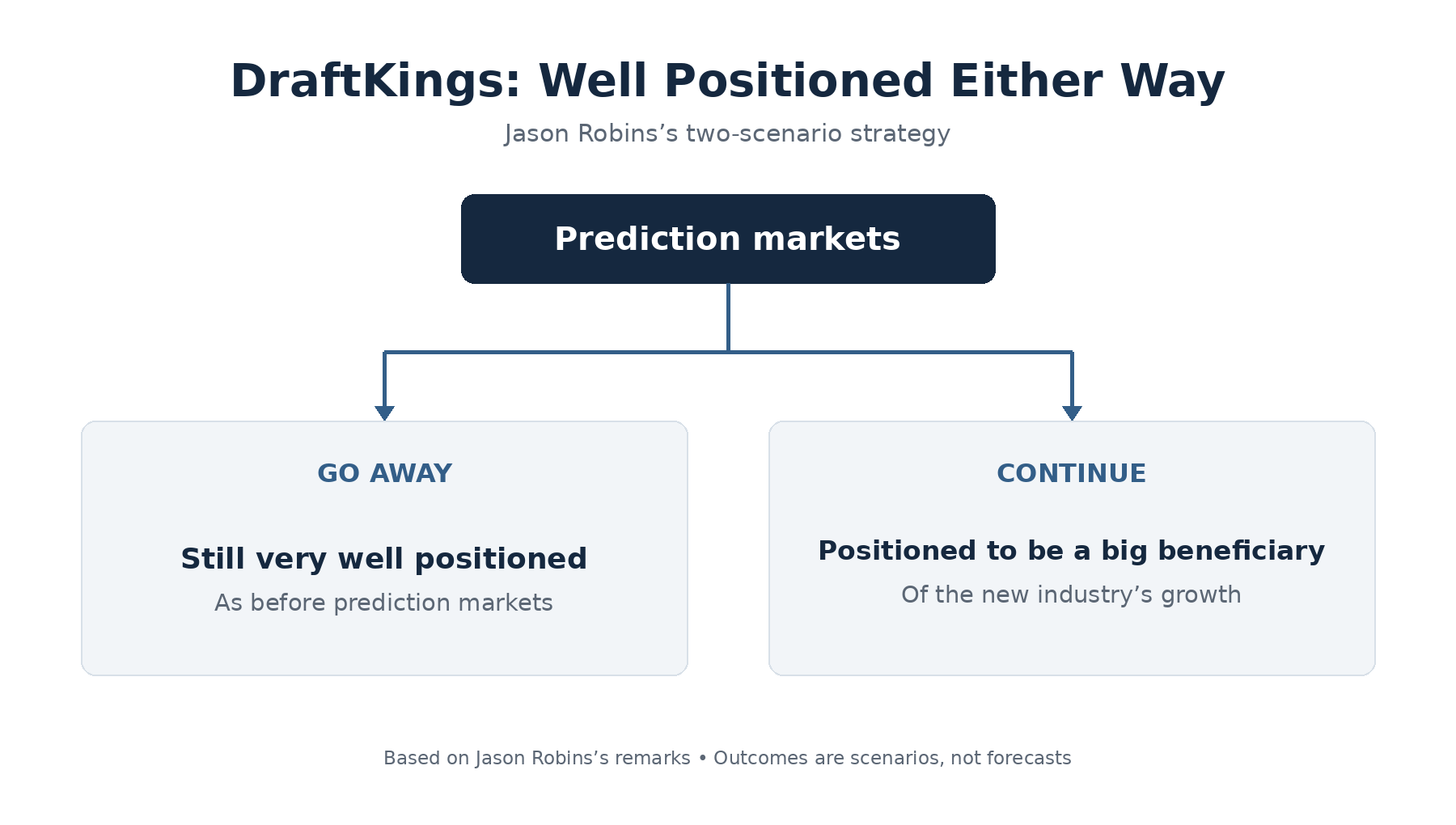
Sounds like a straightforward scenario analysis, doesn’t it? From his perspective, DraftKings wins either way. If sports event contracts survive, DraftKings has its own prediction-market business. If they disappear, a competitor to its sportsbook disappears with them–even if Robins stops short of describing it that way.
Robins acknowledges that he cannot control which outcome will materialize. In the interview, he says the predictions business is growing fast and DraftKings is approaching a double-digit share in sports. That early growth presumably gives him reason for confidence.
His analysis, and the steps he has taken, seem reasonable at first glance. But the second branch does not end there. Let me extend it by adding the horror scenario outlined above. Just one additional future step…
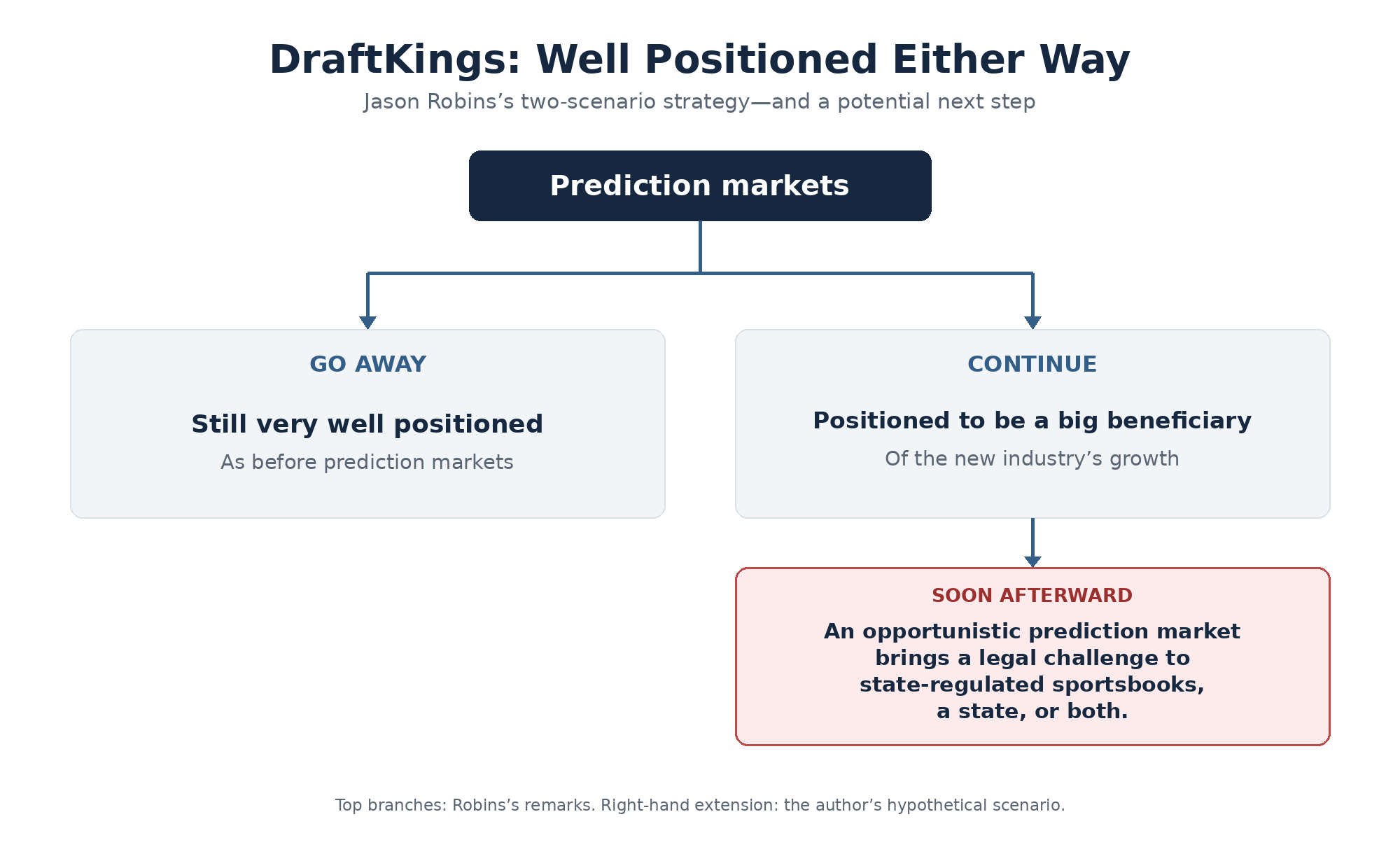
This looks quite different now, doesn’t it? If that challenge materializes, DraftKings finds itself in litigation once again.
The company survived the first wave of challenges to daily fantasy sports while defending the product as a game of skill. I have argued that this description rests on a mistaken premise. It did involve skill. A game it was not. But what doesn’t kill you makes you stronger, and surviving a challenge can make that assumption seem even stronger.
This time, I’m not sure DraftKings can repeat that success, no matter how much money it throws at the fight.
Robins is conflating being positioned to compete with being protected from legal risk. He should also consider what could follow a SCOTUS victory for prediction markets: a legal challenge to DraftKings’ sportsbook business that those markets may then have more incentive to pursue.
Congress Didn’t Write Half A Sentence
The statutory detail deserves its own post, but the central point is simple: The federal framework does not stop at designated contract markets. Reading the full provision raises both the preemption question–whether states can regulate contracts on federally regulated exchanges–and what I call parallelism: whether competing sports wagers can lawfully remain outside that framework.
A ruling protecting exchange contracts would not, by itself, resolve the status of sportsbook wagers. That would require a further legal argument. But what distinction would sportsbooks rely on?
Where Is the Sports-Bet Exception?
The structural differences between a sportsbook and a peer-to-peer exchange are real; I examined them in my Ph.D. dissertation. The question here is whether federal law gives those differences the legal significance sportsbooks would need.
Prediction markets’ petitions point to 2012 guidance from the CFTC and SEC (PDF) addressing consumer and commercial transactions, rather than an express statutory sports-bet exception. Whether that guidance can carry the weight placed on it deserves its own post.
Here is the ultimate irony: Some of the arguments DraftKings, and other state-regulated sportsbooks, might reach are already being made by prediction markets.1 Those markets currently have every incentive to argue why the sportsbook wagers are legally different from their own contracts.
“Currently” is the operative word.
The Real Shrewdness of Prediction Markets: Restraint
A narrative has taken hold in commentary, and sometimes in judicial reasoning, that prediction markets discovered federal preemption and engineered a clever escape from state gambling laws. But the idea has been around for a long time. As I have argued before, treating it as a new discovery requires overlooking quite a bit of recorded history:

The real shrewdness of prediction markets, in my view, is restraint: seeking protection for federally regulated exchanges without asking courts to decide what the same federal framework might mean for state-regulated sportsbooks. Keeping a case narrow is often a sensible litigation strategy. Here, there is an additional benefit: asking for more could get you less.
Protecting an exchange from state gambling laws is one thing. Advancing an argument that could undermine an established sportsbook industry is another. States have licensed businesses, companies have invested, and customers have placed hundreds of billions of dollars in bets. Those consequences do not settle the statutory question, but they give opponents a powerful argument against the broader reading–and courts a reason to look for a narrower path.
Before a Supreme Court ruling, prediction markets therefore have an incentive to insist that their contracts and sportsbook wagers are legally different.
Now assume they secure a favorable ruling. The incentives change. Once their own position is protected, emphasizing the similarities could become more attractive than defending the differences. The question shifts from “Why can’t we offer these contracts?” to “Why can they offer theirs?” The subsequent challenge would still have to succeed on its own merits, but the commercial incentive to bring it would be considerable, and it takes only one prediction market–including a new entrant that never argued otherwise.
Restraint before the ruling is no assurance of restraint afterward.
Sportsbooks may then find themselves reaching for the very distinctions prediction markets are advancing today.
And to their horror, they may not like what they find.
Is This All Priced In?
Robins rejects the idea that prediction markets explain the pressure on DraftKings’ share price, but the stock’s performance raises a question about what investors do see. Here is the TradingView chart as of the close on September 30, 2026:
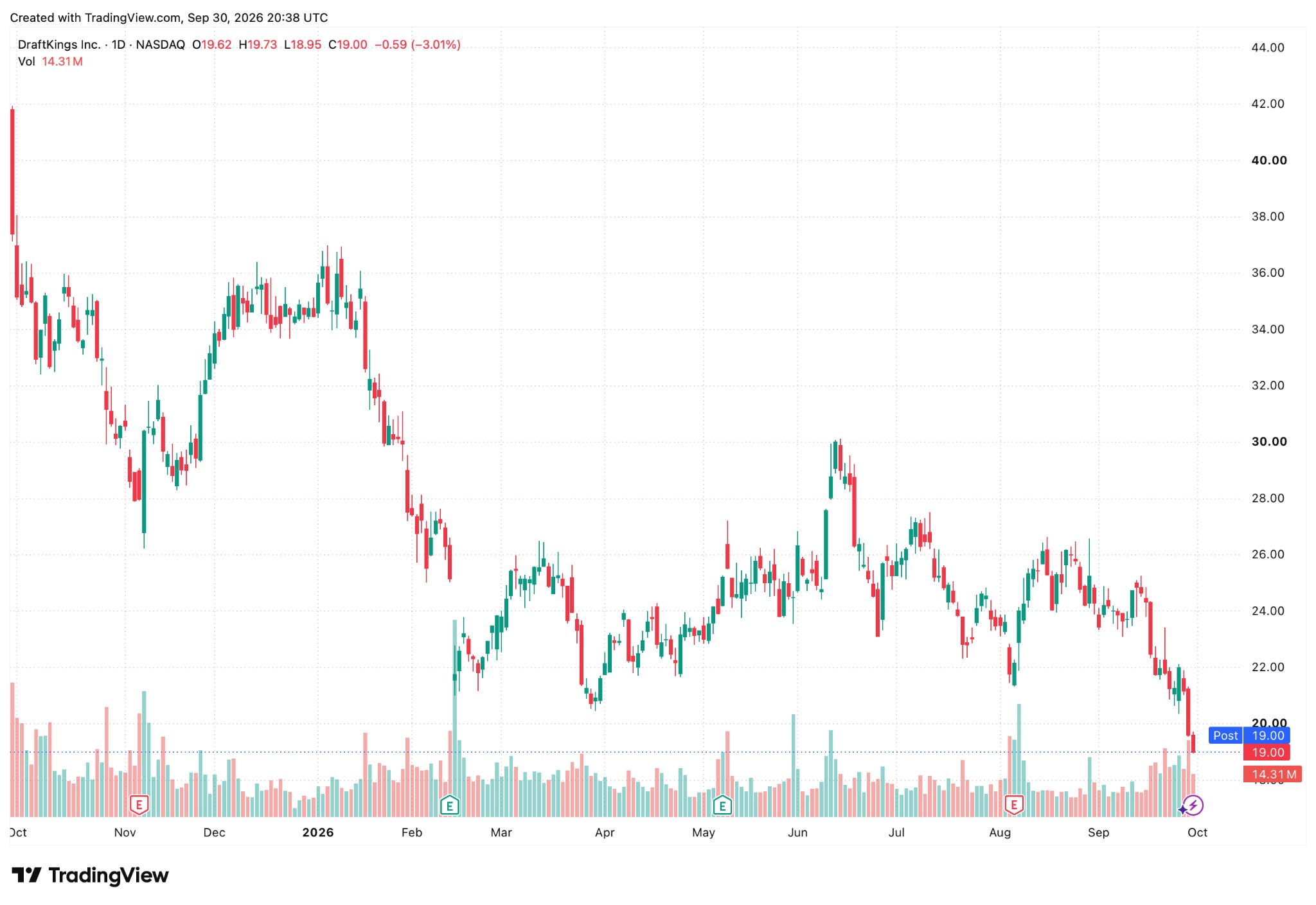
About $19 a share, clearly in a downtrend and a level not seen since early 2023. Is the market seeing something that Robins doesn’t? What risks are investors pricing in?
The chart alone cannot tell us. Competition from prediction markets may be part of the story, alongside other factors. But losing customers to a competing product is a different risk from facing a challenge to the legal foundation of your sportsbook business.
The scenario outlined here requires several things to happen: The Supreme Court takes a case, prediction markets secure a favorable ruling, and someone brings, and ultimately wins, the broader challenge. That could take years. Yet a company’s valuation reflects expectations about cash flows far into the future, in fact, into perpetuity. A distant risk can still matter today, depending on its likelihood and potential impact on cash flows.
Perhaps investors already contemplate that possibility. Perhaps they are more narrowly focused on competition for market share. Owning a prediction-market business may help DraftKings respond to either risk, but can it offset the loss from the sportsbook business should that scenario play out?
“Well positioned either way” leaves that view in question.
What Have Investors Been Told?
There is another potential consequence: a dispute over what was actually disclosed to investors. I have not reviewed DraftKings’ disclosures to this point, so I cannot say whether they address this scenario. But Robins’s “well positioned either way” framing raises a question worth investigating: Does the company describe prediction markets only as a competitive threat, or does it also contemplate a challenge to the legal foundation of its sportsbook business?
Those are different risks. One concerns losing customers and revenue; the other concerns whether the company can continue offering the underlying product. If the second scenario materializes, investors may question whether it was anticipated, how it was assessed, and what was communicated to them. How would Robins’s public confidence look alongside the company’s formal discussion of those risks?
The possible consequence is another round of litigation–this time involving investors. Whether any such claim would have merit is a separate question.
Full Circle
Victor Rocha, conference chairman of the Indian Gaming Association and publisher of Pechanga.net, has been outspoken in his opposition to sports prediction markets. Consider this warning:

His warning that Kalshi could lose sports captures just one side of the story, the left-branch scenario in Robins’s analysis.
But what if Kalshi keeps sports–and a prediction market then challenges sportsbooks’ right to offer theirs?
Daily fantasy sports helped open the door to nationwide sports betting. Sports betting helped build the customer base and commercial demand that prediction markets now serve. Each arrival helped create the conditions for the next. The last entrant may now challenge the legal assumptions supporting those that came before it.
That outcome is neither immediate nor inevitable. But today’s incentive to distinguish exchange contracts from sportsbook wagers may yield to tomorrow’s incentive to emphasize their similarities. It takes only one challenger.
What is DraftKings without sports betting?
“Well positioned either way” is a confident answer to a different question.
The industry opened the door. Its successor may show it the exit.
First in, first out?

This essay presents legal and economic commentary, not legal, financial, or investment advice. The scenarios discussed are hypothetical, not predictions or recommendations to buy or sell any security. As of publication, I hold no position in DraftKings (DKNG), including options or short positions.

See Robinhood’s petition (PDF) and Crypto.com’s petition (PDF).