



High school sports betting might be coming to America.
I know what you are thinking.
“Have you lost your mind?”
“That will never happen.”
“Did you even see the CFTC’s Notice of Proposed Rulemaking (‘’NPRM’’)?”
No, maybe, and yes. Just hear me out.
The Federal Move
The CFTC issued its Notice of Proposed Rulemaking (Press Release). There is a lot to discuss here, but let us take this one step at a time. This passage is our starting point:
The Commission also notes that, to the extent event contracts based on pre-collegiate sports events would yield economically useful information, this use of the event contracts could raise public interest concerns relating to marketing and other commercial use of information related to minors. There may also be public interest concerns related to the disclosure of minors’ personal identifying information. For these reasons, under the Commission’s proposed factors, it would be likely that event contracts involving pre-collegiate sports events would be found to be contrary to the public interest.
Given the CFTC’s stance, our headline sounds… ridiculous?
At first glance, the CFTC and the states appear perfectly aligned. I’m not aware of a single state that allows betting on high school sports. New York, for example, has this prohibition on the books:
Wagers cannot be placed on any sport or athletic event in which any New York college team participates, regardless of where the event takes place, or high school sport or athletic event.
The CFTC’s NPRM would prohibit federally regulated event contracts on pre-collegiate sporting events as contrary to the public interest.
So if federal and state governments are aligned, why would anyone think high school sports betting is coming to America?
Because incentives matter more than intentions.
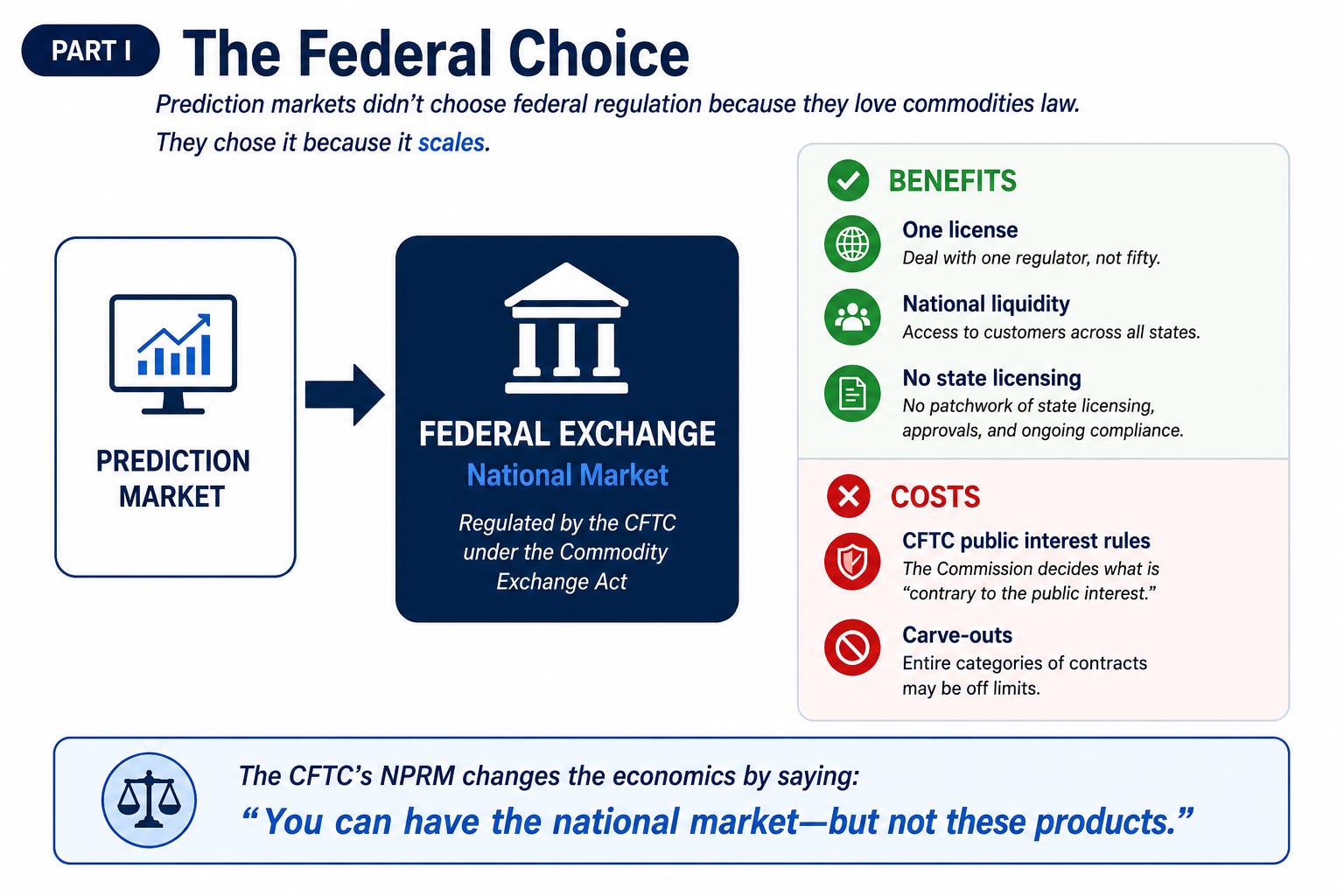
Prediction markets didn’t choose federal regulation because they love commodities law. They chose it because it scales.
One market.
One rulebook.
One national customer base.
This is also why some state-regulated sportsbooks are adopting a “if you can’t beat them, join them” posture. DraftKings reported in an SEC filing that annualized consumer trading volume on DraftKings Predictions rose 24% month over month to $1.3 billion, and the stock, after a long slump, is moving.
Prediction markets have changed the calculus. Now the CFTC’s NPRM changes the economics by saying:
You can have the national market—but not these products.
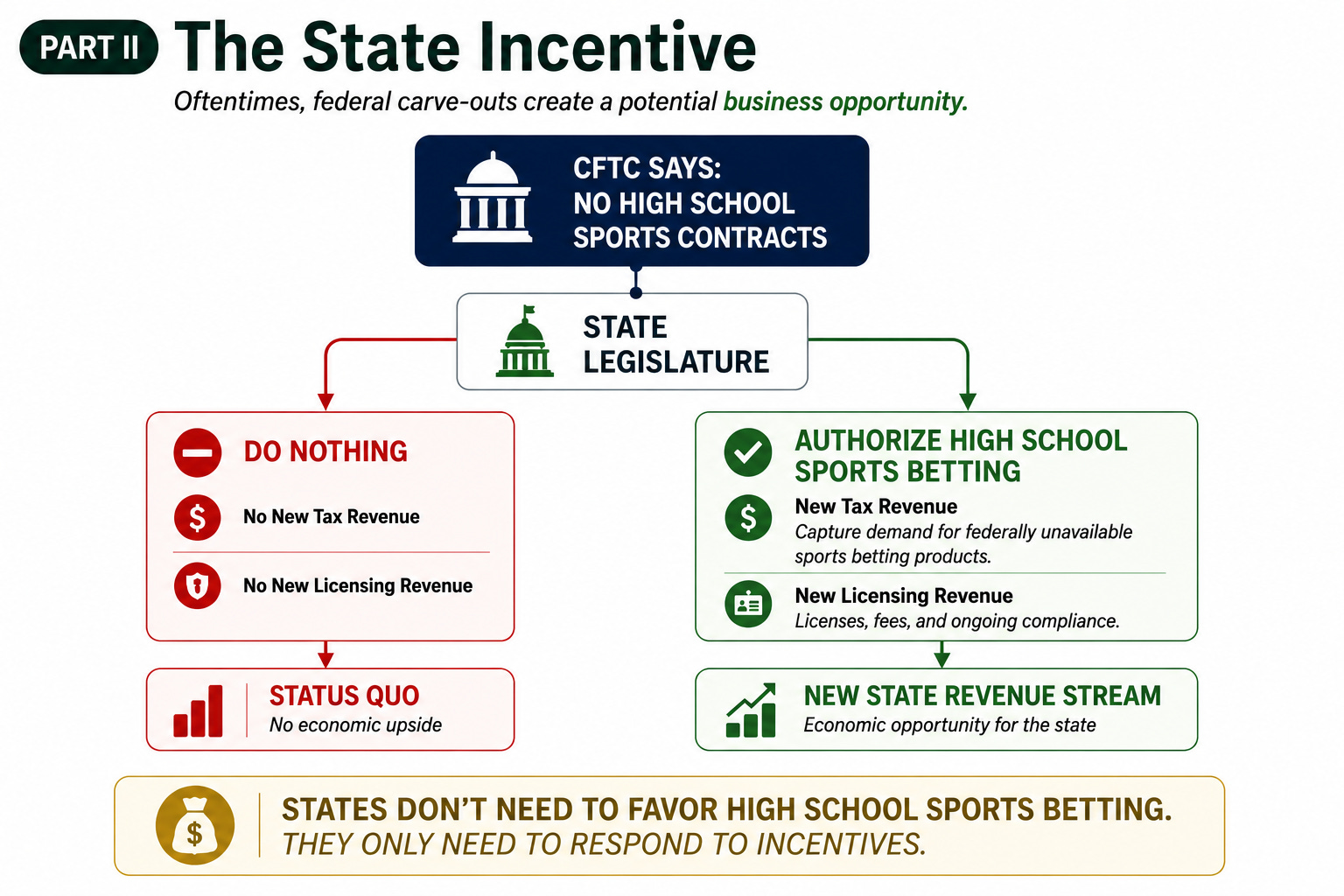
Oftentimes, federal carve-outs create a potential business opportunity. Here, the carveout just happens to create a unique opportunity for the states.
Not because states suddenly love high school sports betting, that has always been politically toxic. High school sports are treated as sacred. The incremental revenue was never worth the backlash.
Now, though, the calculus has shifted. If sports gambling migrates to prediction markets, state revenue dries up. The early signs are already surfacing.
At the same time, doing nothing isn’t really an option. But what can the states actually do?
They’re already fighting prediction markets. The trial court scoreboard on our LexCurrent PM Tracker currently reads 11-4, but that score is misleading. Many of those wins came from Nevada, where Judge Gordon’s analysis never really held together:

At the appellate level, states appear poised to win in at least one place. In the Ninth Circuit, a panel including Judge Nelson took issue with Reg 40.11 during the oral hearing; and in all three rulings that came afterward, ruled in favor of the states.1
The states are going to lose this fight. If you need to look past the statute to win (paywall), you’re simply not going to win.2
The need for tax revenue remains as does the need for funding education, youth sports and other priorities. The moment states became dependent on gambling revenue (state “legalization” post-Murphy 2018) was the moment when serious questions needed to be asked. Some did ask them, but the economic incentives carried the day. There’s no reason to think they won’t again.
Maybe the states want to take their chances with SCOTUS. That’s one option.
But the NPRM just gave them another card to play–a nuclear option:
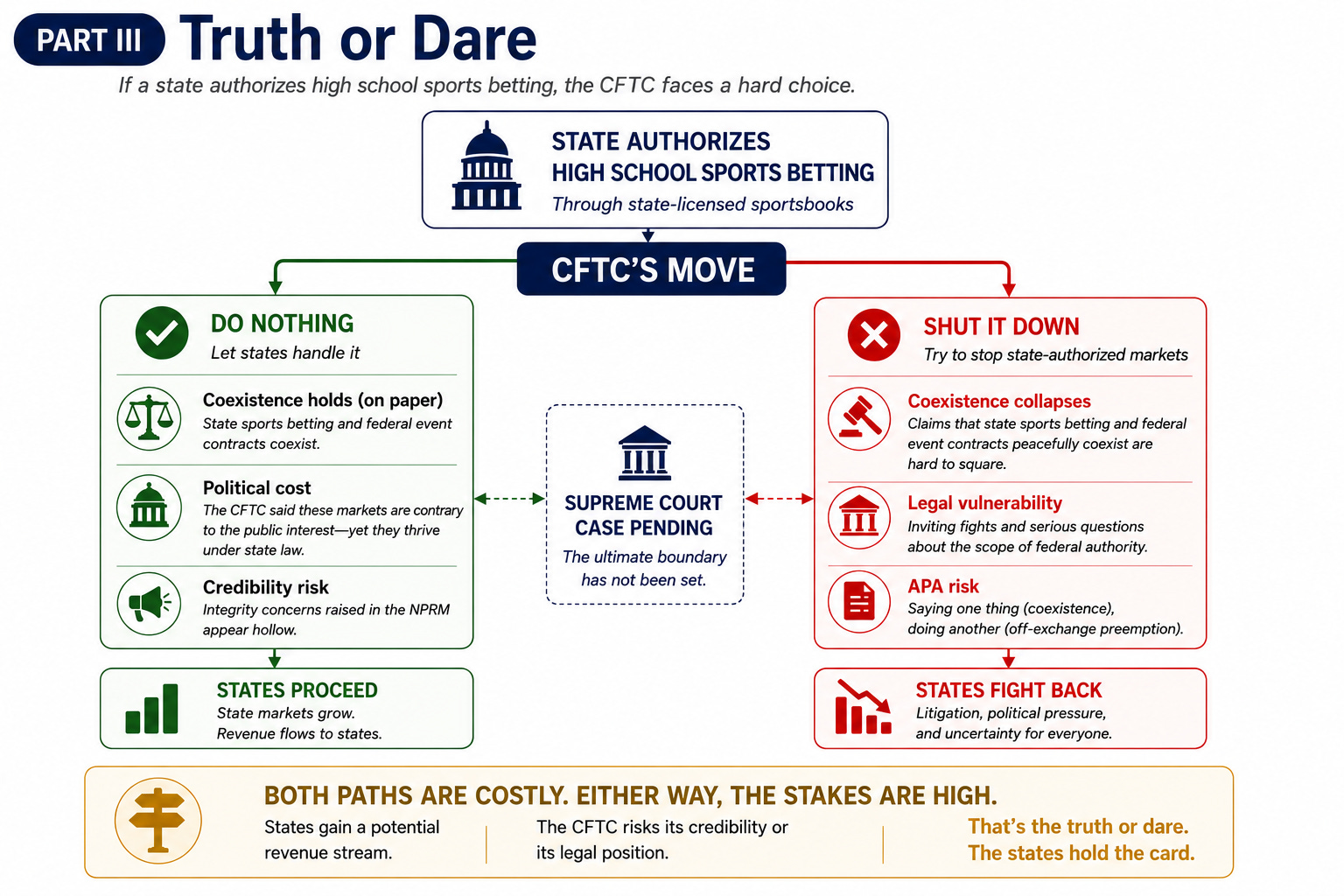
Can states authorize high school sports betting? Why not? Remember how when daily fantasy sports was on life support, New York Assemblymember Pretlow famously argued that the legislature can do anything:
My point is we, as a Legislature, determine what that is, what that crime is and what that punishment is. We, as a Legislature, can today say that wearing a yellow tie is illegal.
The more interesting question is: If even one state makes that choice, what does the CFTC do?
Can you say… stuck between a rock and hard place?
If the Commission does nothing, it will have declared these markets contrary to the public interest while allowing them to flourish under state law.
If it intervenes, it becomes harder to argue that state sportsbooks and federal event contracts peacefully coexist.
That’s the dilemma and the states have the power to force the CFTC into it.
Conclusion
This isn’t really a story about high school sports betting. It’s not even a story about legal arguments–at least not directly.
It is a story about incentives.
You can almost put a fork in the states. They do not have a strong hand and never really did. They just benefited heavily from an ecosystem where most everyone decided to put the blinders on (especially the CFTC), and party early.
Here’s the pressure point:
The moment the CFTC says, “these products belong outside the federal marketplace,” it creates a financial incentive for states to ask a different question:
If Washington won’t offer it, why shouldn’t we?
That question alone changes the game.
It forces the CFTC to respond, and paradoxically, that may be the states’ strongest strategy.
The states hold the card.
The only question is if and when they decide to play it.


Judge Nelson is now facing a judicial misconduct inquiry in an unrelated matter: https://www.reuters.com/legal/government/us-appeals-court-judge-charged-parking-lot-scuffle-faces-ethics-complaint-2026-06-08/
Dan Wallach: “The courts are wearing blinders and just focusing on the plain language of the statute. It's a textual analysis.”