



The prediction market industry is getting a ton of coverage these days, so let’s begin with a quick who’s who.
Tarek Mansour is the natural starting point. As CEO of Kalshi–valued at $22B in the latest round–he has the ear of nearly everyone. He is widely followed and what he says quickly becomes part of the news cycle.
Shayne Coplan, CEO of Kalshi’s archrival Polymarket, just inked an MLB deal. Polymarket is still mostly international, but their U.S. footprint is growing in size, so we’ll certainly hear more from him.
A number of attorneys are also shaping this conversation. Daniel Wallach, a vocal states’ rights advocate, recently appeared in the PBS documentary titled Breaking the Deadlock: Gambling With Your Life. Andrew Kim has been quieter lately but remains a frequent commenter. Rob Schwartz, former CFTC General Counsel, litigated the Kalshi election contracts matter and is now a partner at Morgan Lewis–recently published a short prediction market piece (PDF) in Futures & Derivatives Law Report. Each brings a distinctive lens.
Journalists are on the beat as well. Nick Devor at Barron’s has been excellent, especially his coverage of the CFTC’s Chicago enforcement team. His recent Q&A with Paul Grewal is a must-read (we posted a follow-up on Monday). Ben Horney at Front Office Sports broke the MLB news. Dustin Gouker, posting at Event Horizon and The Closing Line, was early to this space and brings the advantage of having covered DFS extensively a decade ago.
Last but not least, politicians are now showing up to the party. Gavin Newsom issued a press release and an executive order (PDF) last week. AOC has chimed in and so has DeSantis.
And, this one is hot off the press:

And the accompanying press release.
Love her or hate her, when Elizabeth Warren enters a conversation, she amplifies it. More broadly, politicians arriving in droves could be a precursor of what’s coming. Are prediction markets about to become the next big campaign issue? (Listen to our latest quick-hit podcast)
A natural question has emerged: Who is the most influential person in the prediction market industry right now? If you were putting someone on the cover of a magazine, who would it be and why?
We’ll stick our necks out with an unlikely candidate:
Judge Gordon.
The States Are Leading Big Time–Most of It Traces Back to Judge Gordon
It’s the end of the month, and the end of the quarter, so here’s the updated scoreboard:
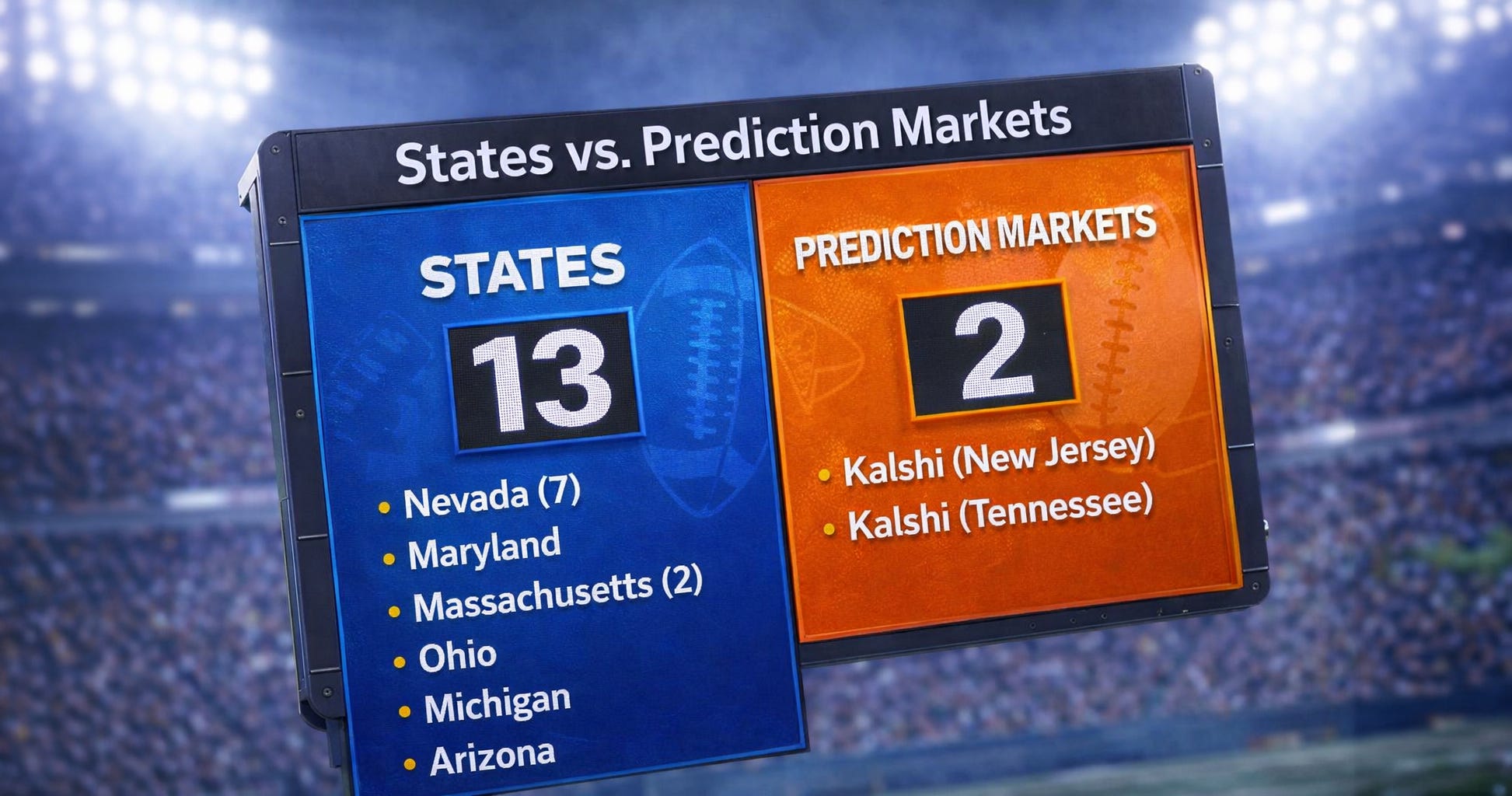
Yes, the states are crushing it. We’re running out of space on the left-hand side.
But if you trace the story back to the beginning, one figure sits at the center of nearly every major outcome: Judge Gordon, the judge who handed the first sports event contract victory to…
Kalshi.
As Alanis Morissette would say: Isn’t it ironic? Don’t you think? How can the same federal judge rule in favor of a prediction market early on, yet become the most influential force behind the states’ winning streak?
This is how:
Nevada, the mecca of sports betting, sent a C&D letter to Kalshi on March 4, 2025. Kalshi did not comply. Instead, they used the letter as fuel to sue the state in federal court. Judge Gordon granted Kalshi a preliminary injunction (PDF) on April 9, 2025 and they lived to fight another day in Nevada.
That opinion likely influenced what came next: another Kalshi win, this time in New Jersey. Judge Kiel cited (PDF) Judge Gordon’s opinion, six times. That was entirely expected; the cases were nearly identical.
Then came Maryland. It felt like the drive that would either make the game 7-14 (back in it) or 0-21 (game slipping away). The latter wouldn’t have been insurmountable, it was still very much mid-first quarter, but momentum matters. Anticipation matters. Perceived defeat often changes behavior long before actual defeat arrives.
Maryland became the turning point. Judge Abelson ruled for the state (PDF). Some immediately called it the first step toward a SCOTUS showdown (including us). We agreed with the trajectory, though not with Judge Abelson’s preemption analysis; on that front, we believed Kalshi had the advantage. Still, the wheels were in motion.
Then things became even more interesting. The Third Circuit appeal (stemming from New Jersey) was already underway, with oral argument (audio, transcript) held on September 10, 2025. Meanwhile, another nearly identical lawsuit had landed on Judge Gordon’s desk.
He looked at it with fresh eyes and… reversed himself.
Everything began to unravel from there.
Judge Gordon’s Reversal Sets The Tone
In Nadex v. Nevada1 (PDF), Judge Gordon wrote:
Despite my prior ruling in Hendrick, I reach a different conclusion in this case.
It was the second loss for prediction markets–and the first for Nadex. The scoreboard moved to 2-2, which wasn’t unusual. What was unusual was the same judge sat on both sides of the scoreboard.
Nevada seized the moment, asking him to dissolve Kalshi’s preliminary injunction (PDF), while also citing the Maryland decision.
Unsurprisingly, Judge Gordon did just that (PDF)—a couple of days before Thanksgiving. For good measure, he added another state win (against Robinhood) the next day. The Robinhood decision (PDF) cited both Hendrick (the Kalshi PI dissolution) and Nadex.
Just like that, the states took a commanding lead. The scoreboard read 4-1, with three of those wins originating from the same judge.
We were not convinced. Many of the arguments in those decisions seemed unlikely to hold up on appeal.
We were not alone. Andrew Kim called Judge Gordon’s Nadex position “not solid legal reasoning” and suggested he may be “setting up himself for reversal.”2

But other federal judges didn’t necessarily see it that way. Kalshi scored in Tennessee but lost several more. As of March 11, 2026, the scoreboard was 9-2. As of March 31, 2026, it’s 13-2.
States appear to be winning and Judge Gordon is the gravitational center of that momentum.
He built a tower that looks sturdy at first glance.
Will it hold? Or will it topple?
Incentives In Disguise
There is an idealized version of the world in which decisions are made on the merits. You pick friends because you genuinely enjoy their presence, not because others like them. You hire based on quality, not popularity. You invest based on value, not because other fund managers like the company.
I clung to that view far too long, and deep down, I haven’t completely given up hope that we might get there one day, or at least make strides toward it. That’s how I think the world should work. Infamously, and we all know this, that is not how the world actually works.
What I described can perhaps be characterized as peer pressure, but I think that’s too lazy of a conclusion. What we call peer pressure is often just incentives in disguise.
Back when I was on the job market coming out of the Ph.D. program, I had applied to a big-name firm. I didn’t receive a call back. I figured my resume didn’t make the cut so I moved on. A few months later, an acquaintance encouraged me to apply. It didn’t make sense to me. “I had already applied and didn’t receive a call back,” I told him. My resume didn’t change, so why would the outcome? He looked at me funny and said, “Trust me.” I re-applied and got the interview.
At the time, I didn’t understand it. Did the company like me or not? Why did they reach opposite conclusions, a few months apart, with the same resume?
Years later, reviewing hundreds of resumes for PwC, I finally understood what happened and why. When you’re buried under volume, you start looking for quick signals. You feel like you have to. There isn’t enough time to deeply evaluate everyone, so you rely on shortcuts. Someone else’s prior validation becomes a filter.
The outcome was different the second time because there was a new signal; my application was delivered through a person one of the recruiters trusted. What I thought was the exact same application wasn’t so, it was delivered differently, and therefore, it was received differently. The episode wasn’t about inconsistency. It was about efficiency–a way to allocate limited time and attention in a world overflowing with noise.
And the irony is that a very similar dynamic exists in the industry designed to make the world more just.
When it comes to incentives in disguise, law is no exception.
The Power of Precedent
Judges often operate under the same constraints as the rest of us. The docket must move. There are more cases than time. Shortcuts are inevitable.
Precedent becomes the shortcut.
This is not a slight on the judiciary–it’s reality. Even judges without preconceived outcomes (a common critique) must make high-stakes decisions quickly, often without full visibility into the broader historical context.
So they look to precedent.
To be fair, precedent can be powerful. It can bring in consistency, stability and predictability.
At the same time, it can be misleading. Weak arguments can survive for years simply because no one has the time or incentive to challenge them until a better case comes along. SCOTUS only takes about 2% of cases presented to them. The rest settle into the legal landscape–right or wrong.`
Back to prediction markets: When Judge Gordon ruled for the state and against Nadex, Kalshi, and Robinhood, he provided the building blocks for every other courtroom.
His tower became the template.
