

The fight over prediction markets can feel chaotic. Courts, regulators, sportsbooks and exchanges all seem to be arguing about different things at once: Preemption, swaps, gambling, jurisdiction and public interest.
But step back and the pattern becomes clearer.
This isn’t a single dispute. It’s a sequence that will determine who wins, who loses and what comes next.
In complex regulatory battles, the most important question is often not who is right. It’s which question gets answered first. Once the order of the questions becomes clear, the structure of the fight comes into focus.
Prediction market litigation is advancing through exactly that kind of structure—one question at a time.
When you map the dispute that way, the litigation stops looking like a pile of disconnected lawsuits and starts looking more like a subway map with defined stops along the way. There are three stops on this route:
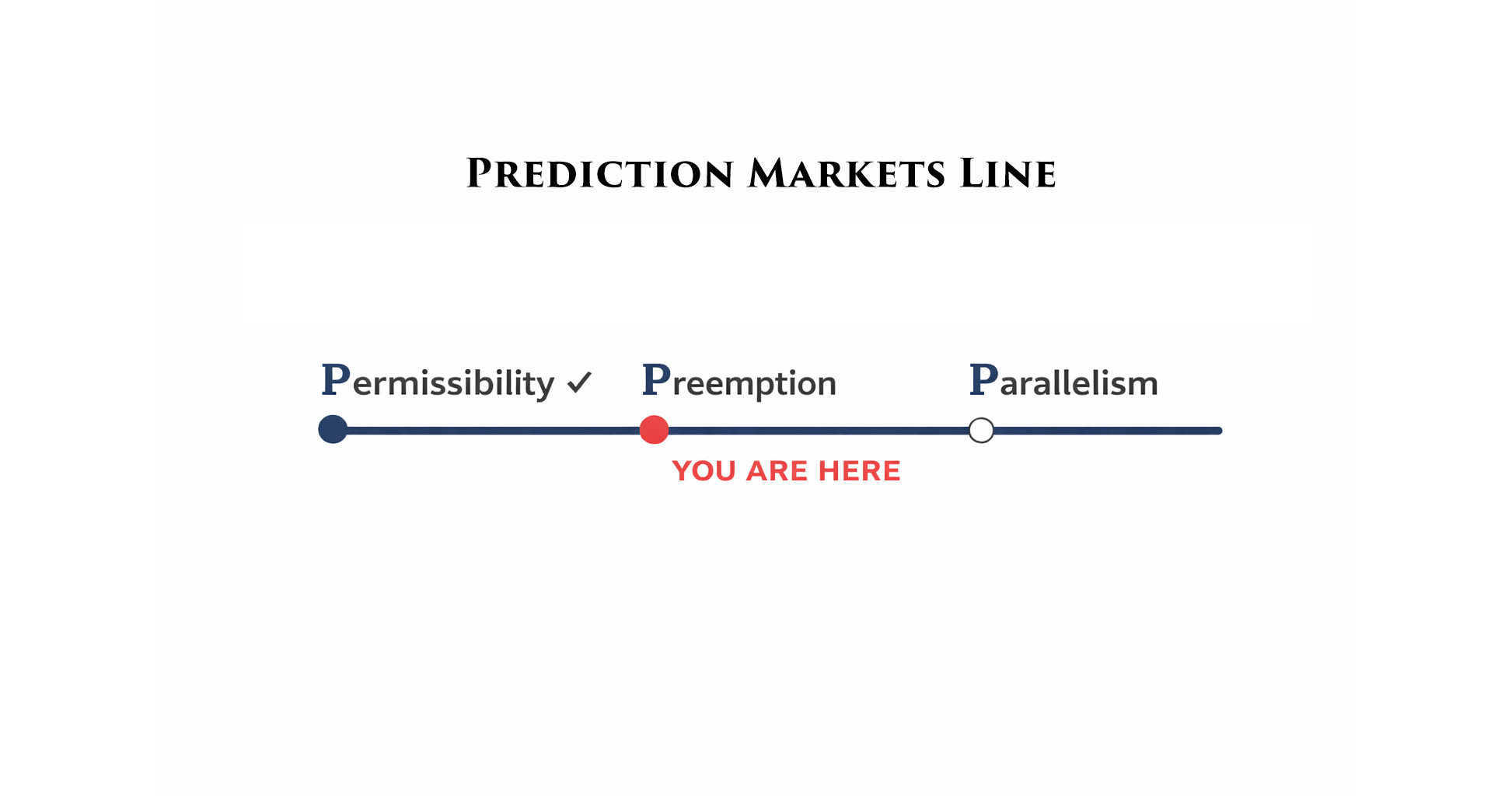
Permissibility: Are event contracts allowed under the Commodity Exchange Act?
Preemption: If they are allowed, who regulates them: The federal government or the states?
Parallelism: And if they are derivatives, where are they legally allowed to trade?
That’s the sequence. Each question naturally leads to the next.
Litigation Sequencing vs. Doctrinal Sequencing
If those three words ring a bell, it’s because we introduced them recently as: The 3P Framework.

But, and this is the key point, the order was different.
In our framework, we had placed preemption first, then permissibility, then parallelism. That was not a stylistic choice, it was doctrinal. Proper legal analysis must begin with jurisdiction. If the federal government has authority, one set of laws governs permissibility. If the states do, a different set of laws applies. The legal status of sports gambling rests on an interconnected web of statutes, and you cannot properly adjudicate permissibility without resolving jurisdiction first.
That said, here’s the critical observation:
Litigation sequencing is not the same thing as doctrinal sequencing.
In theory, the logical order of legal analysis begins with jurisdiction, followed by permissibility and then parallelism addresses the co-existence question. In practice, courts address the questions that land in front of them, in the posture in which they arise. Litigation rarely unfolds in the tidy order that doctrine would prefer. Instead, disputes are resolved through threshold decisions that reflect timing, strategy and procedural happenstance. And, in the case of prediction markets, the sequence we displayed above is the sequence the courts actually followed.
This naturally raises the next question:
Was this sequencing intentional, or did it emerge organically as litigation evolved?
Evaluating the Intentionality Behind Litigation Sequencing
There are many cases and many parties in various court dockets today, but the modern era of prediction market litigation began with Kalshi. If intentionality exists anywhere, that’s where you’d expect to find it.
So, how much of this sequencing was deliberate?
The honest answer: We truly don’t know. Perhaps one day executives will be deposed and forced to answer under oath. Even then, attorney-client privilege may keep parts of the story sealed.
Still, I will share my foresight with you–not insider knowledge, just my analysis:
Kalshi likely didn’t sit down on day one and map out a multi-year sequencing strategy.
Early on, they likely expected to fight to center on public interest analysis.
As litigation unfolded, an opportunity emerged:
The dispute could be narrowed, staged and sequenced.
First, Kalshi was handed a golden opportunity to isolate the permissibility question and win on election contracts, temporarily sidelining the “gaming” issue. That required a concession on sports event contracts–one they made without hesitation. They sacrificed sports event contracts to win elections.
Once that bridge was crossed, there was no real reason to not bring sports event contracts back. Yes, collateral estoppel was a theoretical concern, but apparently not a deterrent. It took Kalshi just a few days to pivot 180 degrees and self-certify sports event contracts.
The CFTC declined to initiate review on Kalshi’s self-certification, even though it did so on Nadex’s. That opened the door for the preemption phase of the litigation sequence. Kalshi quickly scored two early wins in Nevada (PDF) and New Jersey (PDF). Score: 2–0, Kalshi.
When the CFTC dismissed its appeal of the election contracts case, the next stage of the sequence opened up in earnest: Preemption.
At each stage, Kalshi had little incentive to broaden the fight prematurely.
Preemption didn’t need to be argued when the opponent was the CFTC. That phase was all about permissibility.
With permissibility resolved for elections, and with the states now the primary opponents in sports‑event‑contract cases, there was no reason to dwell on the past. It was preemption’s turn.
Permissibility for sports was never litigated—it was conceded, then reintroduced through self-certification and CFTC inaction. The industry seemed to miss that detail entirely; permissibility never made its way back to the docket.
So what about the future? What about parallelism?
As The Cranberries would say, no need to argue. Parallelism doesn’t need to be litigated when the opponent is the state. Just extend the olive branch: We can co-exist. The unspoken rationale: This is a preemption dispute, your Honor. Off-exchange trading isn’t before the court.
And the CFTC—now functioning more like an industry advocate than a regulator—is singing the same tune: We can co-exist.
The CFTC is Losing the Prediction Markets Narrative

CFTC Chair Mike Selig was at the Milken Institute’s Future of Finance 2026 event a couple of days ago:
None of this required a master plan to be drafted on day one. Even if such a plan existed, executing it would have been nearly impossible. Litigation sequencing often emerges in real time. It evolves organically.
Litigation sequencing reflects the order in which courts confront issues—not necessarily the order in which those issues are logically related.
That said, experienced litigators recognize which issues are decisive. They isolate them when possible and avoid expanding the dispute until the earlier gates are resolved. Once one stage closes, the next becomes unavoidable.
Intentional or not, this was elegant sequencing from Kalshi. Back in November we observed:
Kalshi is making a decent effort to isolate the questions and adjusting its strategy on the fly. That is their legal strategy—moving the ball incrementally.
That’s how we derived the route plan depicted above. Prediction market litigation is advancing—one question at a time.
Looking Ahead
Right now, the train is sitting squarely at the second stop: Preemption. Depending on how you do the counting, there are somewhere between 40 and 50 cases currently being litigated across the country, and likely more on the way.
Understanding litigation sequencing is essential. It explains why certain arguments appear when they do, why others remain dormant and why the industry finds itself locked in a preemption battle today.
The route isn’t random. It’s emergent. Now that we can see the path clearly, the next stop becomes easier to anticipate. Before we move forward though, we need to examine what happened at the first stop, which we will detail in tomorrow’s post.
Stay tuned.