


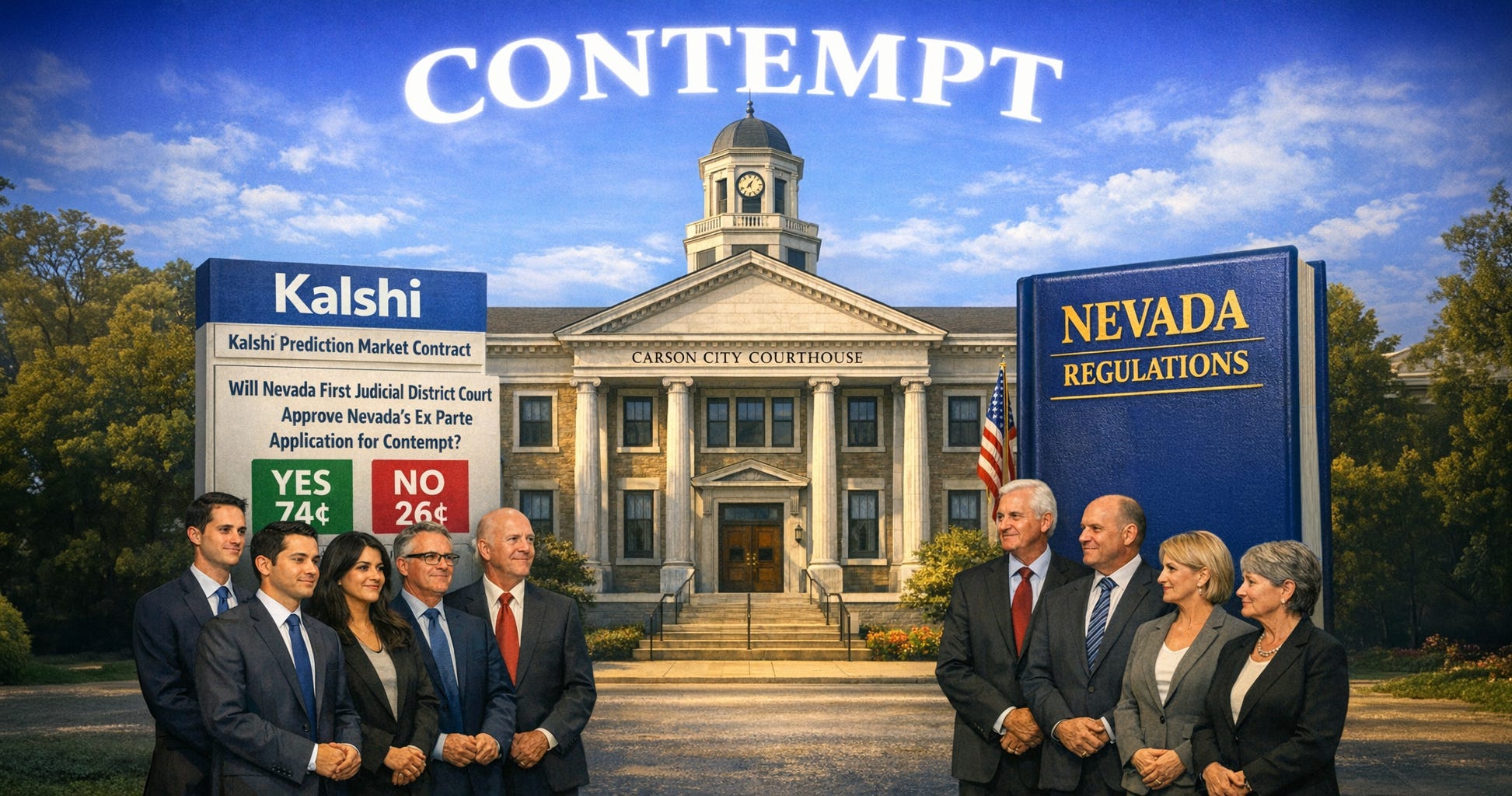
Nevada has now taken the most aggressive step yet in its case against Kalshi. On June 4, the Nevada Attorney General’s Office filed an Application for an Ex Parte Order to Show Cause Regarding Contempt, arguing that Kalshi has openly violated the court’s Amended Preliminary Injunction (May 18th). The filing is blunt: Kalshi was ordered to geofence Nevada users out of sports, entertainment and election markets. While the PI was in effect, Nevada investigators were still able to buy those contracts eight times over four days.
The state’s message is unmistakable: Kalshi is out of compliance and the court must intervene forcefully.
Today I will break down what Nevada is asking for, what the court might do next and why a contempt finding in this case would reverberate far beyond Carson City.
What Nevada Says Kalshi Did Wrong
Nevada’s contempt application rests on a simple factual claim: Kalshi willfully ignored the injunction.
The May 18 Amended Preliminary Injunction was specific; Kalshi is barred from offering:
… sports-related event contracts…election-related contracts… entertainment-related contracts.
The court clarified that the order applied to anyone physically located in Nevada, not just Nevada residents.
Yet Nevada investigators, using standard iPhones on Nevada cellular networks and no VPNs, were able to purchase:
NBA playoff contracts;
MLB game contracts;
A French Open tennis contract;
A Mexico–Australia soccer contract; and
A Los Angeles mayoral election contract.
The filing describes it as a violation of the events just described above:
Specifically, on eight separate occasions, ... a BOARD investigator was able to purchase sports- or election-related contracts…
Nevada and Kalshi present sharply conflicting accounts of what geolocation and geofencing require. In the federal district matter of Kalshi v. Hendrick, Xavier Sottile–Kalshi’s Head of Markets, asserted in his declaration that implementing industry-standard geolocation would be “incredibly costly,” estimating that contracting with a certified vendor could run “up to tens of millions of dollars annually” and would take months to negotiate and integrate.
Nevada’s expert, commercial gaming attorney Dan Reaser, directly disputed that characterization in his own declaration (PDF) filed back in October 2025. Drawing on his experience with Nevada-licensed sportsbooks and gaming operators, Reaser explained that geolocation and geofencing are “routine, widely deployed, and neither technically difficult nor cost-prohibitive” for Nevada-licensed operators. In his view, Kalshi’s decision to build its own system–and to test it using “family and friends”–reflects a voluntary choice to avoid established, reliable solutions rather than any genuine technological or financial barrier.
That contrast becomes even more pointed in light of attorney Dan Wallach’s reference to Kalshi’s own sworn filing showing the company spent approximately $190,000 building its own internal geolocation system–which we now know failed miserably.

Regardless of who wins or loses here, the fact remains that Kalshi failed to, or simply voluntarily chose not to put much effort into this as they continue to maintain that the CFTC has exclusive jurisdiction and therefore Nevada has no authority to require it and that Nevada’s demand could jeopardize Kalshi’s federal designation. On the other hand, it’s only Nevada that is holding Kalshi in contempt right now and firmly relies on local experts that geolocation is standard in regulated gaming, not difficult and not cost-prohibitive. In other words, Nevada operators use it everyday and it appears as though Kalshi’s claim is exaggerated.
One could also say that Kalshi did implement geolocation, they did spend money on it, they did choose a low-budget internal system that was inadequate (relying on IP addresses), they did choose not to use a certified vendor, so they did know that geolocation was required to block Nevada’s users. This all undermines Kalshi’s “we shouldn’t have to geofence”1 argument because they tried it, they did it cheaply, it failed, and Nevada caught them.
Recent figures quoted in this document state Kalshi has eclipsed $4.2 billion in weekly volume, yet they can’t afford to hire a legitimate vendor to geofence Nevada?
What Happens If the Court Grants the Contempt Application?
If the judge agrees with Nevada, Kalshi faces immediate and substantial consequences.
1. A Formal Contempt Finding
This is not symbolic. A contempt finding is a judicial declaration that Kalshi disobeyed a lawful court order. Courts treat this as a serious institutional affront. It becomes part of the record, part of Kalshi’s reputation and part of every future regulator’s file.
2. Disgorgement of All Nevada Revenue Since May 18
Nevada asks the court to order:
“… disgorgement of every dollar KALSHI has earned from Nevada operations since May 18, 2026.”
This is the harshest remedy available. It would require Kalshi to hand over all revenue attributable to Nevada users–even if Kalshi disputes the underlying legality of the markets.
3. Alternatively, Daily Monetary Penalties of at Least $120,000
Nevada proposes a coercive fine:
… a sanction of at least $120,000 each day that KALSHI is not in full compliance.
This number is not arbitrary:
This is estimated by taking KALSHI’s $600 million/day trading volume, dividing by 50 to approximate Nevada’s share of the transactions, and taking 1% to estimate KALSHI’s fees on those transactions.2
The point is to make noncompliance more expensive than compliance.
4. Attorneys’ Fees and Costs
Nevada cites NRS 22.100(3) to request full reimbursement for the emergency filing. This is standard in contempt proceedings and adds to the financial pressure.
5. Potential Escalation if Kalshi Still Does Not Comply
If Kalshi continues to resist, Nevada courts have broad authority to escalate:
Increasing daily fines;
Freezing assets;
Entering default judgment; and
In extreme cases, referring for criminal contempt.
Nevada gaming regulators are not known for timidity.
Why This Matters Nationally: The Ripple Effects
A contempt order in Nevada would not stay in Nevada. It would become a powerful data point for every other state and regulator evaluating Kalshi and other prediction market platforms. Opponents are sure to use this as a persuasive authority in their case filings.
1. It Strengthens the Argument That Kalshi Is a Sportsbook
Nevada’s underlying finding–that Kalshi operates an unlicensed “sports pool” and “percentage game”–is already damaging. But contempt adds a new dimension: Kalshi cannot or will not comply with state‑level geofencing requirements.
Other states may use this to argue:
Kalshi is functionally a sportsbook;
Kalshi’s compliance controls are insufficient; and/or
Kalshi disregards state authority.
This is especially relevant in states like New York, Arizona and Michigan, where similar questions are pending.
2. It Undercuts Kalshi’s Credibility in Federal Litigation
Kalshi’s federal strategy depends on portraying itself as a responsible, federally regulated exchange unfairly targeted by states. A contempt finding undermines that narrative.
Federal judges–especially in administrative law cases–care deeply about good faith. If Nevada proves Kalshi knowingly violated a court order, federal courts may:
Give less weight to Kalshi’s representations;
View Kalshi as a regulatory risk; and/or
Be more receptive to arguments that Kalshi’s markets are gambling.
This could also affect a potential APA challenge, any future CFTC enforcement and the broader question of whether sports event contracts fall under the Commodity Exchange Act.
3. It Gives Other States a Playbook
Nevada’s filing is a template:
Declare Kalshi a sportsbook under state law;
Obtain a preliminary injunction;
Require geofencing;
Test compliance; and
Move for contempt.
States can replicate this sequence almost verbatim.
4. It Pressures Investors, Liquidity Providers and the CFTC
A contempt order signals instability. Investors and partners may reconsider exposure. The CFTC, already under scrutiny for its handling of event contracts, may (although not likely given its recent court filings) distance itself to avoid political fallout.
5. It Complicates the Preemption Fight
Kalshi wants courts to say that federally approved event contracts preempt state gambling laws. But contempt makes Kalshi look like the wrong plaintiff to carry that banner. Courts may hesitate to expand federal preemption for a party that cannot follow existing orders.
In Closing
Nevada’s contempt application is one of the most consequential filings in the entire prediction‑market legal landscape. It is not just about geofencing. It is about credibility, compliance and the optics of a platform that wants federal courts to reshape the boundary between state gambling law and the Commodity Exchange Act.
If the court grants this application, the consequences will be immediate in Nevada–and likely become significant everywhere else.
I’ll be thinking about several follow‑up pieces that build on this moment:
How a contempt finding might affect the New York case specifically, as well as other state‑level actions against prediction‑market platforms.
How this interacts with a potential APA challenge and the CFTC’s posture going forward.
What Kalshi’s strongest counterarguments might be–both legally and factually.
And most importantly, how this could influence the Supreme Court if preemption eventually reaches it, and whether a contempt finding affects the other two Ps in Alper’s 3P Framework: Permissibility and parallelism.
While I have been the COO of Lexicon Labs for quite some time now, I have mostly been working on the back end with the design & structure, as well as working with Alper on his articles and even the LexBeyond podcasts.
I decided that I would like to start chiming in on this space with my first self-written piece. I thank you for taking the time to read it. Happy Monday!


Geofencing and geolocation tend to be used interchangeably but there are some differences. Geofencing is the legal compliance requirement for operators that are required to block users outside the fence. In Nevada’s case, a geofence is supposed to prevent anyone from within the state from being able to access the specific event contracts. Geolocation is the technical accuracy requirement when enforcing geofencing; regulators care whether the operator can prove a user was physically inside the jurisdiction.
My educated assumption here is that dividing by 50, they are referring to the 50 states in their calculation.