
Key Takeaways
Massachusetts just handed the states another win by granting a preliminary injunction against Kalshi.
The ruling contains a critical line: “Under the CEA, only federally regulated exchanges can offer event contracts”–a position that, if enforced consistently, threatens the legal foundation of state-regulated sports betting.
The court sidestepped the key question of whether event contracts are swaps, leaving a dangerous ambiguity.
If sports wagers qualify as event contracts and/or swaps, then offering or trading them off-exchange is illegal under federal law.
This risk has been flagged before, but Massachusetts now provides a judicial quote in a prediction market case that can be cited–raising the stakes for DraftKings, FanDuel, and every state sportsbook.
Irony abounds: Massachusetts, once the savior of DraftKings during the DFS wars, may now be the state that detonates the regulatory moat they spent a decade building.
On January 20, Judge Barry-Smith delivered another win for the states, granting Massachusetts’ request for a preliminary injunction against Kalshi.

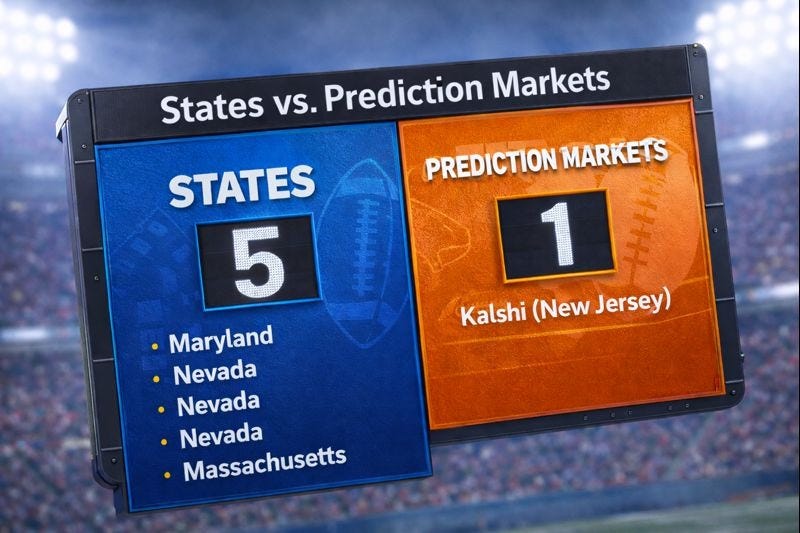
With this ruling, the national scoreboard shifts again–and not in prediction markets’ favor (counting the remand back to state court and preliminary injunction in Massachusetts as one, and Nevada three times because there were three different court cases):
The states are energized. Tribal regulators are pleased. Kalshi looks cornered. Tom Brady and the Patriots were also cornered in Super Bowl LI, trailing the Falcons 28-3 in the third quarter. We all know how that game ended.
Can Kalshi pull off a similar comeback? Can Kalshi out-Brady Massachusetts? (podcast)
We think yes–but the Massachusetts decision creates a potential landmine for others: State-regulated sportsbooks.
A Decade-old Circle Closed
Ten years ago, Massachusetts was the “adult in the room” on daily fantasy sports.
New York was hammering DFS operators. We remember Jason Robins, DraftKings CEO, looking visibly rattled on live TV.
Then-Attorney General Maura Healey stepped in, offering a regulatory lifeline and positioning Massachusetts as the sensible alternative. David Boies, representing DraftKings in New York, praised her approach (Bloomberg paywall):

I think a good compromise is what, for example, the Massachusetts Attorney General is trying to do… [She] has said: This is obviously not illegal gambling, but there are some issues here that need to be addressed. [W]e recognize that’s a sensible way to approach this, a sensible middle ground.
But DFS was, and continues to be, illegal gambling. Whether or not it is a game of skill isn’t the core issue because it’s not a game in the first place; it’s an event contract and/or swap. The CFTC, not the states, has jurisdictional authority over it.
Even without activating that key insight, New York seemed poised to win. The momentum died when New York’s AG settled at the last minute. Cuomo signed DFS legislation into law.
Massachusetts followed, attaching DFS to an economic development bill.
Later, in 2022, Governor Charlie Baker signed House Bill No. 5164 (PDF) to regulate sports wagering in the state.
DraftKings was handed its “hometown hero” win.
The moat was built.
The industry stabilized.
And now?
A Massachusetts judge may have just blown a hole straight through that moat.
The Executive Summary
The Critical Line
The Superior Court wrote: “Under the CEA, only federally regulated exchanges can offer event contracts. 7 U.S.C. § 2(e)” (emphasis added)
But § 2(e) does not mention event contracts, only swaps.The Key Omission
The Court “assume[s] without deciding that Kalshi’s event contracts are swaps.” (We believe they are).
The court’s refusal to engage with the swap argument keeps the door open–dangerously open.The Federal Off-Exchange Ban
Federal law prohibits:
→ offering or trading commodity futures on unregistered exchanges (7 U.S.C. § 6(a))
→ offering or trading swaps on unregistered exchanges (7 U.S.C. § 2(e))
Exemptions are available in both cases, but, in all likelihood, they don’t apply to sports wagers. Therefore, if sports wagers fall into either category, sportsbooks have a major problem on their hands.Sports Event Contracts = Sports Wagers
Judge Barry-Smith is correct when he said that Kalshi’s sports event contracts function like sports bets.
We disagree with the analytical path he took (under the CEA, that determination would run through the Special Rule, not what Kalshi says in its marketing brochure), but the conclusion is correct.Are Sports Wagers Event Contracts?
This is the reverse direction that Judge Barry-Smith failed to explore (we believe they are).
The CEA doesn’t define “event contract,” nor does it require binary outcomes.Are Sports Wagers Swaps?
Once again, Judge Barry-Smith failed to explore (we believe they are).
Contracts on excluded commodities and swaps are two sides of the same coin.
The Court left five and six entirely unresolved.
The Danger for Sportsbooks
If sports qualify as:
Event contracts, or
swaps,
then both offering and trading them off-exchange is illegal under federal law.
This risk is nothing new.
It has been raised by:
An Illinois district court (PDF);
Former CFTC Commissioner Brian Quintenz;
The state of New Jersey (PDF);
The Nevada Resort Association (PDF); and
The state of Connecticut (PDF).
However, the Massachusetts decision now escalates the threat.
It provides a judicial statement, in a prediction market case, that event contracts/swaps can only be traded on federally regulated exchanges.
That transforms a theoretical argument into a citable legal authority.
This is the nightmare scenario for the gambling industry:
Sports bets offered by DraftKings, FanDuel and every other state-regulated sportsbook are commodity futures contracts traded off-exchange, surviving only because the CFTC has not acted.
Now, a judge has put that possibility into the record (making it more difficult to dismiss).
Sportsbooks vs. DCMs: The Real Divergence
The venue doesn’t change the nature of the contract.
Both sportsbooks and DCMs offer sports gambling instruments.
But, the consequences differ:
Kalshi and prediction markets
→ Could face Wire Act exposure (unlikely under current DOJ priorities)
→ Could be impacted if states/tribes/others challenge the CFTC under the APASportsbooks
→ If their products are off-exchange futures/swaps, they are violating the CEA
→ These issues are already in active litigation, albeit indirectly
→ Publicly traded operators may also face securities law exposures if these risks are undisclosed to their investors
By attacking Kalshi, the states may have inadvertently raised the legal risk profile of the entire sportsbook industry they regulate.