



I. Setting the Stage
Prediction markets are entering the most consequential legal moment in their history. For the first time, multiple states, federal regulators and the CFTC are all colliding over a single question: What exactly are these markets–federally regulated financial instruments, or state‑regulated gambling?
We will lay out, in a two-part series, an examination of this conflict.
Today we start out with the map–a clear, high-level overview of what’s happening in New York and why it matters nationally. New York has become the most aggressive state actor in this space, launching sweeping enforcement actions, facing federal counter‑suits and triggering a wave of defensive litigation from platforms seeking to protect their ability to operate.
But New York is only part of the story.
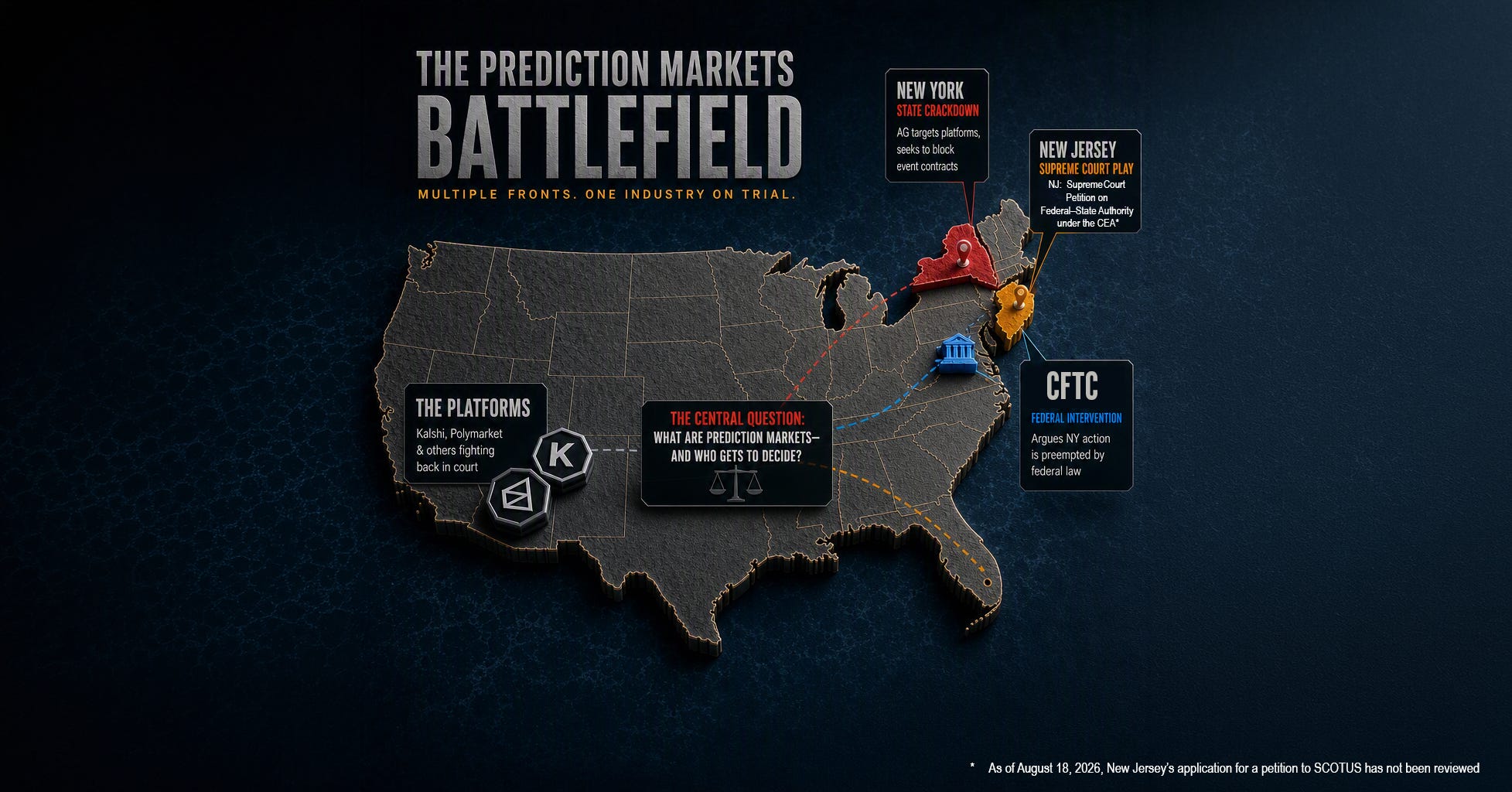
There is potential for a parallel track to the New York battles. Quietly brewing is a potential showdown at the Supreme Court level involving the state of New Jersey. They applied for, and were granted, two extensions of time to file a petition for writ of certiorari, which we should find out about on or before September 3rd. If New Jersey ultimately files for the petition and the Supreme Court elects to hear it, the ruling could reshape the national landscape–much as the consequences of Murphy v. NCAA reshaped the regulatory environment around sports betting.
So below we will create that imagemap for you and will outline:
The cases filed against New York;
The cases New York has filed;
The federal government’s intervention; and
The emerging pressure coming from New Jersey.
Part II will pick up from that map and explain the federal response–including the CFTC’s sudden use of emergency powers after more than forty-five years of silence, and what that signals about where this conflict is heading.
For now, we start with the battlefield itself:
II. The Battlefield: New York’s Multi‑Front War
New York’s actions have created a multi-front conflict that now defines the national landscape. What follows is the map: The three fronts New York is fighting on, the cases that define each front and how they fit together into a single legal terrain.
A. Platforms Suing New York
Several platforms have gone on offense, filing federal actions to stop New York from classifying their markets as illegal gambling. These suits form the “platform v. state” front of the conflict, and they share a common goal: Forcing federal courts to recognize prediction markets as instruments governed by the Commodity Exchange Act (“CEA”) rather than state gambling laws.
8/5/26 - Novig v. New York (1:26‑cv‑06676)
Novig challenges New York’s attempt to treat its markets as illegal gambling, seeking declaratory relief and federal preemption.
6/12/26 - Crypto.com v. New York (1:26‑cv‑04980)
Crypto.com argues that New York is intruding into federally regulated derivatives markets and that its enforcement posture violates the CEA.
10/27/25 - Kalshi v. New York (1:25‑cv‑08846)
Kalshi challenges New York’s classification of its event‑contract markets, asserting federal jurisdiction and seeking protection from state‑level shutdowns.
Taken together, these suits form the platform-side effort to push the dispute into federal court and force a ruling on the regulatory identity of prediction markets–an issue further explored in Section III.
This front matters because it forces federal courts to confront whether prediction markets fall under the CEA–a question New York has avoided by treating them as gambling.
B. New York Suing Platforms
At the same time, New York’s Attorney General has launched sweeping enforcement actions against multiple platforms, including:
4/22/26 - New York v. Gemini (1:26‑cv‑03318);
4/21/26 - New York v. Coinbase (1:26‑cv‑03300); and
7/31/26 - New York v. Kalshi (1:26‑cv‑06550).1
These cases seek injunctions, disgorgement and in some cases massive damages and they rest on the legal theory that prediction markets are “quintessential gambling” squarely within New York’s enforcement powers.
This path is New York’s attempt to establish a statewide precedent that would effectively shut down prediction markets unless they conform to gambling-law frameworks.
C. The Federal Government Suing New York
The conflict took on a new dimension when the United States, acting through the Department of Justice on behalf of the CFTC, entered the battlefield directly in:
4/24/26 - United States v. State of New York (1:26‑cv‑03404)
In this suit, the CFTC argues that New York is intruding into a domain Congress reserved for federal oversight. This is not a platform defending itself, it is the federal government asserting exclusive jurisdiction over event-contract markets under the CEA.
This suit introduces the federal government’s position into the conflict–a role examined more fully in Section III.
D. Consolidation, Reassignment and Escalation
The courts have begun treating these disputes as systemic, not isolated. That shift is clearest in In re Kalshi Sports Prediction Market Litigation (1:25-cv-08585), where the court formally consolidated four related federal cases into this one, and reassigned two others to the same judge, because of their overlapping similarities:
10/16/25 - Yee v. KalshiEX LLC (designated as the lead case mentioned above)
11/26/25 - Pelayo v. Kalshi Inc. (consolidated) 1:25-cv-09913;
1/13/26 - Hallman v. KalshiEX LLC (consolidated) 1:26-cv-00317;
1/29/26 - Jennings v. Kalshi Inc. (consolidated) 1:26-cv-01924;
2/20/26 - Reynolds v. Kalshi Inc. (reassigned) 1:26-cv-05238; and
5/11/26 - Roberts v. Kalshi Inc. (reassigned) 1:26-cv-05246.
Although most of the private Kalshi-related federal cases are now being treated as a single action, they are part of a much larger picture. New York has become the most crowded and complex battleground in the country. When the database on LexCurrent’s PM Tracker is filtered for New York cases, it reveals nineteen separate prediction-market lawsuits–far more than the platform v. state and federal v. state conflicts described earlier. The docket includes private plaintiffs, class actions, commercial disputes and even a flight-tracking company suing Kalshi over aviation-related contracts (See FlightAware v. Kalshi 1:26-cv-06824). New York is not just hosting the core jurisdictional fights; it’s hosting everything.

These procedural moves, a significant consolidation and additional related-case reassignments, place the Kalshi-related disputes under unified judicial management. This escalation matters because unified judicial management increases the likelihood of a single, authoritative ruling on the federal-state boundary. Section IV explains why this clustering matters and how it fits into the broader federal-state conflict.
E. The New Jersey Factor: The Ultimate Judicial Lever
As mentioned earlier, there is potential for a parallel track to the New York battles and one that could overshadow all of them:
New Jersey’s forthcoming petition for writ of certiorari to the U.S. Supreme Court. - SCOTUS Docket 25A1465
Similarly to what New Jersey did in Murphy v. NCAA, it may soon be asking the Court to define the federal–state boundary for markets that states want to treat as gambling.
If the Court takes the case, the entire New York litigation becomes downstream.
III. Surface vs. Subsurface Dynamics
Section II mapped the visible fronts of the conflict. This section turns to the deeper structural forces beneath those filings–the dynamics rooted in the same question introduced at the outset: The legal identity of prediction markets and who has the authority to regulate them.
A. Surface Dynamics: The Visible Legal Conflict
The surface narratives introduced in Section II–New York’s gambling classification, the platforms’ federal-instrument framing and the federal government’s assertion of exclusive jurisdiction–form the visible layer of the conflict. But they do not explain its intensity or its trajectory.
These are the official narratives–the arguments the parties are willing to put on the record.
But these surface dynamics don’t fully explain the intensity of the conflict, or why multiple states and federal agencies are suddenly colliding over a market that—depending on how one defines it—either emerged recently or has existed for years under different names. To many observers, sports‑event contracts appear “new,” because the modern exchange‑listed versions only began to proliferate in the last couple of years. But if the Supreme Court ultimately concludes that these state-regulated sports bets are event contracts under the CEA, then they have existed all along—just off‑exchange, unregulated, and classified differently.
These visible disputes over licensing, classification, injunctions, and enforcement are symptoms of a deeper jurisdictional struggle. To understand that struggle, we have to look underneath.
B. Subsurface Dynamics: The Real Drivers of the Conflict
Beneath the surface filings, four structural forces are driving the conflict: Expanding state power, platforms seeking federal recognition, federal regulators asserting supremacy, and New Jersey’s anticipated SCOTUS challenge. Section IV traces how these forces shape the trajectory of the litigation.
Together, these forces explain why the conflict feels bigger than the individual cases. The surface is about gambling laws. The subsurface is about jurisdiction, federalism and the future architecture of prediction markets.
C. Why New York’s Position Creates a National Problem
New York’s position carries national implications. Because New York is the country’s financial-regulation hub, its classification of prediction markets became the default model for other states and even federal agencies evaluating similar markets.
D. The Outcome Will Define the Future of Prediction Markets
These subsurface dynamics reveal the stakes: The legal identity of prediction markets and their ability to operate nationally. Section IV traces how the litigation is moving toward a resolution of that identity.
IV. Where The Map Points Next
With the map established in Section II and the structural dynamics outlined in Section III, the next question is where those forces lead. Section IV traces the trajectory of the conflict–the points toward which the litigation is now moving.
A. The Federal–State Boundary Must Be Decided
All of the litigation is now converging on the federal-state boundary, and the judiciary must resolve it. That means the litigation is heading toward a ruling–whether in SDNY,2 the Second Circuit, or eventually the Supreme Court–that clarifies whether the CEA preempts state gambling laws in this domain.
This is the central junction on the map. Everything else branches from it.
B. SDNY Is Becoming the Forum of Decision
New York is not the first jurisdiction to confront event-contract markets. By the time the New York activity picked up steam in early summer, more than thirty decisions around the country had already begun shaping the contours of how courts view these instruments. SDNY itself has already issued several meaningful rulings, including Judge Torres’s substantial July 7th order in Kalshi v. New York denying Kalshi’s preliminary injunction request. In other words, New York entered a landscape that was already active and already partially mapped.
But New York has now made a significant showing with a concentration of cases that now makes it the center of gravity for what comes next. Four consolidated Kalshi-related matters (collectively referred to as the In re Kalshi Sports Prediction Market Litigation matter) and two reassigned Kalshi-related cases are now under unified judicial review, and nearly a dozen additional prediction-market-related suits are active in SDNY. These include actions involving Crypto.com, Gemini, Coinbase, Novig, the CFTC and the state of New York.
New York may have been a little late to the party, but it has become the forum everyone is watching. The sheer density of litigation, the institutional actors involved, and the coordinated judicial oversight give SDNY outsized influence over how the next phase of the conflict will unfold. The rest of the country already has some decisions to look at–but it will look to New York to see where the law is going.
C. The United States’ Position Will Shape the Outcome
With the United States now a direct litigant, the federal-state boundary cannot be avoided. The CFTC’s filings ensure that SDNY must address the scope of federal authority under the CEA.
This does not predetermine the outcome, but it does ensure that the federal–state boundary will be addressed directly rather than sidestepped. The United States has placed the issue squarely on the table.
D. New York’s Enforcement Strategy Faces a Fork in the Road
New York’s enforcement posture now hinges entirely on the federal-state boundary ruling. There will likely be a mixed bag of rulings coming down the pipeline and some of them may conflict with each other. If they all happen to rule in favor of federal preemption, it would effectively cabin the reach of the state’s gambling-based framework as it relates to sports event contracts; if they rule in favor of state authority, it could elevate New York’s model to a national template. Other states do not have to follow, but New York typically is where the country looks to when it comes to financial regulation.
E. The Private Actions May Become Vehicles for Clarification, Or Not
The Kalshi-related private actions mentioned earlier are no longer moving independently. They are now under the purview of Judge Rochon who will be deciding the core federal-state dispute. On the surface, this looks like a judicial cleanup of sorts with one judge overseeing three different dockets with overlapping disputes. In theory, that should create a coherent pathway for applying whatever federal-state boundary the court ultimately adopts.
But this format doesn’t necessarily guarantee clarity. It may just as easily magnify the underlying conflict. These cases involve different plaintiffs, different theories of harm, different regulatory postures and different factual records. Folding them together could produce a unified interpretive lens–or it could produce a dense, tangled set of rulings that reflect the complexity of the disputes rather than resolving them.
The significance is that these private actions now sit inside the same proceeding that will grapple with the core jurisdictional question. Whether they become vehicles for clarification or engines of further complexity is not yet knowable. One should keep both possibilities in mind: Consolidation can create harmony, but it can also concentrate conflict.
F. The Supreme Court Is Now a Real Possibility
New Jersey’s petition places the federal-state boundary question within reach of Supreme Court review. If the Court takes the case, the federal–state boundary question will be answered at the highest level, and the SDNY litigation will become part of a larger national reckoning. The issues are jurisdictional, interstate, and boundary-setting–the kind of questions the Court often resolves when federal and state authority collide.
New York is the fight.
New Jersey is the lever.
G. The Industry’s Future Depends on the Path the Courts Choose
The litigation is now approaching the point where the scope of the CEA, as it relates to prediction markets, will be fleshed out. If New Jersey does submit its application for writ of certiorari, then it will likely be the SCOTUS ruling that will go toward determining whether these markets can operate under a national derivatives framework or remain subject to state gambling law. As we contend in our previous articles, SCOTUS would need to make a determination on the 3P Framework together, otherwise be faced with potential further litigation over the permissibility and parallelism aspects.3 If the case is not taken up by SCOTUS via New Jersey, then we will likely see continued fracturing across the nation.
Closing Thoughts
The disputes in New York and New Jersey have set the stage for the next phase of the story–the intensification of the federal posture. What comes next in Full Court Press is an uncommon and pointed response by the CFTC; one we haven’t seen in over four decades.
We will examine how seriously federal regulators now view the jurisdictional stakes. We will explain why the federal government chose this unusual route, what emergency powers actually mean and how these actions may fit into a larger constitutional clash now forming around prediction markets.
For now, the map is drawn.


Unlike the Gemini and Coinbase actions, the Kalshi case was filed only after it first sued New York and lost in federal court. In other words, it is a follow‑on enforcement action rather than an initial state‑initiated suit.
SDNY has issued several preliminary rulings in related cases–including Judge Analisa Torres’s grant of a preliminary injunction and additional stay orders in other matters–but none of these decisions resolve the federal–state boundary question on the merits. These early rulings appear as “scored” cases on the LexCurrent’s PM Tracker, yet they remain intermediate/procedural steps rather than final interpretations of the CEA’s preemptive scope.
That said, the way litigation has shaped up it seems quite unlikely that SCOTUS will evaluate all three issues together. The much more likely outcome is a narrow ruling that focuses on preemption only. We will know a little bit more once New Jersey files its petition.