



We thought last week’s bombshell–the DOJ & CFTC suing three states, Arizona, Connecticut, and Illinois, over prediction markets–would be the natural place to begin this week’s post. But then an even bigger development landed: The long-awaited Third Circuit decision (PDF), a 2-1 split win for Kalshi that reshaped the landscape in an instant. Both stories matter, and both are connected, so before we unpack what the new ruling means, let’s briefly rewind to last week and pick up the thread of how we got here.
Notes From The Conference
The Indian Gaming Conference took place last week in San Diego. I wasn’t there, but prediction markets were everywhere–with Monday being exclusively dedicated to the topic, and the rest of the week was peppered with related sessions.
The headline? Money is pouring into the prediction-market litigation war chest:

There was even chatter about sports betting returning to the California ballot in 2028:

The overall tone was unmistakable: A rallying cry for the tribes:

But, will it succeed?
The Outside-Lane Illusion
In the late ‘90s, after shedding the baby fat that overstayed its welcome, I joined my college track & field team. Sprinting wasn’t my cup of tea–genetics made sure of that. I had stamina, but not speed. At 6’2’’ weighing in the 180s, I wasn’t built like a featherweight distance runner either. My sweet spot became the 1500m: Long enough to hide my lack of explosiveness, short enough to keep my frame from becoming a liability.
One Saturday, the middle-distance group gathered for a 400m time trial. I’d never raced a 400 before. I’d heard about “the wall,” but never met it personally.
The coach put me in the outside lane and said, “Let them chase you.”
I took off like a rocket. I crossed the 200m in ~27 seconds–fast for me–and I was “leading.” Or so I thought.
Then the curve ended.
The other three runners were all of a sudden ahead of me.
I hadn’t lost the lead.
I never had it.
The outside lane had fooled me. It does that. It gives you the illusion of being ahead and then reality hits. I knew that, but in the heat of the moment, I was fooled anyway.
And then came the wall.
The last 100 meters felt like 100 days. The others cruised to personal bests. I practically walked across the line.
A fake lead. A brutal wall.
A lesson I’ve never forgotten.
And that lesson is playing out again–this time in prediction-market litigation.
Is The States’ Lead Real?
As of April 1, 2026, the scoreboard reflected a comfortable 13-21 lead for the states:
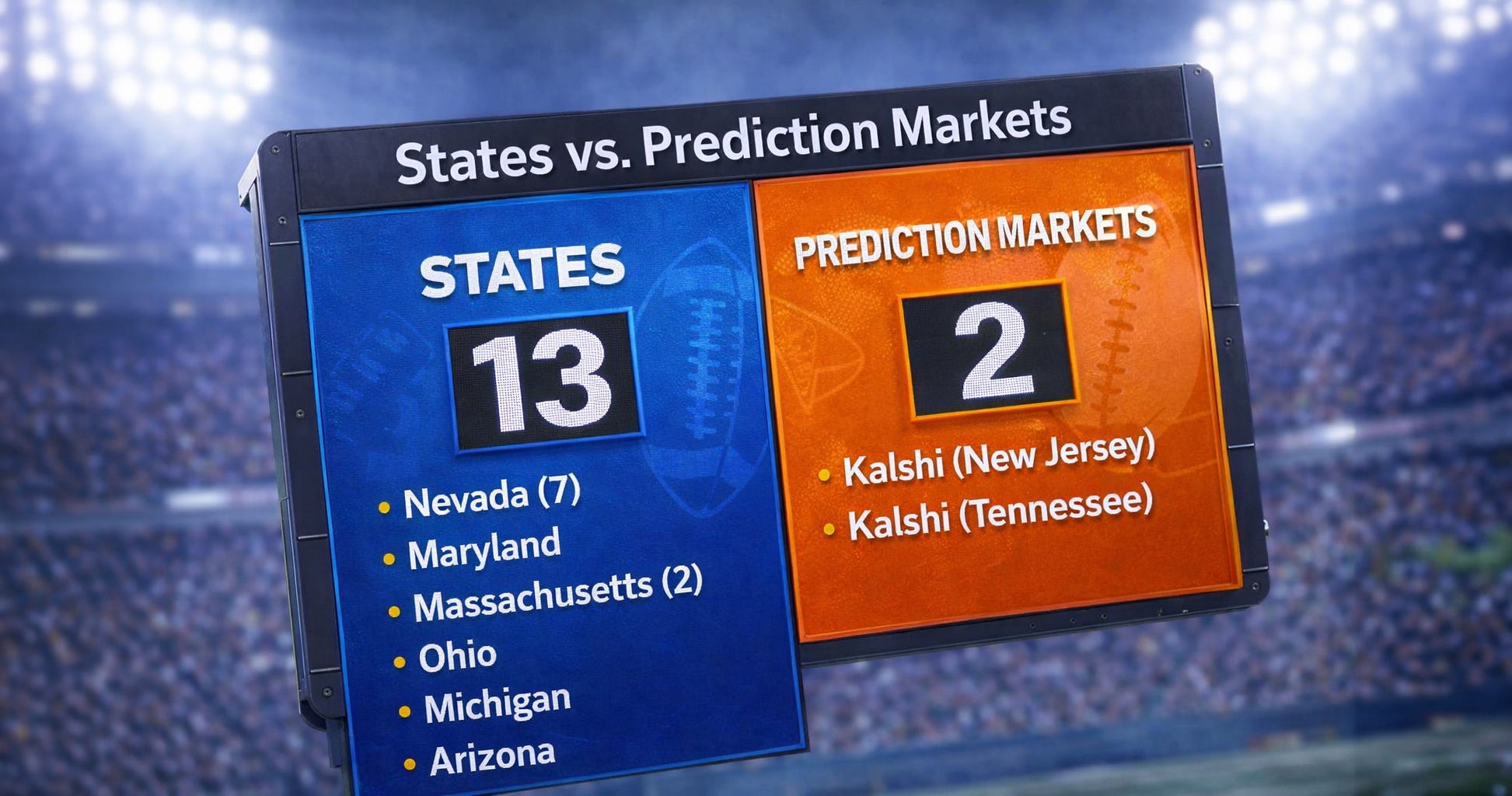
But our last post’s subtitle said it plainly: Why the states’ lead in prediction market litigation seems fragile:

Some leads are illusions, like an outside-lane mirage.
Some leads are real but brittle.

Nathan Martin catching Kenya’s Michael Kimani in the closest finish in race history? Kimani’s lead was real. Mine wasn’t.
So what about the state’s lead?
Are they actually ahead?
Or are the federal district-court and state-court skirmishes just noisy outside lanes masking the true race?
Last week on LinkedIn I wrote:
The scoreboard may not reflect it yet, but Team Prediction Markets is playing well.
And now, after the past 72 hours, that statement has aged like a fine wine.
Federal vs. State: A Plot Twist
The DOJ/CFTC lawsuit against three states was a plot twist no one saw coming:

The DOJ once sent Jay Cohen to prison over the Wire Act for offering “sports futures.”
Now it’s suing states so “sports futures” can succeed.
The CFTC once gave ErisX no choice but to withdraw their sports event contracts.
Now it’s suing states so sports event contracts can succeed.
The law hasn’t changed.
The Wire Act is still there.
The CEA is still there.
It’s the federal government’s position that has changed.
And just as that shockwave was settling in, the Third Circuit dropped its long-awaited decision.
The Third Circuit Decision

A 2-1 split win for Kalshi.
Not shocking to me–I wrote just last week that a shutout was unlikely and that a 2-1 for Kalshi would shake the Jenga tower.
The Third Circuit decision is imminent. A shutout seems rather unlikely.... A 2-1 split win for Kalshi would shake the Jenga tower. A 2-1 for New Jersey would make the tower even more sturdy… for now.
Well, the tower certainly shook.
But here’s the twist:
The correct legal interpretation isn’t fully in the majority opinion.
And it isn’t fully in the dissent either.
The best reading of the statute is stitched together–majority on some issues, dissent on others. That’s both unusual and telling. We will follow-up with a full analysis in another post.
Walking Into a Trap
Warren Buffett once quoted a saying in poker:
“If you’ve been in the game 30 minutes and you don’t know who the patsy is, you’re the patsy.”
Patsy. Fool. Same idea.
And speaking of fools, Arizona dropped this gem a week before April Fool’s Day, fittingly:

Certainly the Supreme Court isn’t composed of fools.
But one can argue that someone in this litigation is acting like one.
The Chicago Lesson: Not Looking Back
I’ve lived in three major cities: Istanbul, LA (twice) and Chicago.
We started with a running story from Istanbul.
We added another one from the LA Marathon.
So let’s finish with Chicago by watching Adriana Pirtea’s heartbreaking finish:

Adriana Pirtea had passed the reigning champion, Berhane Adere, and never looked back.
She celebrated early, assuming the race was already won.
She was high-fiving spectators.
She was waving.
Little did she know, Adere began sprinting.
Pirtea didn’t know.
She didn’t want to know.
In her mind she had already won the race.
Pirtea was the patsy and she lost the race she should have won.
Confidence is powerful–when you manage the downside.
Ignoring the downside isn’t confidence.
It’s foolishness.
Are The States Celebrating Too Early?
I’ve been critical of the states’ litigation strategy for a long time. Not because I don’t understand it–I do. I just don’t believe they’re playing their best card:

Rob Schwartz sees the tension.
Andrew Kim calls it a trap.
Paul Grewal publicly puts the odds at 90% (prediction markets prevailing on jurisdiction)
When the CLO of Coinbase is that confident,–maybe, just maybe–you should look back before you round the corner.
The DOJ/CFTC suit was the first warning sign.
The Third Circuit decision is another.
This could get ugly for states and tribes real fast.
Co-Existence Is a Myth
There will never be parallel federal sports gambling and state-regulated sports gambling in this country.

The Third Circuit tucked that issue into a footnote in the opinion (PDF):
We need not address the parties’ extra-textual arguments related to whether the Act preempts all state gambling regulation, because Kalshi does not argue that the Act preempts all state gambling regulation.
The Supreme Court won’t.
And even if it does, the prediction markets won’t.
Here’s what happens the moment prediction markets win on preemption:
They sue the states and tribes arguing that state-regulated sports gambling is illegal off-exchange swap trading (Quintenz has already said as much).
States will cry foul, accusing Kalshi of conducting an about face, pointing to that footnote in the opinion and arguing how Kalshi put the parallelism issue aside only to backtrack it.
None of it will matter.
Courts will read the statute and conclude–comfortably–that there is no room for state-regulated sports gambling.
This isn’t the Chicago Marathon.
There are no prizes for second place.
If the feds cross the finish line first, the states and tribes may lose everything.


With the Nevada decision last Friday, the latest score is 14-2.