


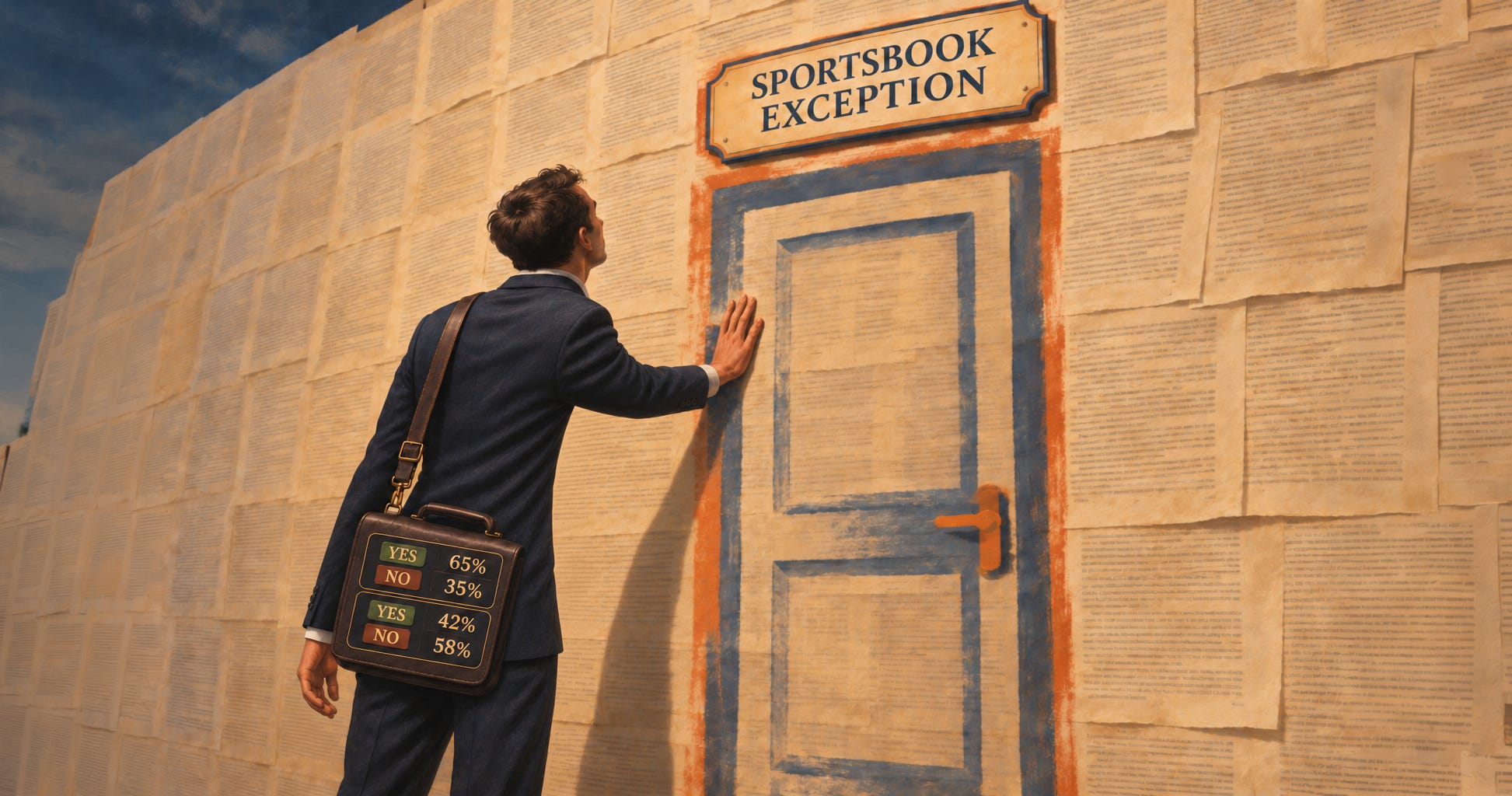
This narrative may be familiar to you:
“Prediction markets are just different.”
“You can’t trade out of a contract.”
“There is no house on the other side.”
“We don’t win when the customers lose.”
And so on.
Let’s take a closer look. Prediction markets are different mechanically. I happened to learn this early on because my Ph.D dissertation was on traditional bookmakers versus peer-to-peer exchanges.
“You can’t trade out of a contract.” Yes, that’s true.
There is no house on the other side. Well, there are market makers. And Letitia James, Attorney General of New York, has alleged that 100% of the other side of Kalshi’s sports combo markets are either Kalshi Trading directly or Kalshi approved market makers, not other every-day traders. So the jury is still out on that claim.
And yes, prediction markets don’t win when a customer loses, per se. But they certainly do win when they can find two customers to match. This is also linked to the previous narrative line.
The overall narrative already has some glaring holes, and industry observers like Steve Ruddock have challenged both the claim that peer-to-peer wagering isn’t gambling and the suggestion that there is no house. Former New Jersey Gov. Chris Christie, now an adviser to the American Gaming Association, takes up the latter point in the Wall Street Journal, citing Utah’s allegation that Kalshi’s own trading arm acts like one.
Even if the narrative were airtight, that wouldn’t necessarily mean clear skies for prediction markets. There is a more fundamental question that all these distinctions leave unanswered:
Does any of it matter, legally?
And as far I can see, it doesn’t.
When the Distinction Disappears
Why is that important? What happens if prediction markets and traditional sportsbooks are legally indistinguishable?
Well, if sports event contracts are swaps, and there is no meaningful legal distinction between those contracts and traditional sports bets, then state-regulated sportsbooks are dealing in swaps, too. Consider this excerpt from a scathing New York opinion (PDF) by Judge McMahon:
[T]raditional bets ARE “sports event contracts.”
Finally, a court characterized sports bets the way I have always expected they should. Earlier decisions danced around the issue, suggesting the implication, but never quite saying it plainly. I called this phenomenon, The Redacted Middle:

So what if sports bets are swaps? My reaction isn’t, “Oh no, those can’t be swaps!” My reaction is that if they’re swaps, they’re swaps. Maybe we have a longstanding non-enforcement issue. What conditions brought us to this point? How did we arrive at this outcome? That’s what I want everyone to understand.
I don’t reject legal conclusions simply because I don’t like them. I want to understand what led to those conclusions in the first place.
And if I’m right, then yes, that analysis extends to state-regulated sportsbooks.
So the consequences are vast. Which brings us to another question: How confident am I that nothing in the law creates some daylight between prediction markets and sportsbooks?
A Passionate Advocate
One of the most passionate proponents of the idea that prediction markets and traditional sportsbooks are legally distinguishable is Millbank partner Josh Sterling, who was reportedly in the running for CFTC Commissioner in the second half of 2025.
Sterling has discussed these distinctions on several occasions including these different podcasts from the Prediction Markets Report, Law of Code (starting at 2:31:32) and this one hosted on SBC Media:

He also recently talked about it at the NEXTPredict conference:

I strongly recommend watching the full recording of the live event, especially this panel. Elliott Stein of Bloomberg Intelligence did a wonderful job moderating this panel, and it’s an entertaining discussion. But for our purposes, let’s focus on this statement from Sterling:
What I’ve heard in court is, well, it’s either save the states or the states are doomed. I just think that’s an intellectually dishonest viewpoint, and it’s right there in the statute.
Where?
Which statute, exactly, distinguishes prediction markets from traditional sportsbooks?
I don’t see it, but let’s not take it from either of us. Instead, let’s look at what some of the high-profile companies now at the doorsteps to the Supreme Court with every incentive to identify every relevant legal argument, have to say.
After all, if that distinction really is written into the statute, surely their lawyers would have targeted it directly, would they not?
