


I had a blast at PREDICT 2026 last week. Thank you again to my fellow panelists: Rob Schwartz, General Counsel #16 at the CFTC, now with Morgan Lewis; Tyler Badgley, General Counsel #17, currently at the CFTC; and Elliott Stein, Senior Litigation Analyst at Bloomberg. It was a privilege to share the stage with all of you.
Here is a picture from our panel. That’s me speaking with the mic:

I spent most of my time talking about my Murphy amicus (PDF) and my 2013 petition. I believe it is fair to say that I was blessed with the opportunity to start thinking about these issues early. Time on any panel is limited, but if you are interested in how I, the lone non-lawyer on the panel, came to write a Supreme Court petition, I previously told that origin story (the petition is available there as well):

Back to the panel. Rob Schwartz asked me whether I think the Supreme Court should weigh in on the case. Absolutely, I said. I felt it should have taken the case 13 years ago when it had the opportunity.
If it does, and if it rules on federal preemption, an uncomfortable question will come to the forefront:
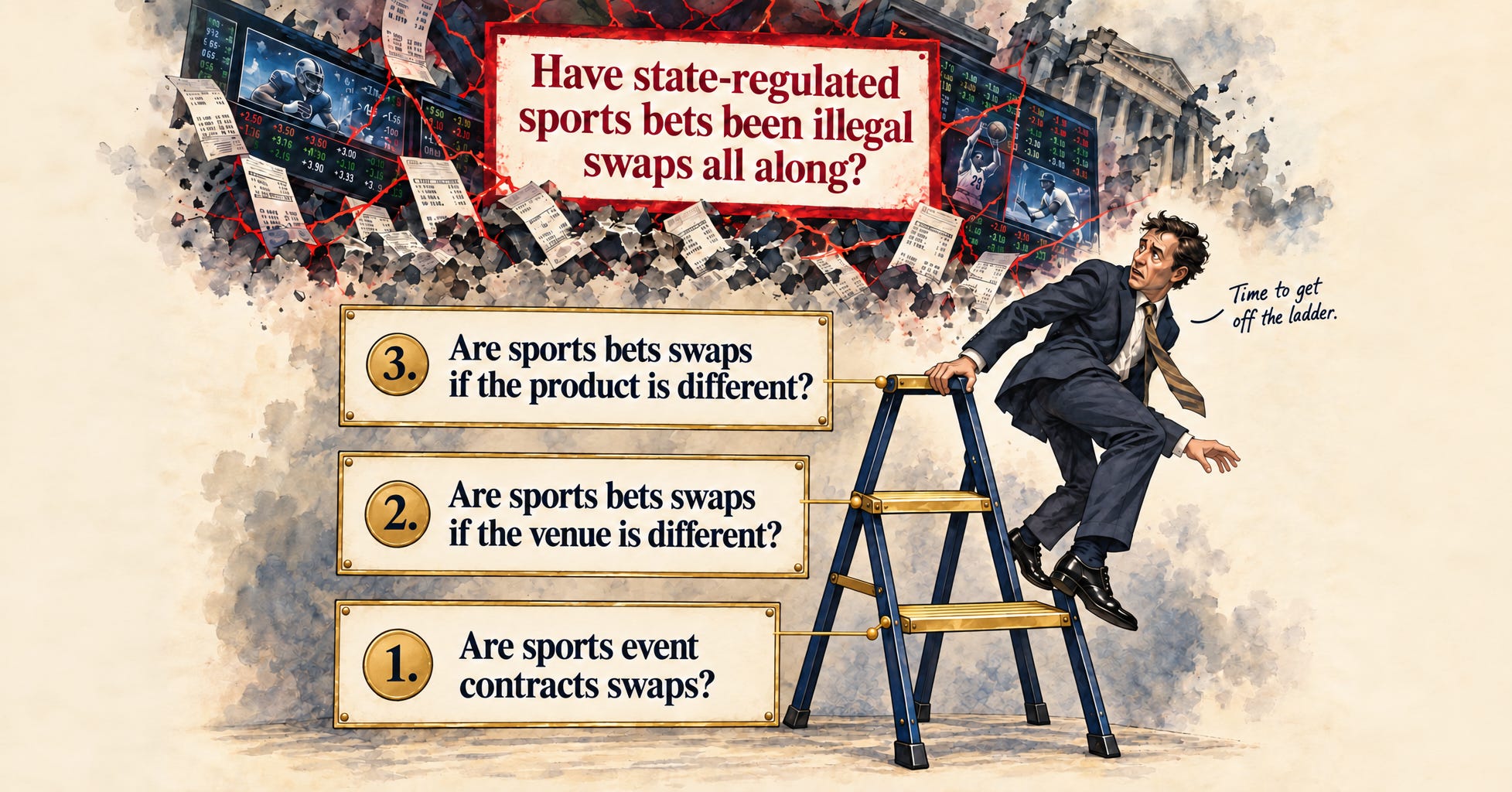
Are state-regulated sports bets swaps?
Because if they are, well, they likely have been illegal all along. And I’m far from the only one who is saying this…
If These Are Swaps, What About Those?

Somensatto reflects on the recent Illinois district court ruling (PDF) that sided with prediction markets, and follows the chain of logic: If sports event contracts over here on designated contract markets (“DCMs”) are swaps, what about those state-regulated sports bets over there? Aren’t they swaps, too? And, if they are, the law seems pretty clear that you can’t trade them legally off-exchange. There are exemptions, but they do not apply.
That argument is one I have been making for a very long time. But now that it is front and center, with a potential SCOTUS showdown looming, I started thinking: What is the best way to organize and visualize this?
I came to the conclusion that a ladder might be helpful. And there is so much nuance here, it’s impossible to cover it in one post. So let this one be the start of an informal four-part series.
Step 1 - Are Sports Event Contracts Swaps?
Last week, the General Counsel of the CFTC was sitting next to me on our panel. He made the point that maybe the CFTC should prohibit these contracts, but that does not mean they are not swaps. I agree completely. So did the Illinois court–and of course, the Third Circuit.
Somensatto’s question is an if-then, with the “if” contingent on the Illinois court getting it right. What if it didn’t? After all, if you look at our LexCurrent scoreboard, significantly more courts have ruled in the opposite direction. Maybe the Illinois court got it wrong? Let’s explore that possibility.
To do so, let’s start with the counterarguments that have found some success in the courts. Let’s call these the four paths leading to Step 1 of the ladder. If any one of these arguments holds up, sports event contracts are not swaps. In that case, we would not even reach the question of whether state-regulated sports bets are swaps.
Path 1 - Events Are Different From Outcomes
The argument has much of its origins in Judge Gordon’s opinions, which I covered in detail.
In a nutshell, the argument is textual. The statute doesn’t say “outcome.” Events and outcomes are different things, the argument goes, according to some dictionary definitions. So contracts on sports outcomes cannot be swaps.
I’ve always found that argument strange. The counterargument that comes straight from the Illinois ruling (PDF) discredits it convincingly:
Differentiating between the results of games and the contingencies associated with those results is basically semantics. Imagine two contracts, both made on August 28 before the first pitch of a game between the Chicago Cubs and the Cincinnati Reds. One bets on the Cubs winning the game. The other bets on the Cubs’s season-long record going up. Both contracts hedge against the same possibility: the Cubs losing. They pay out under exactly the same circumstances. Under defendants’ interpretation, though, one is a swap and the other is not.
It also doesn’t survive the follow-up question. Are election contracts not swaps because elections are events and there is no such thing as election outcomes? Seems counterintuitive, right? The obvious answer is “Yes, elections certainly do have outcomes.”
Finally, I dug deep into some contemporaneous rulemaking efforts by the CFTC (PDF), which makes it pretty clear that, at that time, the regulator did not view “events” and “outcomes” differently; they used those words in the same sentence. If you need a regulatory smoking gun, that one works pretty well.
I don’t believe this argument holds water. I laid out the reasoning in detail in my event vs. outcome-focused publication:

Next.
Path 2 - It’s Not A Swap If It’s Entertainment
Aaron Klein (Brookings Institution) makes the argument:

The idea here is stronger. Certainly, the Commodity Exchange Act (“CEA”) has something to do with economic purpose. Broadly speaking, the US has carved its own path by keeping gambling via futures at bay, away from financial markets. I have always believed that was a core policy choice that made U.S. markets the world’s best.
The problem? Nothing in the definition of “swap” actually says that. Congress could have said “hedging,” “economic purpose” or “public interest.” But it didn’t.
And here is an unappreciated piece of legislative history. The relevant words in the swap definition–“occurrence, nonoccurrence, or the extent of the occurrence of an event or contingency associated with a potential financial, economic, or commercial consequence”–did NOT come into the statute through Dodd-Frank. I repeat: These words are NOT a product of Dodd-Frank. They came in via the Commodity Futures Modernization Act (“CFMA”) of 2000.

Why does that matter? Because there is this narrative that Dodd-Frank, which was meant to right some wrongs associated with the deregulatory attitudes of the early 2000s, could not have made sports betting permissible.
For starters, permissibility under the CEA is a different question, one that has to be tackled via the Special Rule. So that argument already does not rest on a strong foundation. The foundation is even more unstable when you consider that the words we are debating are the words Congress already chose a decade earlier.
But let’s go further. Even if Congress chose these words in 2000, not 2010, could it have intended the “consequence” language as a substitute for “economic purpose”? If yes, then Aaron Klein would be correct.
I have thought deeply about this question. I also happen to know the person whose fingerprints are all over the CFMA. I ultimately concluded that the “consequence” language was not meant to be a substitute for economic purpose:

I have a great deal of sympathy for the argument that sports event contracts are inconsistent with what Congress envisioned, but I refuse to bring that thinking into the definition. Once again, preemption and permissibility are different questions.
Congress gave the CFTC exclusive discretion over these contracts. Feel free to challenge the wisdom of that decision, but it is difficult to dispute that this was precisely Congress’s intention. And if we agree with that, we can certainly take issue with the CFTC not taking action. But that, too, has nothing to do with how swaps are defined.
If sports event contracts are not swaps, that conclusion should be supported within the four corners of the exclusive jurisdiction provision. Nothing else.
Path 3 - Consequences May Not Exist
This brings us to an argument that sounds convincing at first glance. Gary Gensler, for one, made it here:

He said:
In the body of the statute… there’s words that clearly express that has to be associated with commercial, financial, economic consequence. Risk. That’s not what whether somebody makes a three point basket in the third quarter. That’s not what Congress was addressing.
Gensler is doing two things here, and it’s helpful–in fact critical–to separate them. First, he makes the same argument Aaron Klein is making. He claims that the definition itself is about risk. And to his credit, the swap definition does mention the word risk a couple of times. But, and this is important, it does so in the context of interest rate swaps and similar instruments, not in the prong that describes event contracts.
Even if the bridge from “risk” to “hedging” is plausible, Congress could have explicitly mentioned the word “risk” in the event contract prong of the swap definition (ii). It didn’t. And that interpretation would likely make the “gaming” prong of the Special Rule superfluous, too. So, we end up back where we started.
But the second part of Gensler’s argument deserves equal attention, because there is something here. What exactly is the commercial consequence associated with a random three-point shot?
This path represents perhaps the strongest barrier to the swaps step because it actually appeals to people’s common sense. It is not intuitive to see what financial, economic, or commercial consequence a micro-trade would offer. Some would, of course, call these prop bets. Parlays are even more troubling.
From a statutory standpoint, Gensler’s argument does have some force. It doesn’t bring outside considerations or contextual readings into the statute. It’s right there, part of the definition. If there is no association with a potential financial, economic, or commercial consequence, it is not a swap, period.
The argument is powerful for two reasons. It appeals to one’s own common sense, AND it uses the statute’s own words against itself.
Why, then, could it fail?
Three words: The Super Bowl.
Let’s start with the premise and follow the logic to its conclusion. If you say, in basketball, a three-point shot is not associated with any such consequence, you have my ear. But let’s keep going. What about a regular season game? What about a playoff game? What about championships? What about the Super Bowl?
I discussed this at length:

This is the problem: What works in isolation doesn’t work as a limiting principle. Faced with this same conundrum, Kalshi’s counsel had to concede (PDF Transcript) that there is some invisible line somewhere.
JUDGE CHAGARES: What are some kinds of sports betting that would not fall within your definition of swap?
MR. HAVEMANN: I think that there are probably certain player props that would not have, you know, sufficient economic consequences to fit within the definition.
I believed that was a concession that didn’t need to be made. If your answer to the swap question changes when the event is significant enough, and I just can’t see how it wouldn’t, where does that leave us?
The CFTC, in its current state, has a seriously reduced staff including only one commissioner whereas the norm is five. The broader agency also has seen some cuts, which was one of the topics discussed at PREDICT 2026, with Latham & Watkins attorney Yvette Valdez calling on the CFTC to grow substantially especially if sports is under its remit.
The CFTC regulates commodity futures, not the underlying commodity itself. But it does have enforcement authority over the spot markets. That was also Rostin Behnam’s concern over election contracts and the need to be the “election cop.”
What does that mean? The CFTC is already seeing a consistent inflow of event contracts. Dorothy DeWitt offered a vivid analogy at the conference (I am paraphrasing): Imagine a “ping” every time a new event contract is introduced. In the old days, those pings were occasional. Today, it’s “ping, ping, ping”—a steady stream of activity.
The CFTC is responsible for policing all of that; even with self-certification, regulators still need to make sure the contracts comply with the core principles and determine whether they warrant review under the Special Rule. Sports contracts increasingly dominate trading volume across these markets, making the agency’s job that much harder. And now, on top of all that, does the CFTC also need to decide which event contracts have sufficient association with a potential commercial consequence to separate what’s in from what’s out? And if there is disagreement, the courts sort it out after the fact? That is simply untenable.
At the conference, Jack Murphy of Akin Gump talked about a similar concept in a different context. If I recall correctly, his example involved “mention markets.” President Trump saying “tariffs” alone doesn’t seem to have much consequence. If he says, “I intend to raise tariffs by 50%,” that might.
Sports, by virtue of its reach, presents the same problem on a much greater scale. Let me illustrate the tension:
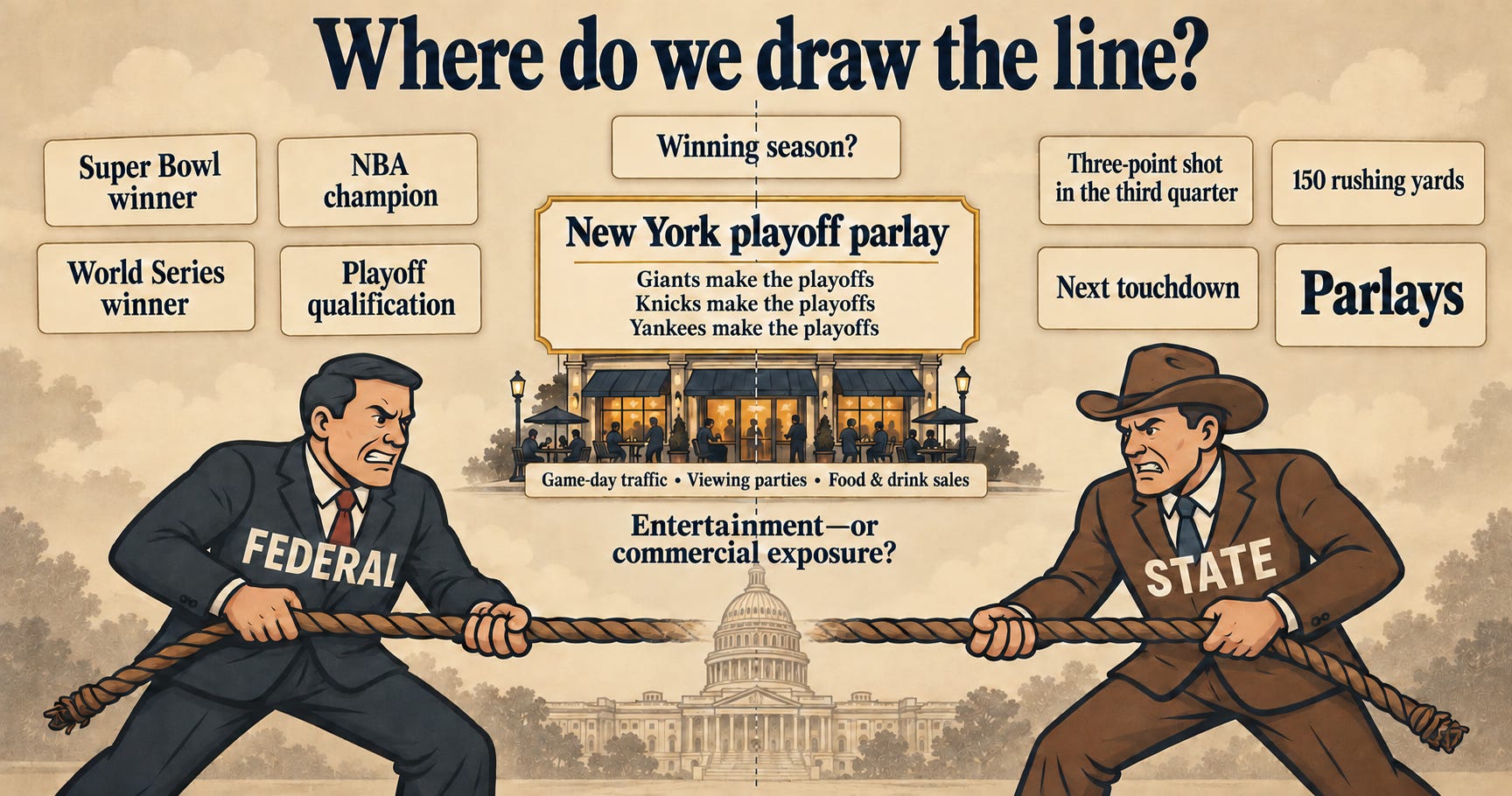
Prediction markets get Super Bowl and other important events, with a dividing line nobody knows where to draw. States get everything else. Not a horrible outcome for prediction markets: They would end up with the highest-volume markets, but litigation would be never-ending.
Where exactly should the line be drawn? Is a winning season commercially significant enough? Sometimes that gets you into the playoffs, but not always. And either way, is that enough to qualify as a swap?
Even parlays are up for debate. Sure, it is difficult to see what Josh Allen throwing for three touchdowns, Bijan rushing for 100+ yards, and CeeDee Lamb catching two touchdowns would mean for any business. But what about my New York example illustrated above? That is a parlay, but there is at least an argument that three New York franchises qualifying for the playoffs may create material business risk that some businesses might want to hedge.
Again, I view this as the strongest path that the states have. But there is no limiting principle here, so I reject this argument. I like my resolution better. Simply accept the fact that Congress did a subpar drafting job here and work to get it clarified further. It did write broadly, and if you look at the statute in whole, it makes sense. The swap filter is broad. Anything can be a swap.
That doesn’t mean the three-point shot contract or the 10-leg parlay belong in financial markets. The Special Rule takes care of that. The CFTC’s failure to take action on these contracts creates the illusion that the definition is the problem. In reality, the people’s discomfort appears to be less about whether these are swaps and more about whether these swaps should be permitted.
But again, that’s a different question.
Path 4 - Consequences May Exist, But They Are Downstream
This is slightly different from Path 3, which challenges the existence of potential consequences. Here, the question is whether those consequences are direct or downstream.
I believe this one is easier to dismiss. For starters, none of that distinction is in the statute. And “associated with potential … consequence” comfortably covers direct and downstream consequences.
In addition, the argument fights against itself. Chris Dodd–yes, as in Dodd-Frank–submitted an amicus brief (PDF) and said:
A comparison between sports wagers and traditional derivatives illustrates this distinction. A bank is exposed to changes in interest rates; an importer is exposed to currency fluctuations; and a farmer is exposed to changes in commodity prices caused by weather and other conditions. (emphasis added)
It is curious that Dodd actually used the example prediction markets love to cite: weather.
When the interest rate changes, my bank automatically adjusts the APR on my credit card. I don’t lift a finger, but my bank account feels the pain if I carry a balance. And if I am the bank on the other side, revenues do go up or down, which could be material.
In other cases, it’s not the event itself that creates the financial risk, but the consequences of that event. When it snows, a de-icing compound business sells more product. The lack of snow creates a P&L risk they may want to hedge. Dodd admits as much saying, “caused by.” Merriam Webster defines “cause” as “something that brings about an effect or a result.” That sounds like… downstream?
And the same argument extends to elections, too. What was the economic result when President Trump was elected? Like, what actually happened that night? Sure, stock and crypto prices may adjust quickly, and perhaps some options and futures with them. But there is no denying that there may also be rather significant impacts downstream–the president changing tariff policy, for example. A campaign promise, coupled with an election result may move the needle. Implementation of a new policy may move the needle again. By the direct vs. downstream distinction logic, elections may also be off the table.
I don’t believe this path is credible for the states at all.
Bringing Step 1 and the Four Paths Together
Let’s put it all together and visualize it:

Some paths are stronger than others. I believe Paths 1 and 4 are nonstarters: They are arguments manufactured to reach a particular outcome. Path 2 has some plausibility and earns my attention, but I don’t see it surviving a textualist reading.
Path 3 is the strongest. It appeals to both my common-sense persona and the textualist in me, but the line-drawing problems are extremely serious. If no limiting principle can be found within an ocean of thousands of event contracts, I’m out. My hunch is that at least five Justices will come to the same conclusion.1
Let’s keep climbing…
Step 2 - Are Sports Bets Swaps If The Venue is Different?
Assuming the swap characterization of sports event contracts holds up, we are now past Step 1. The immediate question becomes: What about traditional sports bets?
One argument is that sports bets still get a pass because they happen at a different venue. The co-existence argument.

I don’t believe they get that pass, and the reason is simple: The law doesn’t make a venue exception. But file that thought and please visit us again. Next on FCP: Congress Didn’t Write Half A Sentence.
Step 3 - Are Sports Bets Swaps If The Product is Different?
There is one more path that may be available to traditional sports betting that would disqualify them as swaps, even if there is no venue exception. There may be a product exception. Sports bets, the argument goes, are just a different animal. On an exchange, you don’t bet against the house (although there are still some arguments against this because of the exchanges’ market makers trading against you) and you can trade out of the contract.
I don’t believe this line of reasoning is convincing either, because I don’t see anything within the four corners of the statute that supports it. To be clear: I am not denying that these two models are different. The lead paper in my Ph.D. dissertation was bookmakers vs. exchanges, after all. What I reject is the argument that the law suggests different treatments based on these differences. The most anybody could cite on this is the CFTC and SEC’s 2012 interpretive guidance that does not even mention sports.
All that said, please come back for Part III where we discuss: The SportsBook Exception That Isn’t.
The View From Atop
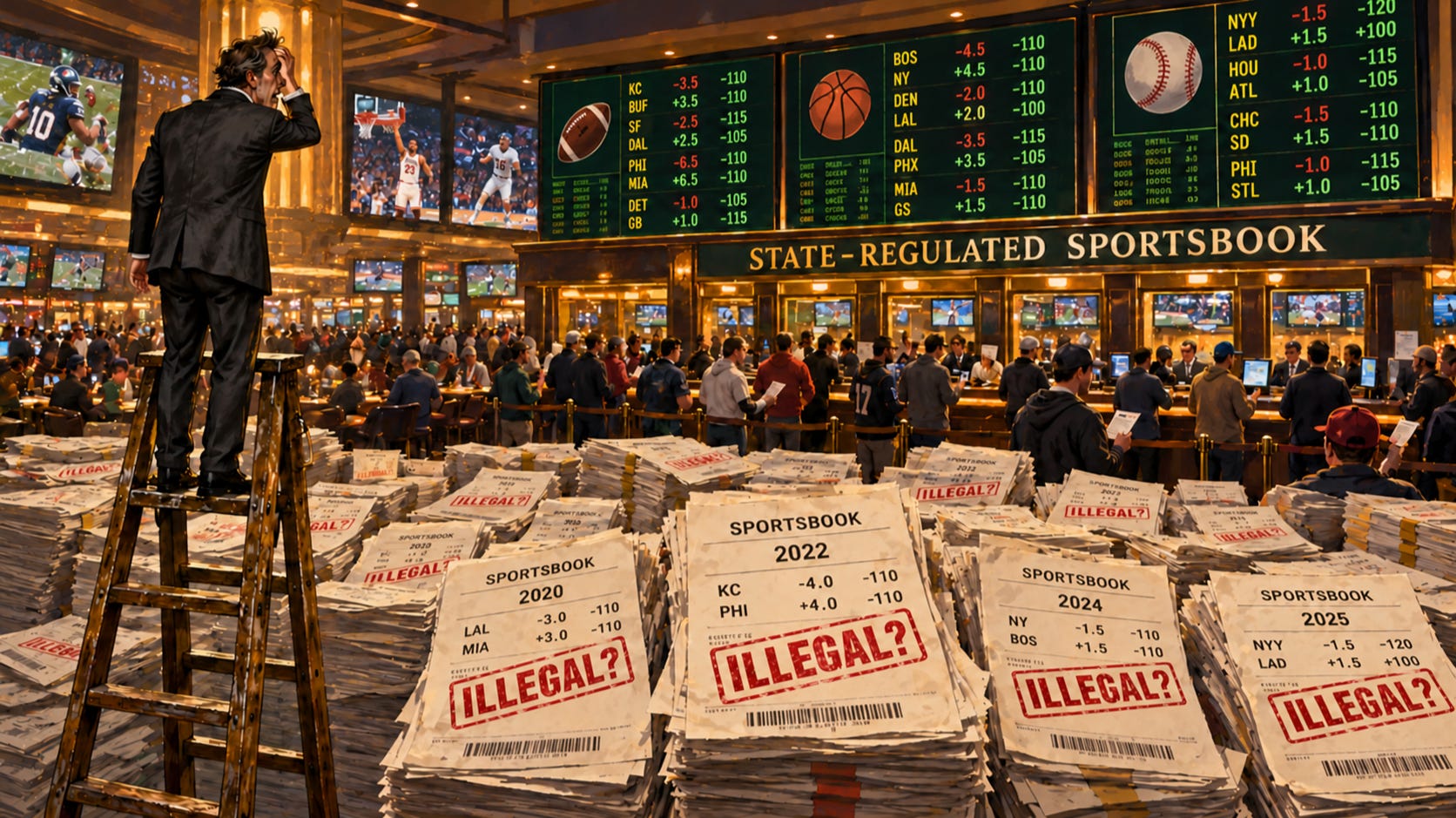
So we covered Step 1 in detail and provided an initial outline of Steps 2 and 3. Now we are at the top of the ladder.
What happens once you climb to the top?
The view from there is… disturbing. Essentially, most bets are off. The ones that have been allowed in state-regulated sportsbooks and casinos.
Bets totaling $167 billion were placed last year alone. Since inception, it’s nearly $700 billion. Was all of that… in violation of the CEA?
That view must have been frightening for John Lothian, one of the godfathers of the futures industry. He did pretty much the same analysis I did, and concluded… That can’t be.
An apparently absurd conclusion can become a very effective weapon in the hands of good counsel, however. This is precisely why state advocates have been encouraging the courts to climb the ladder. The gist of the argument is: “Let’s walk up together, Your Honor. I really want you to see how absurd this is.”
Both the state of New Jersey (PDF) and Nevada said it was absurd. And now we are seeing the same argument in the SCOTUS amicus briefs, including Chris Dodd (PDF) and Gary Gensler (PDF).
If you are an attorney in the courtroom, this is how you turn the inconvenience into a strength. The outcome is absurd + courts do not like absurd results → What do you end up with? Climbing back down to Step 1: These can’t be swaps.
If you don’t like where your legal reasoning takes you, could you abandon the ladder of logic? I have always thought this is a very strange way to conduct proper legal analysis. We don’t like the consequences, so let’s change the answer. But it’s hard for me to conclude anything other than that’s exactly what has been happening.
Put absurdity aside for a moment. What I’m saying is not novel. It’s not even a stretch argument. I’m literally just reading the law, like many others. And the law is not ambiguous on this. If sports event contracts are swaps, and sports bets look very much like sports event contracts in the eyes of the law, they must be swaps, too. But the law does not allow off-exchange swaps unless exempted, and sports bets are not exempted (and therefore illegal).
Of course, nobody wants to hear that. Especially the sportsbooks.
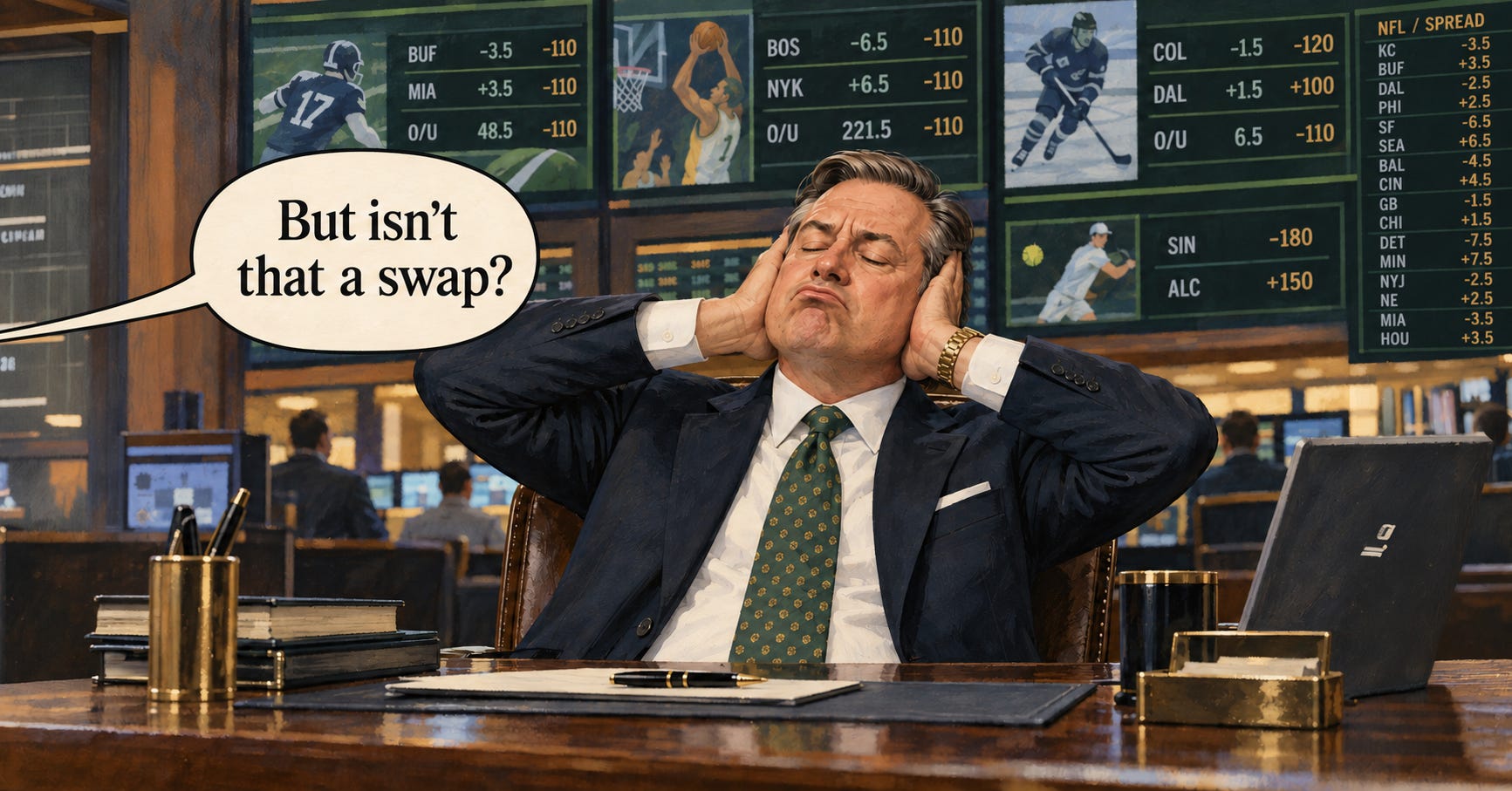
I don’t think reading the law to its conclusions is a unique talent I have. What separates me from many others, I think, is being comfortable with extremely uncomfortable outcomes. The Third Circuit, the Illinois district court, and Matt Levine seem similarly comfortable with the uncomfortable.
Illegality for almost a decade? Why is that not an option?
Blame Trump’s CFTC for not acting on sports event contracts offered by prediction markets if you want, but Biden’s CFTC–and to a lesser extent, Trump’s CFTC in his first term–did exactly the same thing. The issue is not political, really. It’s nonpartisan.
You might say, well, if it’s bad for the states, it must be good for prediction markets. Why are they not making that argument?
Ask prediction market counsel in private, and I guarantee you the majority of them will agree with the legal analysis. Brian Quintenz already has, as part of the public record. They just don’t want to say it out loud, because pushing on that issue creates the risk of losing the argument because of the inconvenience of the consequences. They work backwards from that.
They specifically ask the courts NOT to climb the ladder. Nothing to see here, they say. What we do over here has nothing to do with what they do over there. We can co-exist.
How do you win the overwhelming majority of the cases in a hotly contested matter? You win either because the law is on your side or because lawlessness has been on your side for a while. As strange as that sounds, I am pretty sure I’ve got this right. States are winning because the consequences are alarming, but I am with Matt Levine on this one. I don’t believe the Supreme Court will care.
That said, there is exposure on both sides here, and the consequences of losing are enormous. Neither side really wants this question squarely presented because of its magnitude. In fact, prediction markets don’t even seem comfortable with having contracts available on the SCOTUS outcome. In today’s Money Stuff newsletter by Matt Levine, he offers a fascinating discussion that cites an academic paper by Joseph Grundfest which proposes that Kalshi list a “Kalshi Sports Legality” contract indexed to the outcome of the SCOTUS litigation, addressing whether Kalshi’s sports-indexed contracts are federally regulated in a manner that preempts state law. Similarly, during last week’s PREDICT 2026 conference, Chad posed a question to ProphetX CEO, Dean Sisun: “Wouldn’t it make sense, given there are billions of dollars at stake on a Supreme Court decision (under the assumption the petition(s) are chosen), for prediction markets to create a market that could help offset their own risk?”2
The stakes are real, and the consequences are enormous. Even a narrow ruling could shift who gets to regulate sports wagering–and who gets to offer it. A broader ruling could wipe out sports event contracts or expose state-regulated sports betting as illegal all along. Neither side seems to want to invite a ruling that could undo its own business. And that reluctance has created an almost obvious void in the SCOTUS petitions that have been written.
Petitions That Ask Narrow Questions
When the three SCOTUS petitions were filed, I put the questions presented side by side and posted them on LinkedIn:
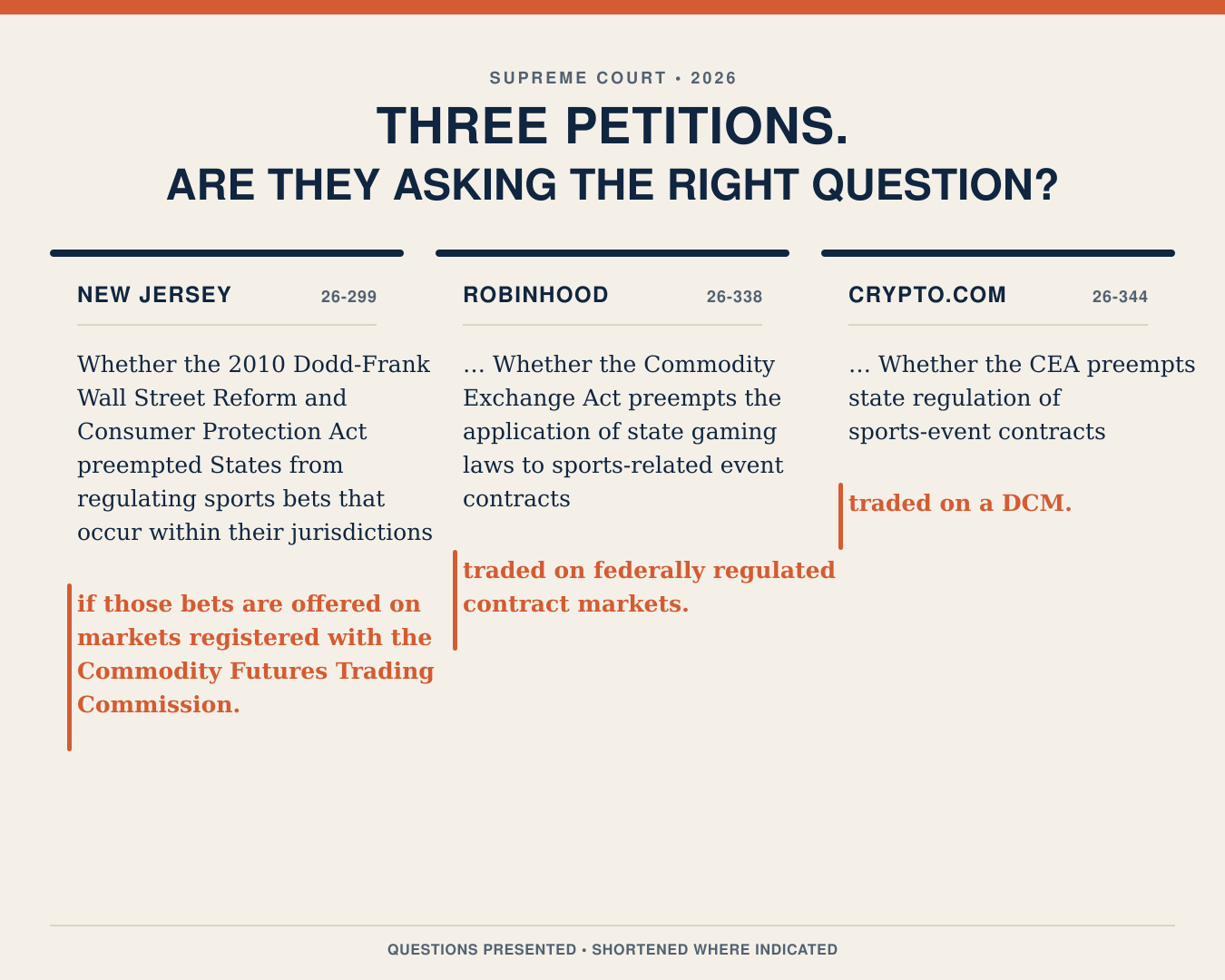
What do you see?
Neither side is asking whether sports bets on state-regulated sportsbooks are swaps. States don’t want to ask that question for obvious reasons, it presents a very uncomfortable potential outcome. But neither do the prediction markets.
The view I take about these petitions is that prediction markets want the Supreme Court to stay on Step 1. The Justices may lean textualist, following in Justice Scalia’s footsteps, but what if they climb the ladder, become frightened by what they see, and–God forbid–go back down and reconsider Step 1? Best they stay right there.
Just in case they do climb, the prediction markets bring Step 3 arguments into the petitions, giving themselves one last chance (and the Justices a potential out) to differentiate their products. Both Robinhood and Crypto.com made the consumer-transactions arguments in passing in their respective petitions.
What about the states? If prediction markets are worried about the perception of illegality tainting the final outcome, wouldn’t they want the Supreme Court to climb the ladder?
Well… Yes and no. The perception has mostly worked in their favor thus far, but they really don’t want a textualist-leaning Supreme Court presented squarely with the question. If the question is out there, the Supreme Court will follow the law; that’s what they do, consequences be damned. And if they do, state-regulated sportsbooks may go away within the next 12 months.
Better NOT to ask the question, but weave it into the story and let their “friends” weave it into the narrative through the amicus briefs.
In a weird way, a narrow question works for both sides here. The likely outcome is an expansion of commerce, with people having multiple avenues to gamble on sports. The American consumer stands to be the real loser.
What Happens Now?
Chris Sieroty of CDC Gaming memorialized my take in his piece, along with the other observations from our panel.
What the media did not cover, and what you would have missed if you were not in the audience, was the second half of my comments. SCOTUS taking the case will bring clarity to whether states can reach sports event contact trading on DCMs. What it would not provide? Broad clarity on what the rules of the road are at the delicious but dangerous intersection of sports and money.
Like… Are state-regulated sports bets swaps?
The answer is almost certainly yes. And if you are prediction market counsel and want to avoid the conversation, there is only so much you can do. The law doesn’t give you much latitude if any at all.
But if you are the CFTC, you can do more. Last Friday, the CFTC issued its Interim Final Rule on what activities may be excluded from the definition of swaps:
The Commodity Futures Trading Commission today published an Interim Final Rule that codifies the CFTC’s longstanding position that casino-style gambling products, including wagers placed on sportsbooks and casino games, are excluded from the “swap” definition.
Attorney Ariel Givner commented:

In my last post, I argued that the moment prediction markets secure a victory on preemption, they will turn around and sue one or more states or state-regulated sportsbooks.

The CFTC’s move is a plot twist that changes the calculus but not the incentives. Now, if a prediction market decides to go after a state-regulated sportsbook, the sportsbook can say, “I am just following federal rules. The federal regulator told me that I am different.” So a prediction market would need to challenge the federal regulator instead.
That, too, deserves an entire post. Cutting the Rope, the finale in this series will be dedicated to that exploration.
I don’t know whether SCOTUS will rule in favor of preemption, although, for reasons outlined above, I can’t really see how a textualist reading could conclude otherwise. What I’m more confident about is that SCOTUS taking the case will leave more unfinished business–resulting in additional rounds of litigation.
Or, as I stated in the panel:
We may be back at this conference for years to come.


To be sure, there were some other arguments made during litigation, drawing from the rest of the statute, the potential state carve-out (the savings clause) being one of them. I don’t think that works either, but we’ll keep that discussion outside this piece. Chad wrote about it here.
Prediction markets that have an inordinate amount of sports event contract volume as part of their overall revenue intake, have significantly more risk than exchanges such as PredictIt that have shied away from sports contracts entirely.