


It’s Litigation Sequencing week and today we pull into Stop #2: Preemption.
On Monday, I introduced the idea of litigation sequencing–the observation that in complex regulatory disputes, the most important question is often not who is right, but which question gets answered first. Yesterday, we covered Stop #1: Permissibility. The train has already left that station. So today, we’ll put permissibility aside for a moment, shift to the next stop on the route and will discuss: Who gets to control these markets?
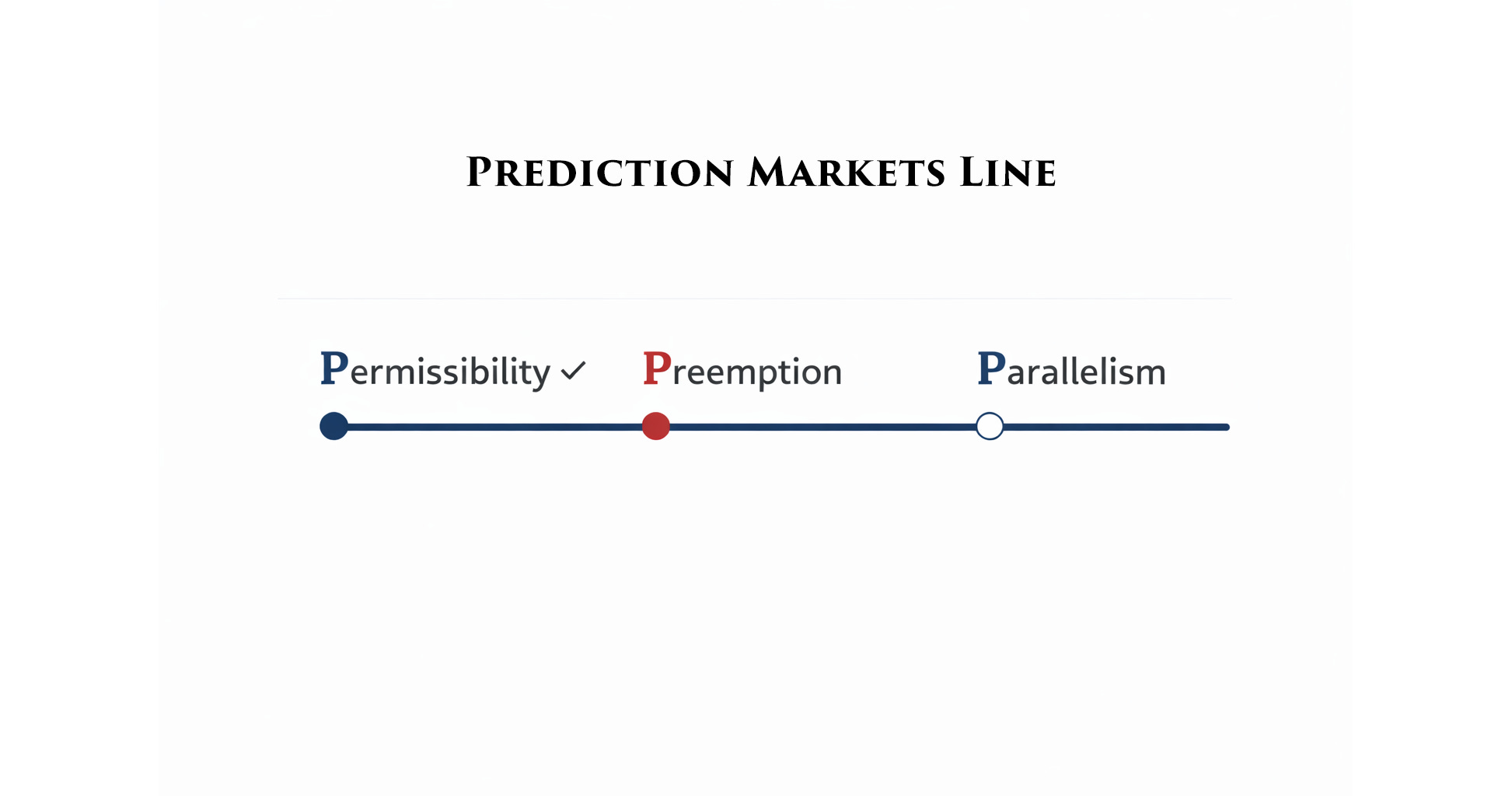
A Quick Recap on Permissibility
If you’re joining the series here–or just want a refresher–here’s the core question from Monday:
Permissibility: Are event contracts allowed under the Commodity Exchange Act?
In Kalshi v. CFTC, the question was narrower:
Are election market contracts allowed under the Commodity Exchange Act?
The best way to map parties’ positions is an infographic, so let us reproduce that here.
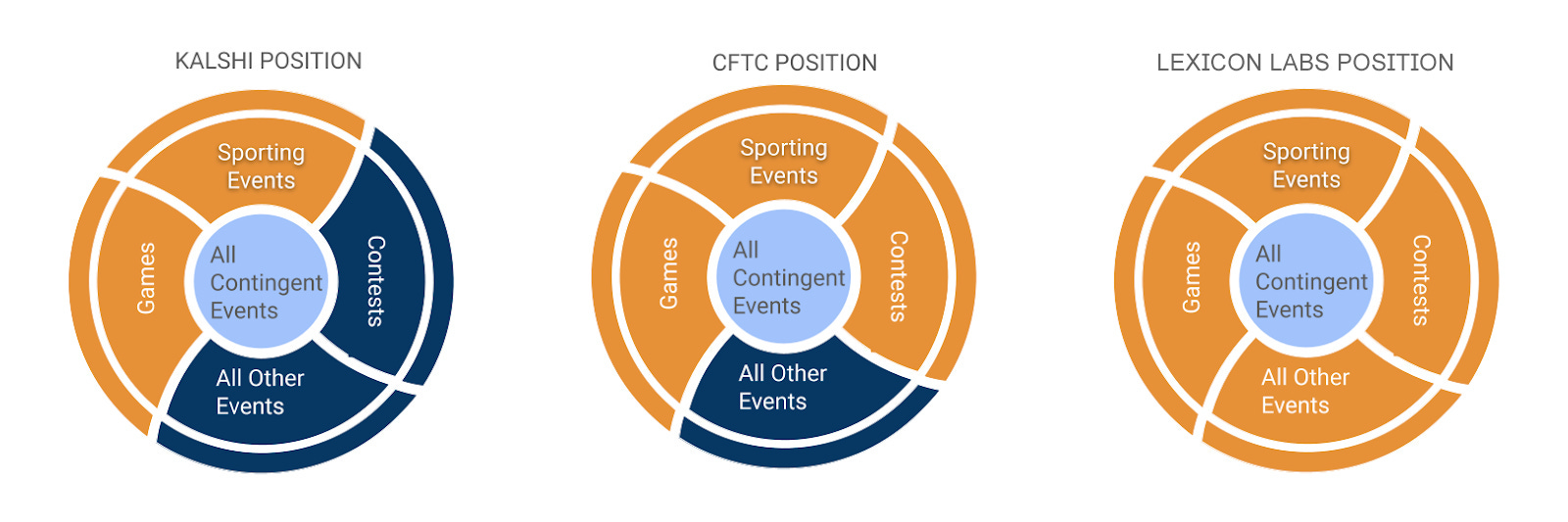
The circle: Represents the universe that contains all contingent event contracts.
The orange: The subset that the CFTC has specific review authority on.
The dark blue: The subset that the CFTC doesn’t have review authority on.
During litigation, the parties agreed on one key point: Sports events contracts involve gaming. The court concurred (PDF):
[E]vent contracts related to any of the sporting events the senator mentioned on the floor could implicate the gaming category.
… and used it as a basis to distinguish it from election contracts:
In fact, if the Court were to take anything from this floor exchange, it would be that the senator would not have intended “gaming” to include elections given the examples offered.
So, basically, the court did touch on the colloquy (PDF), and started to draw some limiting principles around the sports event contracts:
They might involve gaming; and
They were different from election contracts.
But because sports event contracts weren’t before the court, the issue was left unresolved; that gap would later matter.
This was litigation sequencing at its finest.
Kalshi didn’t win because the court decided election markets were good for society. They won because the court concluded the CFTC lacked authority to review them. The only venue to fix that was the appeal, and Kalshi went through the briefing, oral argument, etc. Throughout, they continued to distance themselves from sports event contracts. But that position, while not legally unreasonable, was certainly commercially undesirable. Kalshi realized the grand prize was now within reach, and they didn’t mind doing a colossal 180.
Next came the move that would not have happened under any other administration: Kalshi self-certified its sports event contracts (PDF). Predictably, litigation followed.
The Train Is Leaving The Station
By early May 2025, the preemption fight was already underway. Kalshi was leading on the scoreboard 2-0, having scored two early wins in Nevada (PDF) and New Jersey (PDF). In other words, the train had already begun its boarding process.
That’s when the CFTC believed it was on the wrong train, and hopped off; they dropped their appeal. They would reappear later, but in different clothes.
And just before the doors closed, I stepped through.
May 5, 2025 was the day my wonderful 19-year journey with PwC ended. I had been following prediction markets closely, and now was time to go all in. Three days later, New Jersey appealed (PDF) its loss to the Third Circuit. An amicus opportunity presented itself, and I began drafting immediately.
Because I had been tracking the litigation, the issue was obvious: The courts had moved to Stop #2 without ever resolving the permissibility of “sports event contracts” while at Stop #1. This is what created the false binary:

The DC litigation resolved the question:
Are election contracts allowed under the Commodity Exchange Act?
And not:
Are sports event contracts allowed under the Commodity Exchange Act?
But somehow, this “little” detail called “sports event contracts” got lost in the shuffle.
The Express Train Problem
When I lived in the Greater Chicago area, I preferred the express trains–fewer stops, faster rides. The issue is that stations are skipped and people get left behind.
Prediction market litigation is an express train.
Zoomed in, it looks like a federal vs. state fight, and today, that’s mostly true. We are squarely at Stop #2: Preemption.
Zoom out slightly, though, and you see the real reason we’re here: The permissibility question for sports event contracts is not just missing from the docket today. It never appeared on the docket, ever. The litigation train went straight to the preemption stop:
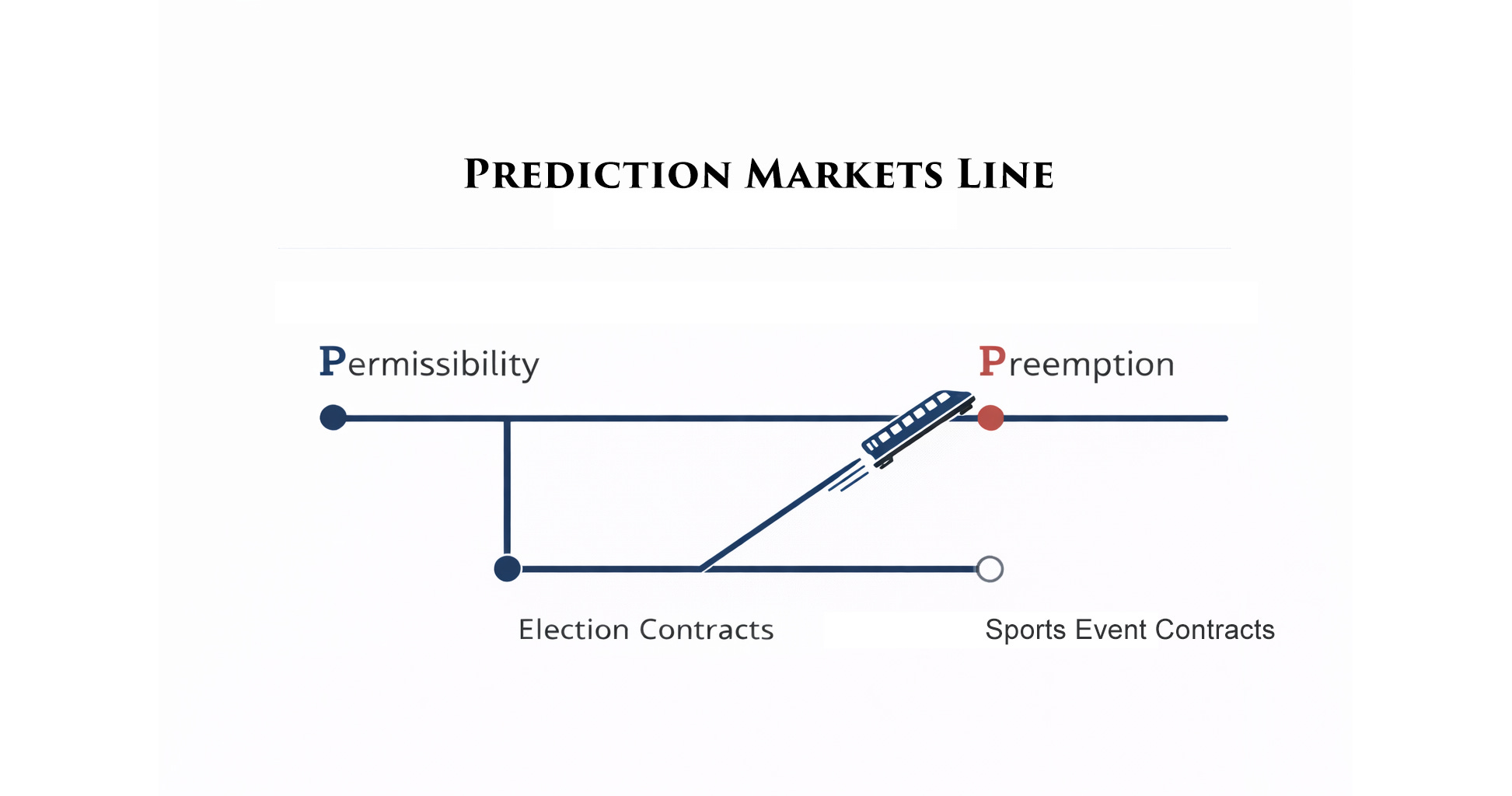
We are living inside a false binary created by Kalshi’s strategy and the CFTC’s inaction.
The states’ frustration is understandable. Sympathy may even be warranted, but sympathy cannot trump the statutes. The CFTC had the discretionary authority and chose inaction. The states were fighting against the wrong party.
That became the premise of our amicus that was filed by one of my favorite partners, Scott Brenner with Parlatore Law Group.
Our Amicus Position

Here is a summary of our position (also located on Lexicon Labs website1):
This is a case of agency inaction, not preemption;
The Commodity Exchange Act preempts the field; sports is an excluded commodity;
The CFTC has sole authority over sports-related event contracts;
Sports gambling cannot occur on a CFTC-regulated exchange–or off-exchange–unless Congress changes the law; and
The APA and Loper Bright provide the tools to serve as a checks and balances on agency inaction.
And if you’re wondering how my personal story led to that moment, this video is a good place to start.
Kalshi itself agreed that a state dispute was the wrong vehicle to resolve the underlying legality of its contracts. They wrote (PDF):
This case is not a proper vehicle to determine whether Kalshi’s contracts are swaps. In arguing that Kalshi’s contracts are not swaps, Defendants in substance challenge the CFTC’s decision to permit these contracts. The proper forum for that claim is through an APA lawsuit against the CFTC, not an action against Kalshi in which the CFTC is not a party.
At bottom, our amicus was an effort to alert the Court that the dispute in front of it would not, and could not, resolve the matter from a public-interest perspective. The evaluation had to be holistic. It was our way of saying: Your Honor, this case is only here because of litigation sequencing.2
The consequences of affirming are not abstract. Affirmance would leave Kalshi running a marketplace largely relying on a product the CFTC would have denied had it conducted the review the statute permits. We analyzed those contracts through the Lexicon Lens and determined that those contracts were both: i) not permissible under the CEA; and ii) almost certainly illegal under the Wire Act:
The Legal Status of Sports Gambling in America

Yesterday, we published Normalized, Not Legalized: A Response to Matthew Yglesias. Our main thesis was simple: Yglesias was operating under the incorrect assumption that sports gambling is a matter reserved to the states.
We did not raise the Wire Act issues in our amicus; we are pretty certain that the Court would have ignored it. We did, however, emphasize that the APA is the proper vehicle to prevent an outcome that makes no sense–legally, structurally or from a public-interest standpoint.
The Third Circuit’s decision is due out any day. Whichever way it goes, unless the Court decides to opine on permissibility, the consequences will be significant, and ironically, neither will aid the American public.
Taking Stock
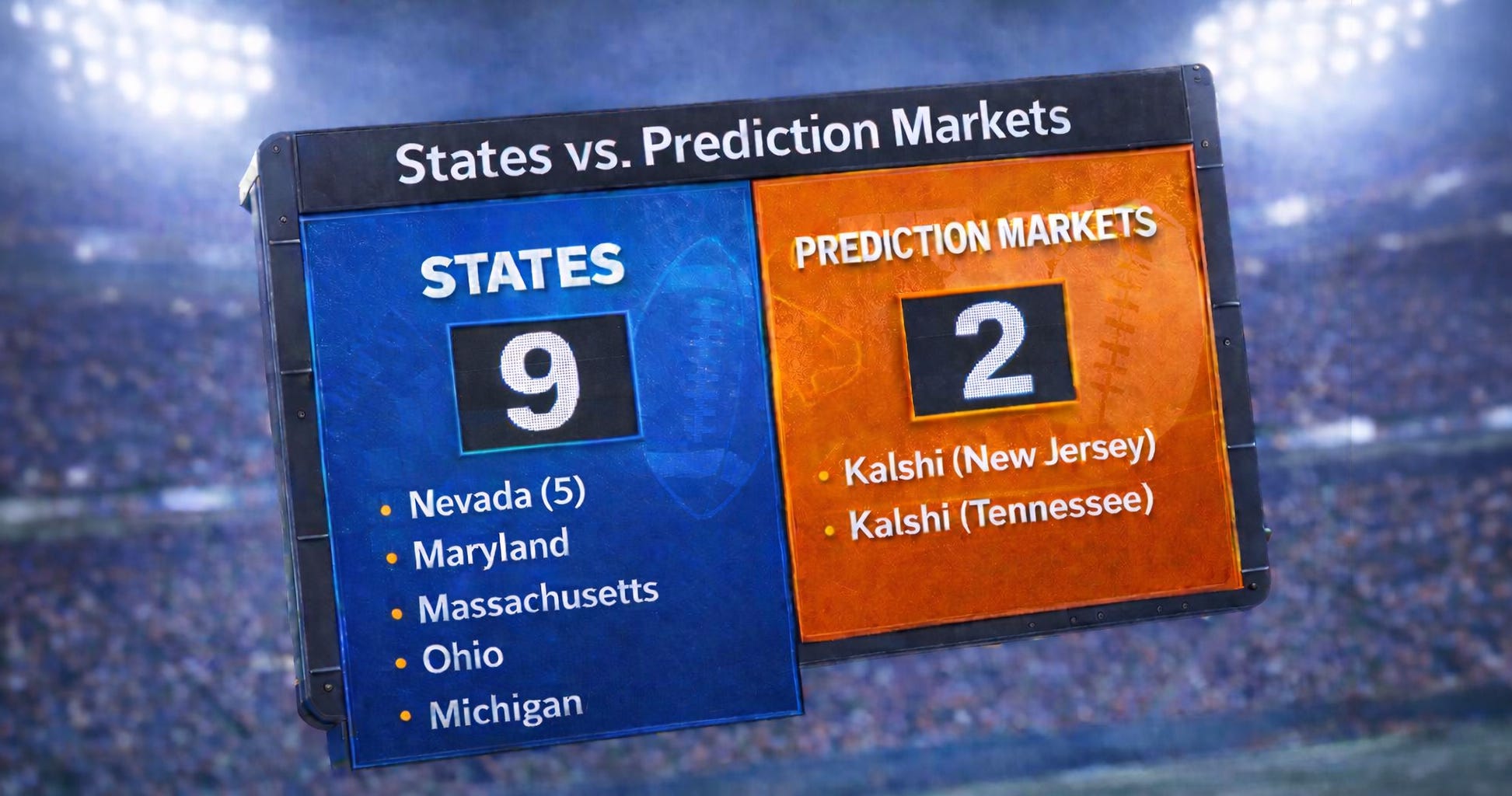
Roughly 40-50 active cases are now orbiting the same core question. The scoreboard today: 9-2 for the states3, though three of those Nevada wins came from the same judge. If Judge Gordon’s analysis falters, and there are visible cracks, the pendulum could swing quickly, especially if the Third Circuit sides with Kalshi.
We’re building a visual tracker to help make sense of the landscape, so stay tuned. For now, you can make use of Mick Bransfield’s version.
What Happened at Stop #2
Viewing through the Lexicon Lens, this stop should have never been on the map in the first place. Whether this works itself out or not, remains to be seen, but from the state’s side, it appears to be a doomed fight. I recently wrote:
States are fighting what we believe is an unwinnable fight, and the cost is borne by millions of Americans who gamble away what’s left in their wallets and sometimes their lives, subsidized by taxpayers (through litigation or otherwise) whose elected representatives consistently enact laws disfavoring sports gambling.
It’s truly an absurd result.
We normalize outcomes we never voted for and we end up paying for the cleanup.Taxation without representation is the grievance that ignited our Republic.
Taxation with representation is where progress runs in reverse.
Of course, some sectors benefit from this chaos:
Lawyers (litigation is a financial boon for lawyers4);
Media (prediction market stories abound, many good, some underdeveloped); and
Selfishly, myself and Lexicon Labs–because we are part of the media ecosystem.5
As the saying goes, “all good things must come to an end,” and that will likely happen in the future when this train pulls into its final destination: SCOTUS.
When SCOTUS takes up this case, we expect that they will analyze each stop, not just preemption. There’s a significant possibility that this is where the prediction market train, and potentially the entire sports gambling industry derails and is retired from service.
This would make it a complicated case with many different potential outcomes. We have assigned different odds internally to these outcomes. I personally believe the likely outcome is not a favorable one for the states (Chad has a different take).
What if SCOTUS takes the case and decides narrowly on preemption? That means the inspector halts the train before it even departs for the next stop. So it is possible that the train just sits at this stop for a while.
That possibility leaves the states in a rather precarious position…
Where We Go Tomorrow
Tomorrow, we close out our Litigation Sequencing series with a roadmap.
The current roadmap being followed by the states: “Double down on preemption; you’ve regulated gambling for a long time.” And if you look at the scoreboard above, the strategy seems to be working.
There is another path for the states.
A less traveled one.
The one we’re advocating for–and the one we believe the states should take too.
There is a catch. Some states will need to sacrifice what they’ve enjoyed for so long. Others, like Texas and Utah, have little to lose. And, as a product of the Golden State, we’ll say it very plainly:
We’re looking at you, California.
Hop on the train. It’s about time.


New Finance Institute underwent a corporate name change in 2025 and is now Lexicon Labs, Inc.
We didn’t actually use those words, but the concept was the same.
We do not count forum-control decisions as “wins”, i.e., if the case is remanded to the state court, or moved to the federal court, we don’t count that on either side. We count TROs and PIs. It looks like Dan Wallach counts them the same way and concurs on the tally.
Top Lawyers’ Fees Have Skyrocketed. Be Prepared to Pay $3,400 an Hour.
https://www.wsj.com/business/lawyer-hourly-rate-bill-3400-807cf6ce (Kalshi’s lawyer, Neal Katyal is on this list)
Had the CFTC argued for public interest in Kalshi v. CFTC, and initiated review on what came after, predictably, we would have much less to write about. In that world, my debut book, Predictable, which is coming out later this year, wouldn’t be nearly as interesting, either.