


We didn’t want our litigation sequencing series to end, but like all good things, this too, must come to an end. So let’s make it count.
On Monday, I introduced the idea of litigation sequencing–the observation that in complex regulatory disputes, the most important question is often not who is right, but which question gets answered first. On Tuesday, we covered Stop #1: Permissibility. The train has already left that station. Yesterday, we covered Stop #2: Preemption. The train is still idling on the tracks, and at this pace, it may sit there for a while–at least until SCOTUS intervenes, that is.
But today, we will play Nostradamus.
If you could see the different futures ahead, what would you do differently now?
Especially if you are in the states’ shoes.
Let us speculate on some alternative futures…
Stop #3: Parallelism
The final stop on the route is Stop #3: Parallelism.
One idea is that federal and state regimes can peacefully co-exist; the utopia where sports event contracts and state sports betting models run side by side. For many, that’s the happily-ever-after scenario.
Is that even realistic? Michael Selig believes so.
It’s true that federal law allows some state action to coexist with federal oversight. But the law does not allow parallel trading of swaps on-exchange and off-exchange.
That’s black letter Dodd-Frank, the very reason the statute exists:
The CFTC is Losing the Prediction Markets Narrative

CFTC Chair Mike Selig was at the Milken Institute’s Future of Finance 2026 event a couple of days ago:
Still, let’s imagine that somehow we still arrive there. Perhaps SCOTUS rules that federal law preempts state gambling law. In that scenario, the train will have reached its final destination:
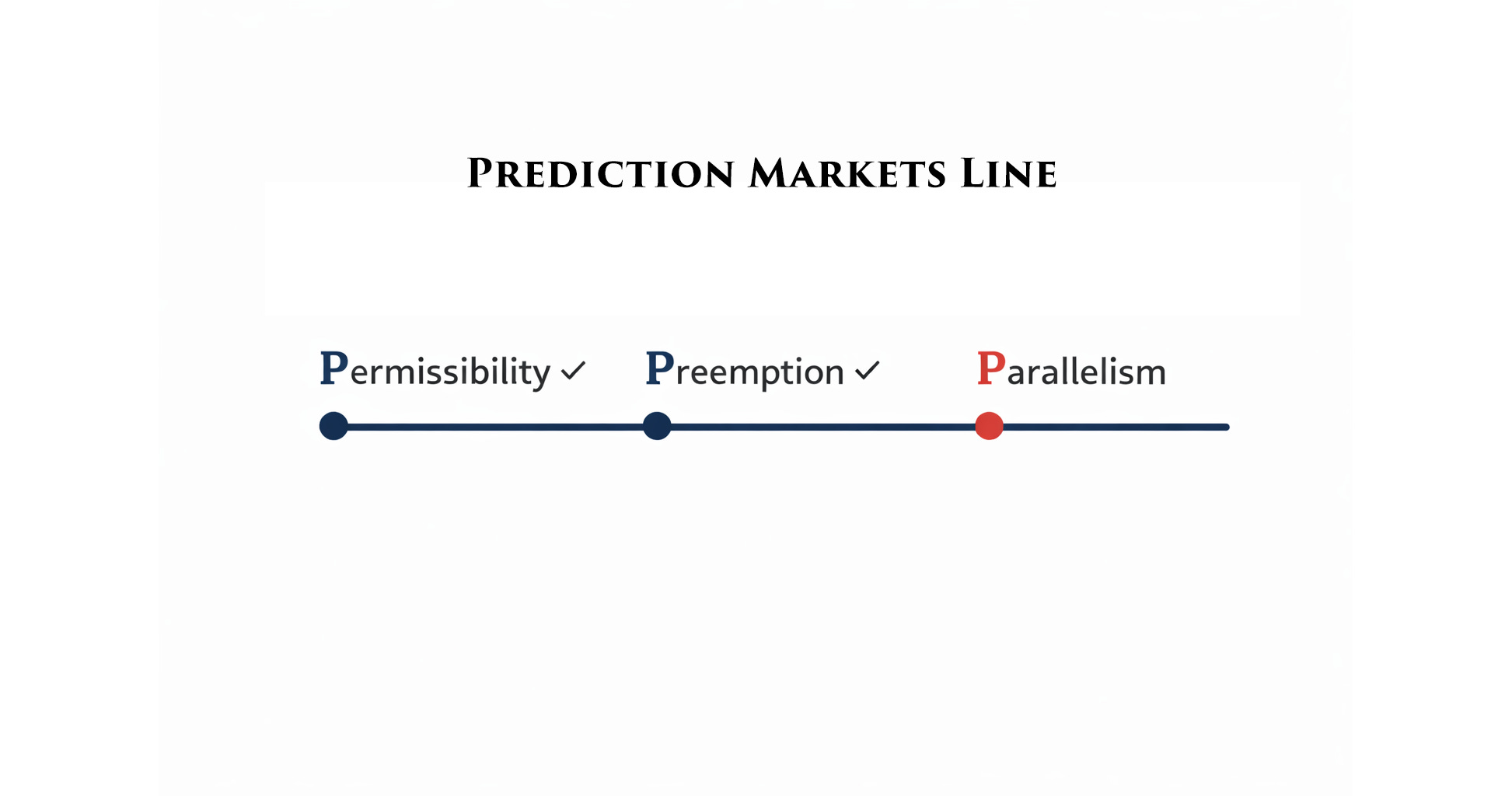
Are we there yet? No.
Could we plausibly get there? Yes.
Could the train stay there? Momentarily, yes. Permanently? Unlikely.
Gazing Into Our Crystal Ball
Our point isn’t whether this issue ends up at SCOTUS, we already believe there’s a 90% chance or higher that it does. Nor is it that SCOTUS won’t rule on federal preemption. I personally think that is quite likely. Chad thinks it’s a little less likely.
But here’s what I have zero confidence in:
Even if we get there, I don’t believe we will stay there.
Economists learn early that everything is about incentives. Once you look at the incentives prediction markets will have, the next steps become obvious:
A prediction market sues state-regulated sportsbooks, arguing they are engaged in illegal off-exchange swap trading.
The CFTC files an amicus brief supporting that position–because it expands the agency’s power;
The courts agree, because the statute is clear; and
State-regulated sports gambling collapses, replaced by a federally regulated, national regime.
States, tribes, state-regulated sportsbooks and their investors should be pricing this in, but most don’t seem to be doing so.
Prediction markets are not trying to coexist. They are isolating the fight to preemption because that is where their strongest arguments lie. Once they win on that front, their coexistence argument disappears; it will have served its purpose and will no longer be needed.
And if you are the states, there’s only one way to stop it.
Revisiting the “What If” Scenario
Remember, there are two ways to litigate permissibility:
Approach #1 (broader): Argue for public interest
Approach #2 (narrower): Zoom in on “gaming”
In our Stop#1 post, we observed:
For decades, the CFTC relied on Approach #1.
…until it abandoned its playbook for an intermediate approach that we labeled Approach #1.5.
We then asked a hypothetical:
What if the CFTC adopted Approach #1 [in Kalshi litigation]?
Our answer:
The CFTC [might] have lost the battle but won the war–and the American public would have won with them.
Let us continue with the train route imagery powering this entire litigation sequencing series:
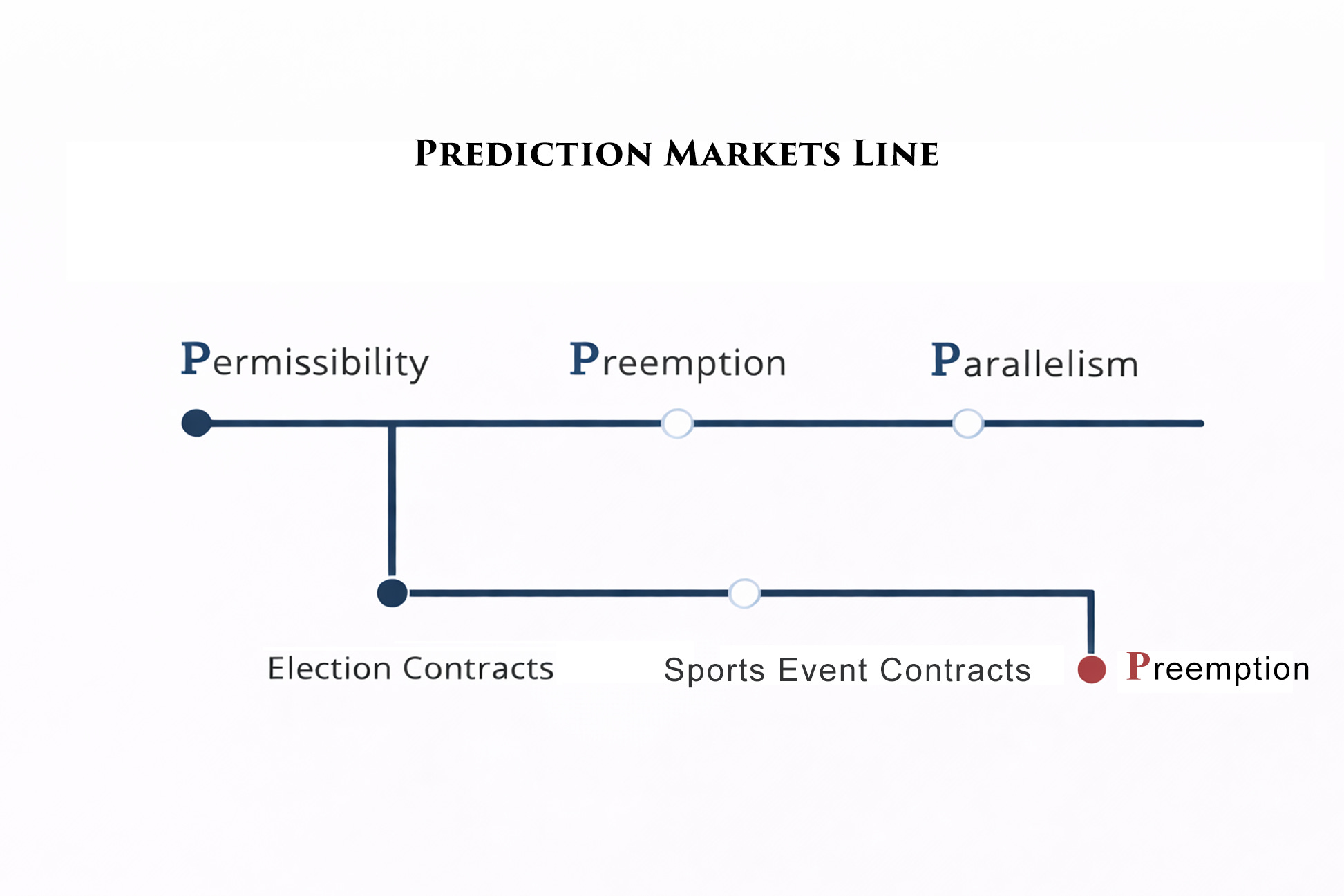
In this reality (the top route):
Election markets might have stayed;
Frivolous contracts like mention markets would not exist;
Sports event contracts would never have been permitted;1 and
There would be no Stop #2 or Stop #3. State-regulated sports gambling would have continued uninterrupted.
Not because preemption disappears, not because off-exchange prohibitions vanish, but because litigation sequencing never begins.
Preemption and parallelism would have remained academic inquiries. I even raised preemption in an amicus brief (PDF) during Murphy, arguing sports bets function as futures contracts and are governed under the CEA, meaning the CFTC has exclusive jurisdiction. SCOTUS declined to engage.
Had the CFTC stayed on track, the train never would have left Stop #1.
Obviously, that’s not what happened. The CFTC opted for Approach #1.5, which cracked open the equilibrium. It shifted us into this alternate world where:
Frivolous markets abound;
Sports gambling organizes daily life; and
The people who control sports gambling are powerful.
We’ve seen this movie before. Literally.
We Live in An Alternate Legal Reality
In Back To The Future 2, one moment in the past rewrites the entire timeline. In prediction markets, that moment was when the CFTC abandoned its playbook and discarded public interest.

Marty McFly slams the table in anger:
The son of a bitch stole my idea. He must have been listening, when I…
…and immediately realizes that he was the reason for this mess.
It’s my fault. The whole thing is my fault. If I hadn’t bought that damn book, none of this would have ever happened.
Had the states not advanced the “book,” none of this would have ever happened. The states gave prediction markets an idea–and they ran with it.
So now the states face a decisive choice:
Become the angry version of Marty McFly and keep fighting the preemption battle; or
Become the restorative force, acknowledge their role in creating this mess and forge a winning path that gets this train back on the right path.
The States’ Strategic Dilemma
We briefly talked through the states’ choice here, let’s recap:
Option A: Fight Jurisdiction (the current route)
Argument: States regulate gambling; federal law cannot preempt state sports betting regimes.
Upside: If they win, the state model and only the state model, survives.
Downside: If they lose, the litigation sequence continues:
Permissibility ✔
↓
Jurisdiction ✖
↓
Off-exchange enforcement
At that point, sportsbooks start to look like illegal off-exchange swap markets.
That’s the catastrophic outcome.
Option B — Reopen Permissibility
Argument: Sports event contracts should never have been permitted under the Commodity Exchange Act.
Upside: The sequence collapses immediately.
Downside: States implicitly concede that sports wagering markets resemble derivatives markets–undermining their own sportsbooks.
That’s the choice.
The Crescent Tactic Trap for the States
Growing up in Turkey, we learned about the crescent tactic (hilal taktiği):
A feigned retreat draws the enemy forward until the wings close around them.
The coexistence narrative works the same way.
It lures the states deeper into the jurisdictional fight.
If they lose there, the sequence advances to off-exchange enforcement–the point where the legal structure closes around the state-regulated sports betting model.
The sequence appears linear.
But if it reaches the off-exchange stage, it becomes a crescent.
This is a trap in the making.
The States Still Control Their Own Destiny
There is a world where SCOTUS sees through this litigation sequencing and addresses the 3P Framework in its entirety. In that world, SCOTUS may shut down the route entirely (the entire sports gambling industry).
You can’t hope for that outcome.
The states must manufacture it.
The best way to predict the future is to create it.
If states keep fighting preemption, they might win.
But they might also end up with the crumbs of a national sports gambling pie.
A better strategic choice exists.
Rewriting the Sequence
The states don’t have to ride the sequence to the final stop.
They can reroute back to Stop #1.
Yes, reopening permissibility puts their own sports betting regimes under uncomfortable scrutiny.
But by focusing exclusively on jurisdiction exposes them to a far greater risk:
Losing not just the case, but the entire sports betting model.
Going “back to the future” where prediction market sports betting dominates solves nothing.
The states must go back to the past and fix the problem at its origin.
Just like Marty McFly.
Embracing The Past
States often argue they have historically regulated gambling.
Casino gambling? Yes.
Sports gambling? Name a state–east, west, north, or south of Nevada–that regulated sports gambling before May of 2018.
As Charles Fain Lehman reminds us, it is easy to forget:
Everyone forgets how recent the new vice economy is. Turn the clock back to January 2016, and recreational marijuana is illegal in all but four states; sports gambling is illegal essentially everywhere; there’s no betting on your phone; OnlyFans is still months from launch; the fentanyl crisis has barely taken off; etc.
Leaning on historical regulation doesn’t match reality.
Leaning on congressional intent is even more risky–Congress was clearly anti-sports gambling.
But if states lean on these arguments the right way–acknowledging they enjoyed sports betting not because they had the right, but because they escaped enforcement–better days may lie ahead.
And if you are a state that didn’t choose sports betting? You have very little to lose.
We’re looking at you California. And Texas. And Utah.
And others similarly situated.
States Step Into Self-regulation
The irony is rich.
The states now face the same opportunity the CFTC faced in Kalshi but declined: Argue for public interest.
The CFTC doesn’t regulate prediction markets–it advocates for them. (Hardly something you’d expect from a well-functioning regulator.)
Prediction markets don’t regulate themselves–they just pretend.
So states may need to step in and fill the void.
They may need to step up and fight the permissibility fight, because the CFTC didn’t.
But they need to be prepared to kill the golden goose that is sports gambling.
Is there a world where truth becomes both reality and the best strategy?
When Truth Becomes Profitable
People often tell me:
You’re probably right, but there’s just too much money involved. They’re too powerful.
I get the reality check. “The truth doesn’t matter.”2
But incentives–not morality–drive outcomes.
Being an underdog has never fazed me. Margaret Mead once said:
Never doubt that a small group of thoughtful, committed citizens can change the world; indeed, it’s the only thing that ever has.
More importantly, I’m not naive, not anymore. I understand the powerful incentive structures. I’m an economist, after all. The key is to make sure that the moral compass and and the incentives are aligned.
The modern adaptation to one of Mother Teresa’s quotes is even better:
I alone cannot change the world, but I can cast a stone across the waters to create many ripples.
I am a stone-thrower.
For the states, the incentives are clear:
Their strongest legal argument–permissibility (not preemption!)–also benefits them.
Lose sports gambling, and casino gaming becomes more competitive.
Casinos still have social/vice costs, but not legal ones.
States can always change course later.
It’s Now or Never for the States
Will the states insist on staying the course and taking their chances on preemption?
Very possible, but the lead is fragile.
One appeals court ruling would flip the entire game for them.
If states continue on this path, they will likely lose–and lose everything.
They are marching straight into the crescent tactic trap.
If they lose sports betting, can they later argue permissibility?
Yes, but it will certainly appear disingenuous. Prediction markets will simply say:
“No state has ever argued these contracts were impermissible.
They only changed their tune after losing.”
And SCOTUS may not take the case again.
The winning moment will have already passed.
The time for states to act is NOW.
States can save casino gaming by taking a stance against sports gambling.
It’s a monstrous pill to swallow, but they must rewrite the sequence.
We’re looking at all states–
But especially you, California. You have nothing to lose.
Hop on the train. It’s about time.


There may have been more ErisX-like episodes. More DCMs would have tried. But the CFTC would have stayed firm.
Of course, what I am offering is an opinion, not a 2+2=4-type truth. But an opinion based on logic, facts, and which does not create any inconsistencies becomes the best approximation of legal truth.