


On October 1, 2026, I made an observation:
Before a Supreme Court ruling, prediction markets … have an incentive to insist that their contracts and sportsbook wagers are legally different.
Then, a prediction:
Now assume they secure a favorable ruling. The incentives change. Once their own position is protected, emphasizing the similarities could become more attractive than defending the differences. The question shifts from “Why can’t we offer these contracts?” to “Why can they offer theirs?”
I stand by that prediction. What may have changed is how to get there.
On October 9, just a day after I returned from PREDICT, the CFTC announced two new regulatory measures that could significantly alter the course of this debate:

Both appeared in the Federal Register on October 19, opening separate 30-day comment periods. The interim final rule also took effect that day.
On November 18, Lexicon Labs submitted a comment letters addressing each measure:

For a closer look:
But before we get into what we told the CFTC, there’s a more fundamental question: What exactly is the agency trying to accomplish, and why now?
Making Law Legible
Here at Lexicon Labs, our mission is making law legible.
But what does that mean, exactly?
Sure, part of it is taking something technical and making it easier to understand for a nontechnical audience. Analogies, diagrams, whatever gets the job done. That’s where my Ph.D. and teaching background come in handy. The former trained me to read, interpret and synthesize complex material. The latter taught me how to distill it into something a broader audience can understand, and hopefully, even enjoy!
But making law legible goes beyond explaining the arguments. It’s also about understanding why one argument gets made while another doesn’t. And if you believe the better argument is always the one that wins (I did, for a long time), you might want to reconsider. The winning argument isn’t necessarily the best argument. It’s the one that resonates with the decision-maker. In litigation, that means the judges and the judicial panels.
If you have children, you’ll recognize this immediately. They might come up with a perfectly-reasoned argument, but does that mean they get what they want? Not necessarily. Sometimes logic works, sometimes it doesn’t. The timing might not be right, the incentive(s) to approve or deny at the time could be a factor among other possibilities.
And as every young child learns fairly quickly, a tear, a pouty lip or even a pair of glaring puppy-dog eyes might just do the trick.
I’m not suggesting that judges are being manipulated. What I’m saying is that emotional resonance is real. That’s not a criticism of the judiciary. It’s simply an acknowledgement of something fundamental: We’re all human.
We can insist all we want that we’re rational creatures, but I don’t believe that’s reality. And I’m saying this as someone trained as an economist. Homo economicus, the assumption that people behave rationally, was where mainstream economics began and, until behavioral economics came along, pretty much where it ended.1 I’m not even sure I’d want a world governed entirely by disinterested rationality. A world without emotions would be a cold, dark place.
Now, back to the litigation. The states are leading, but by how much?

On November 18th, our free PM Tracker scoreboard had a tally of 35-8. Daniel Wallach had it scored 44-6 and Prediction Market Laws reported it as 29-10.
Different numbers, different methodologies. But, no matter how you count the wins and losses, one thing is pretty clear:
The states are winning by a wide margin.
And, similar to the children’s analogy, I’m absolutely convinced that’s not because they have the better legal argument; The better legal argument rests with the CFTC and the prediction market platforms.
In other words, the states are winning because their argument is the one that resonates.
The Courts in Early October
When I offered my prediction on October 1, this is what the prediction-market-litigation landscape looked like:
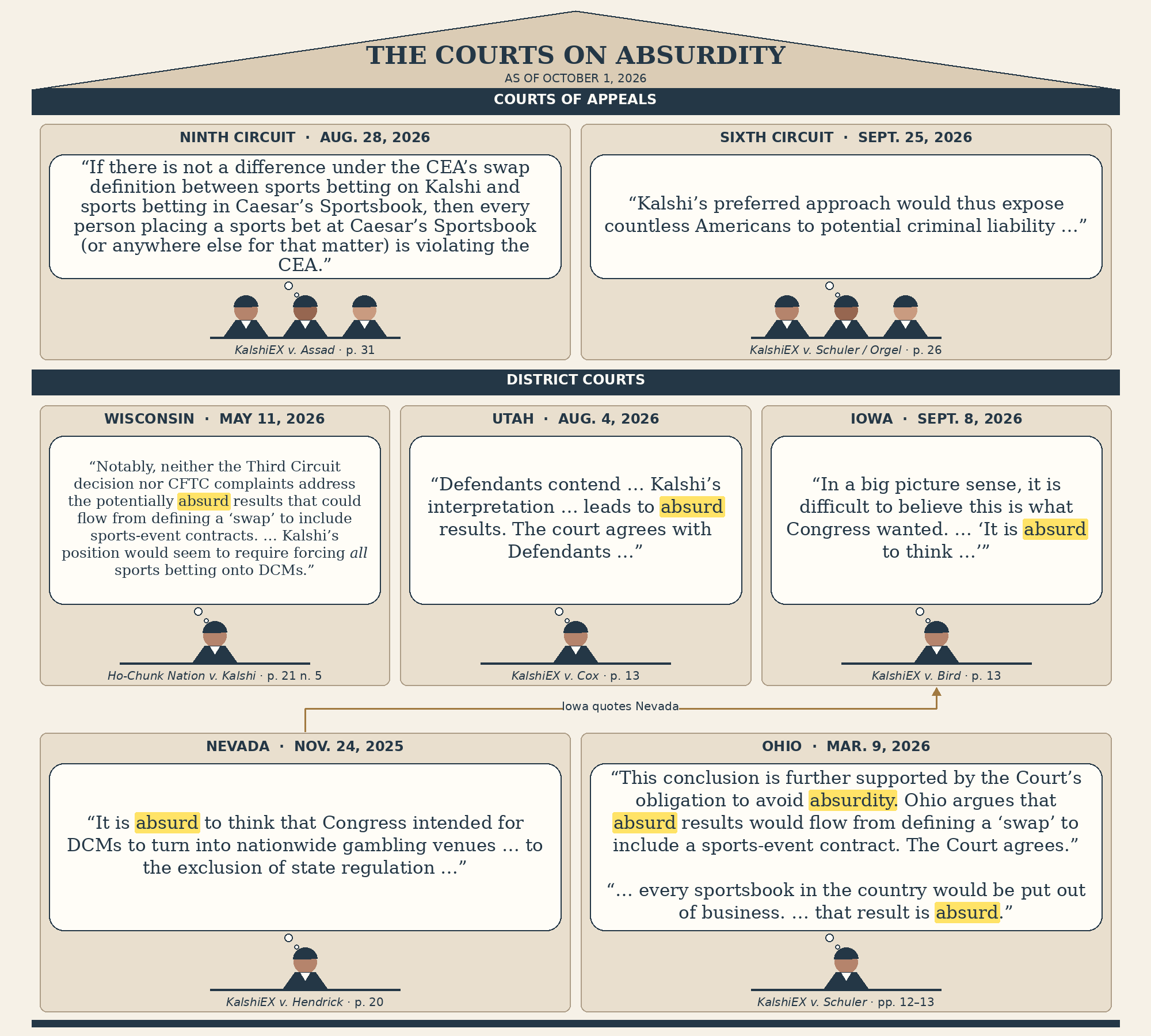
I’ve highlighted the key words for you.
Here’s how the logic flows:
If sports event contracts are swaps → traditional sports bets are also swaps.
But swaps must be traded on designated contract markets (DCMs), subject to applicable exceptions. Trading them off-exchange violates federal law.
Yet state-regulated sportsbooks have been taking sports bets for years.
Follow that reasoning to its conclusion, and you arrive somewhere rather uncomfortable: Traditional sportsbooks may have been operating in violation of federal derivatives law all along:

You piece the law together, follow it where it leads, and suddenly find yourself in a rather uncomfortable spot. And it’s not just the possibility that an entire industry has been operating illegally. It’s the prospect of a judge, whose literal job is to apply the law, having to reach that “absurd” conclusion. That’s … uncomfortable. Perhaps even unacceptable.
I’m not suggesting that every court goes through this exercise and rules accordingly. The Third Circuit didn’t seem particularly bothered by the implications. Neither did the District Court in Illinois. Even Judge Gordon initially appeared receptive (PDF) to the preemption argument before changing his mind.
But some courts clearly are bothered.
Where does that leave prediction markets? Well, when people really want something, they work hard to figure out what works. And once they discover it, they pursue it relentlessly.
Prediction markets want to win for obvious reasons, and sports is the proverbial “golden ticket.” They quickly realized that the off-exchange argument, however compelling it may be as a statutory interpretation, isn’t necessarily the argument that wins in court.
So, they began looking for some daylight between their contracts and traditional sports betting. That’s where the 2012 CFTC/SEC interpretive guidance comes in.
As I discussed in The Sportsbook Exception That Isn’t, the Supreme Court petitions filed by prediction-market companies invoke the guidance’s discussion of customary consumer and commercial transactions to argue that the traditional sportsbook wagers are not swaps.
The problem, as I see it, is that the guidance almost certainly wasn’t written with sports betting in mind.
But as Paul Grewal put it, “...in law you work with the tools you are given, not the ones you wish you had.”

And that, I believe, explains much of what we’re watching.
The statute creates a serious problem for off-exchange swaps. The 2012 guidance offers a possible way around that problem by distinguishing traditional sportsbook wagers from federally regulated derivatives.
Does the guidance actually support that distinction? In the same sportsbook exception article, I explained why I’m not persuaded.
But in the hands of capable lawyers, even a guidance document that literally says nothing about sports betting can become the foundation for an argument that federal prediction markets and state-regulated sportsbooks can coexist. It may not be the tool that prediction markets wanted, but it may be the only one available that gives them what they need.
My prediction was that prediction markets would ride with that argument for as long as it served them. If they lose at the Supreme Court, the question becomes largely academic. But if they win–and notwithstanding the scoreboard, I still believe that’s the more likely outcome–the incentives could change dramatically.
Once prediction markets no longer need to defend the distinction, they may find it more advantageous to challenge it.
I still think time may prove my prediction right. There’s just one adjustment:
The party on the receiving end of that challenge may have changed.
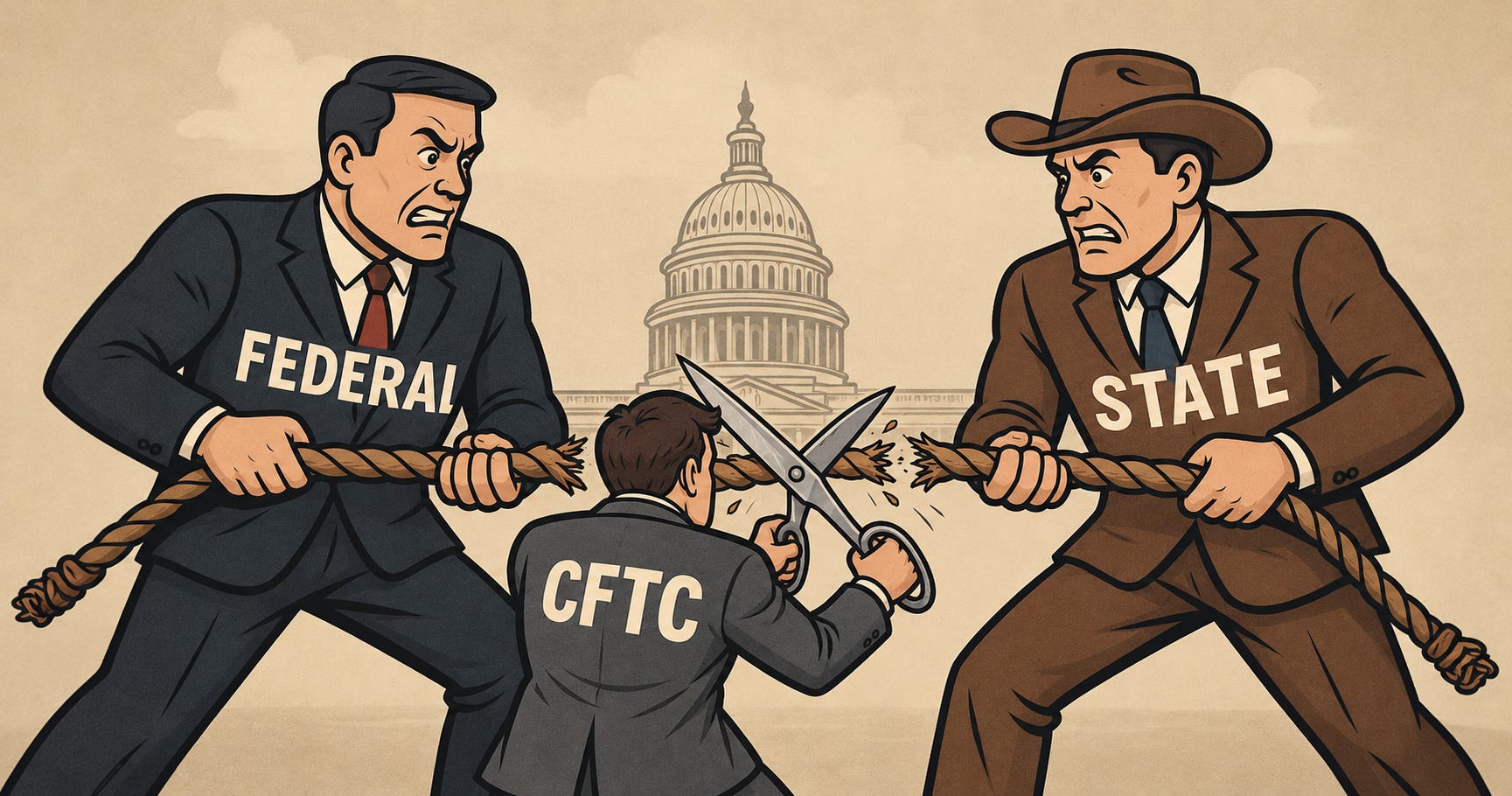
Cutting The Rope
On October 9, the CFTC issued its interim final rule and notice of a proposed rulemaking.
Ariel Givner, a fintech attorney and founder of Givner Law, offered her take:

The CFTC has been laying the groundwork for an argument that federal prediction markets and state-regulated sportsbooks could coexist for some time:

But these rulemaking actions took that argument a step further. So what exactly is the CFTC trying to accomplish? And why now?
Tamara de Silva explains:
The two releases work as a pair. The Sixth and Ninth Circuits worried that if sports event contracts are swaps, every bet placed with a sportsbook would be one too, and would have to move onto a federal exchange.[9] The interim rule answers that concern directly.
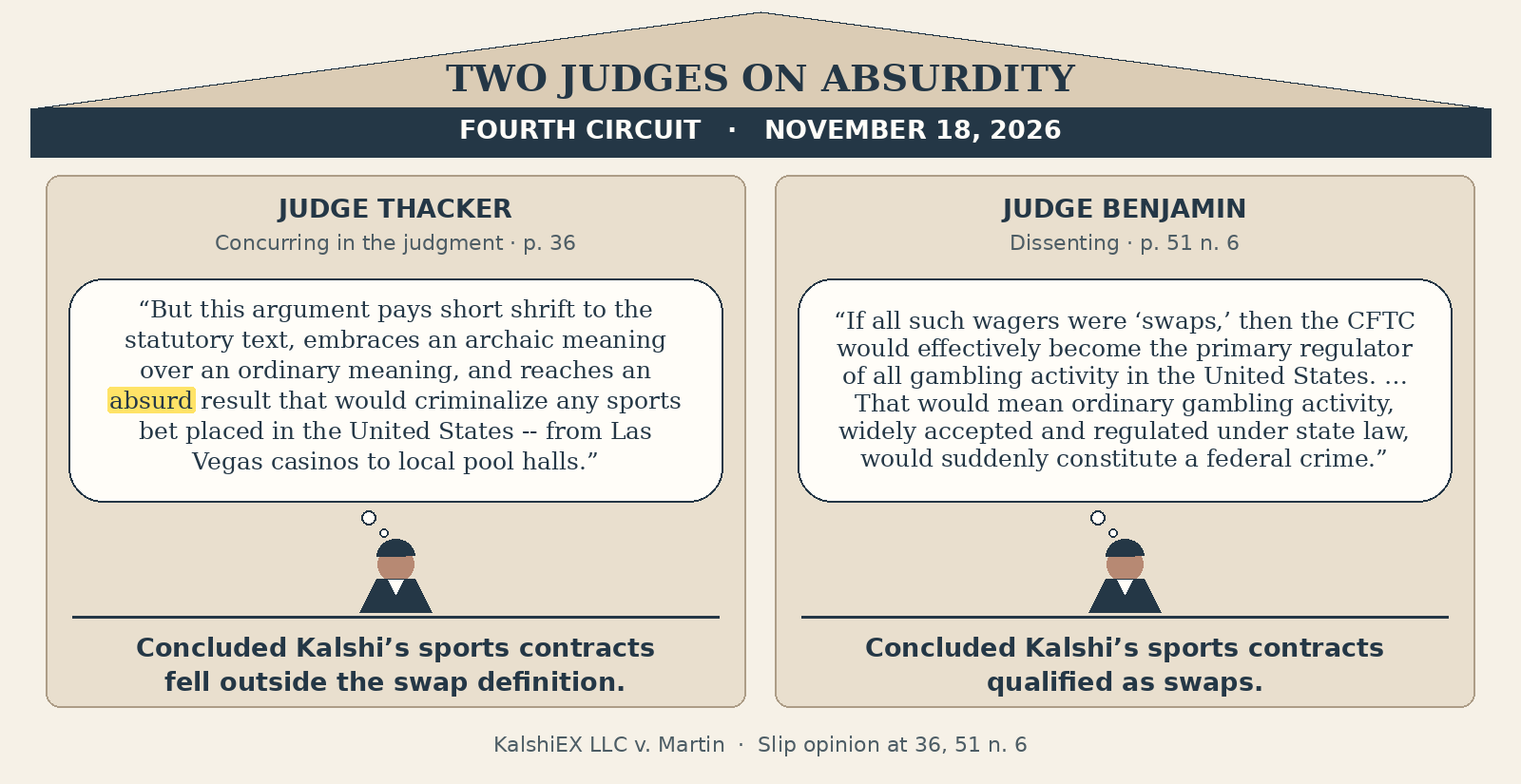
And it does. But that didn’t seem to matter much for the Fourth Circuit. Absurdity was still very much top of mind. Perhaps the best illustration is that Judge Thacker and Judge Benjamin disagreed on the answer to the swap question, yet both recognized the potentially absurd consequences of treating traditional sports bets as swaps.
That really says something, doesn’t it?
Now granted, the interim rule is already effective, but its ultimate durability remains an open question; its approach may invite challenges under the Administrative Procedure Act, particularly in the post-Loper Bright landscape.
There are some obvious questions about this agency’s authority and reasoning that deserve closer examination. But regardless of how those questions are eventually resolved, the move is important.
The CFTC has given prediction markets something they could never have manufactured on their own: An actual regulator taking a position on the issue and putting that position into the regulatory record.
And that changes the conversation.
Our Comment Letters
So, what do our comment letters actually argue?
I hope you will read them and whether you agree or disagree, I welcome your feedback. I’d like to know if they leave you with any additional questions or if they arm you with more conversational knowledge. All feedback is worthwhile.
We’re all pressed for time, so here is the skinny:
Sports event contracts are swaps. I’m in full agreement with the CFTC.
Casino games are not swaps. Again, full agreement. Though I’m not sure we need a rule to establish that because I already read the Commodity Exchange Act (“CEA”) that way.
Private bets are swaps, too. But that doesn’t necessarily put them under the CFTC’s exclusive jurisdiction. They aren’t traded on anything remotely resembling a market.
Traditional sports bets are also swaps, and they are subject to the CFTC’s exclusive jurisdiction. I understand why the CFTC is drawing a distinction here, but I am not persuaded by its reasoning.
And then there’s one category that the CFTC still hasn’t really addressed: daily fantasy sports.
Similar to traditional sports bets, DFS involves transactions whose outcomes depend on contingent events. I’ve been making this observation for more than a decade. In fact, I recently told that story on Steve Ruddock’s Straight to the Point Podcast:

Now, consider the differences:
Traditional sports betting takes place both online and offline, often, though certainly not always, in casinos. DFS, however, unless I’ve missed some novelty model somewhere, takes place entirely online.
Traditional sportsbook wagering is generally against the house. DFS, by contrast, typically involves competition among participants.
The CFTC appears to be treating traditional sports betting as casino-syle gambling. Assuming, arguendo, that is true, then what does it make of DFS? Is that casino-style gambling, too?
I didn’t raise this particular issue in our comment letters, but there’s another complication. Courts have held that certain DFS offerings are not gambling (incorrectly, I might add!). But, there are exceptions, like the 2025 California Attorney General’s Opinion (PDF). What are the implications for the Provider Test?
And, if DFS is gambling, then what kind of gambling is it? It doesn’t happen in a casino. It generally isn’t played against the house. If anything, its structure puts it a few yards closer to prediction markets. Does that make them swaps? They certainly aren’t trading on DCMs.
Those are questions the CFTC may eventually have to answer.
My Thoughts on Absurdity
I believe the states are winning because their argument resonates. The idea that state-licensed sportsbooks have been offering illegal swaps strikes many people as absurd. I get it. Now consider another result.
A state could change its laws to let its own licensees take election bets, then seek to enjoin a federally designated market from offering election contracts or even pursue a criminal prosecution under state law. “This case is about sports” dodges the question. Some states are already targeting election contracts. More broadly, this is a matter of limiting principles; testing a theory against its consequences, litigated or not, helps tell us whether it holds up.
Which is more absurd? A regulator leaving a statute unenforced, or a reading that effectively undoes the division of authority Congress established when it created that regulator? Between the two, I’d choose the first without hesitation.
States have long regulated casinos. Outside Nevada, the licensed sportsbook industry we know today largely dates to 2018. In my reading, jurisdiction over sports outcomes shifted to the CFTC in 2000 (through the excluded commodity language in the Commodity Futures Modernization Act), and was later reinforced in 2010 with Dodd-Frank. With barely a market on either side, that was easy to miss. Post-Murphy non-enforcement made it look as though jurisdiction had never shifted.
And “nobody noticed”? I raised the issue in a Supreme Court docket. Practitioners discussed it. The CFTC’s own HedgeStreet designation memorandum hinted at it. People noticed. Hardly anyone cared. At the time, the question was largely academic. Now the consequences are real, and the more uncomfortable they get, the more tempting it becomes to read them out of the statute.
Creating a carve-out for sportsbooks makes the already strong statutory case for treating sports event contracts as swaps easier to accept. I understand why the CFTC drew that line, but I still believe it drew the wrong one.
My Prediction, Updated
So will the interim rule hold up?
That’s an interesting question. But remember, laws and regulations generally get challenged when somebody has incentive to challenge them.
Tamara de Silva, again:
Who would bring that challenge is less clear. The rule’s direct effect is to leave state- and tribe-licensed gambling where it already is.
She’s right. That’s precisely the point.
The CFTC is trying to cut the rope in the federal-state tug of war. Prediction markets get to operate under federal regulation, while state- and tribal-regulated gambling continues operating under its existing framework. For now, everybody gets to keep playing in their own sandbox.
But Tamara, I do have an answer to your question: Prediction markets would bring that challenge. Just not today. Maybe not tomorrow. But someday. After all, who wouldn’t be interested in a market that has cumulatively generated roughly $800 billion in wagering handle?

Now, you might ask: Would exchanges really sue their own regulator?
Yes, they would, and they have. We actually have two fairly recent examples in CME and Capital Markets Alliance Association (which includes Cboe), both of which sued the CFTC over regulatory questions involving perpetual derivatives. Are these products futures or swaps? The answer has enormous implications for how they’re regulated and, potentially, who gets to offer them.
What’s at stake may be the front door to the future of finance. Or, perhaps the back door, depending on how you look at it. The point is that exchanges don’t necessarily shy away from challenging their regulator when enough is at stake.
So, could prediction markets eventually do the same?
At NEXTPredict, Millbank partner Josh Sterling said: “So there will be litigation. I’ve sued the CFTC twice myself for clients. Won’t do it here.” I have no reason to not believe him and I agree that it likely won’t happen now.
But later? The incentives could look very different once the immediate fight over federal jurisdiction is settled. And if those incentives change, so might the arguments. Stranger things have happened.
And wouldn’t that be the ultimate plot twist?


See Richard H. Thaler, “From Homo Economicus to Homo Sapiens,” Journal of Economic Perspectives 14, no. 1 (2000), 133–141, and “Behavioral Economics: Past, Present, and Future,” American Economic Review 106, no. 7 (2016), 1577–1600. See also Matthew Rabin, “Psychology and Economics,” Journal of Economic Literature 36, no. 1 (1998), 11–46, and “A Perspective on Psychology and Economics,” (PDF) European Economic Review 46, nos. 4–5 (2002), 657–685.