


Yesterday, we argued that Murphy remains unfinished business for the Supreme Court. As we summarized on LinkedIn:
A common takeaway from Murphy is that the Supreme Court “cleared the way” for states to legalize sports gambling.
The holding was narrower: PASPA violated the anticommandeering rule. Other federal constraints remain.
A scalpel, not a bulldozer.
Literally, within minutes of us publishing that piece, the Tennessee news dropped. And just like that, the scalpel moved south.

The reaction was immediate–and mostly celebratory. The prediction market industry has taken a beating recently, and this ruling finally gave them a reason to cheer the news.

Key Takeaways Around the Tennessee Decision
The Prediction Market Industry Desperately Needed a Win
Michael Selig, the CFTC Chair, has been on an aggressive public campaign:
January 29: The proposed rule + advisory withdrawal announcement;
February 4: The formal withdrawal;
February 16: The WSJ opinion piece;
February 17: The Fox appearance (Mornings with Maria);
February 17: The CFTC amicus brief in the Ninth Circuit; and
February 17: The “We will see you in court” video.
After that level of advocacy, a court win would be welcome news. It just happened to arrive yesterday from Tennessee in the form of granting a preliminary injunction to Kalshi (PDF Opinion).
The Court is Correct - Kalshi’s Sports Event Contracts Are Swaps and Fall Under the CFTC’s Jurisdiction.
This part shouldn’t surprise anyone who has been paying attention.
The statute is broad–extremely broad–and we’ve been saying this for years:
Our perspective hasn’t budged since 2013 because the law hasn’t changed. If you value decade-long consistency, you’ll find it here. If not, there is plenty of commentary out there for you–though even reputable outlets routinely miss the mark, and we call them out on it (i.e., NPR).
The Court’s Hidden Conclusion
The opinion contains three key excerpts:
“An event contract is a derivative contract for which the payoff is based on a specified event, occurrence, or value—for example, the level of snowfall from a certain storm or the dollar amount of hurricane damage.”
Under the CEA, only exchanges regulated by the CFTC—known as designated contract markets (“DCMs”)—can offer event contracts.
And, based on Kalshi’s description of its operations, although there may be differences under the hood between trading on Kalshi and placing a bet with a licensed sportsbook, for any sports-betting enthusiast unfamiliar with the CEA, it appears to the court that a user would find Kalshi’s offerings similar, if not identical, to a sportsbook.
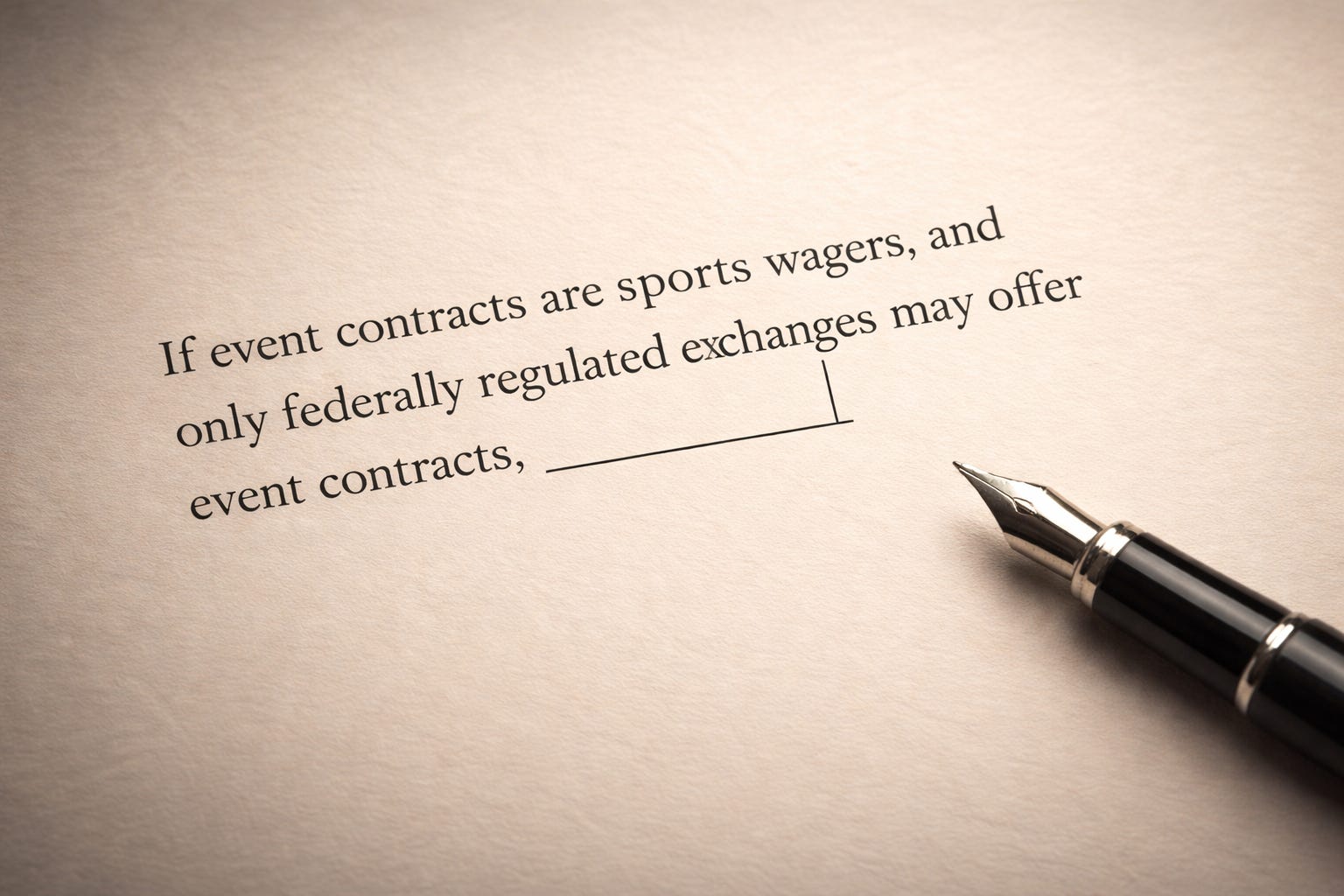
Put those together and you have this riddle–one Lex & Bianca will answer in our upcoming LexBeyond podcast titled: “When the Duck Meets the Mockingbird - Ep. 16”:
Congressional Intent and Swap Classification Are NOT In Conflict
Daniel Wallach, a prominent gaming attorney and state-rights advocate, argues that congressional intent should override statutory text:

But the Tennessee court (PDF) said exactly what the courts must do:
The court begins its analysis, as it must, with the statute’s text.
Here’s the real twist: The statute and congressional intent are not in conflict here. They both point to the same outcome: Sports gambling remains illegal everywhere.
CFTC jurisdiction and permissibility are separate questions. Courts are currently resolving narrow issues and not looking at the complete landscape. Viewed through that narrow lens, Tennessee is correct: Sports event contracts are swaps. Now, what happens when you use the wide-angle lens and reverse the question–are traditional sports bets swaps? When the Supreme Court eventually follows that analysis all the way through (jurisdiction, permissibility, off-exchange trading, etc.), the conclusion is inevitable and affects the entire sports gambling industry.
That may be a tough pill to swallow for Wallach, Chris Christie and other like-minded state advocates, but policy preferences are not legal analysis.
What About the People of Tennessee?
The Court emphasized the social costs of gambling:
If the defendants succeed on the merits, they can seek fines against Kalshi. But they will have lost months, if not years, of maintaining the integrity of sports betting and treating and preventing problem gambling and gambling disorders, including among those under 21 years of age, as the Act requires.
And:
And it is likely that some portion of Kalshi’s Tennessee members now have, or will develop during the pendency of this case, gambling disorders. If the defendants succeed on the merits, then the cost to the state for being improperly enjoined is the missed opportunity to help problem gamblers, would-be problem gamblers, and minors, some of whose behavior will lead to heartbreak for themselves and their families, with consequent deleterious effects on the state.
This justified an additional $500,000 bond.
But here’s the real question:
What about the Tennesseans who have been gambling since 2020 under a regime that was illegal from day one?
Who protects them?
What is the proper remedy?
The Volunteer State was an early adopter of post-Murphy “legalized” sports betting. Its mobile-first model made it a standout. Since launch, the state has handled more than $20 billion in wagers–impressive for a mobile-only market.
New York leads the nation with more than $26 billion wagered in 2025. Tennessee’s ~$5 billion annual handle isn’t in that league, but relative to population and structure, it’s punching above its weight. Residents bet heavily and consistently.
Which now brings us to our final point:
If the Court is truly concerned about social costs, the bond for Kalshi may be the smallest one on the table. Tennessee’s concern for the social costs of gambling is well‑placed, but it also exposes the uncomfortable truth the opinion never addresses: Millions of Tennesseans have been wagering under a regime that was never lawful to begin with. If Kalshi’s offerings (which, the Court acknowledged, resemble sports betting) trigger federal oversight and can only be offered on designated exchanges (if they can be offered at all), then Tennessee’s own sports betting apparatus sits on a fault line.
The court’s logic doesn’t just justify the paltry $500,000 bond.
It points straight to much larger liabilities: The entire Tennessee sports‑betting market with its attributable social costs and the bill that comes due when a state runs an illegal market for years.